Showing posts with label ICP. Show all posts

Saturday, 17 September 2016

MERS is a disease we spread...

There is little doubt now that Middle East respiratory syndrome  (MERS) disease outbreaks are triggered by sporadic zoonotic transmission of the MERS coronavirus (MERS-CoV) from an infected camel to a susceptible human. 

Little doubt to anyone who has followed the story of MERS at all, anyway.

But that's just the tip of the iceberg. 

The majority of human cases that have contributed to those steep rises in the cumulative MERS-CoV detection graph below are there because humans have infected other humans while in or associated with a healthcare facility. A telling picture when you consider that MERS-CoV is not a great transmitter. We've done much to make something from what should have been nothing.

Can we vaccinate against lapses in infection prevention and control?


Sunday, 4 September 2016

There (might be) something in the air tonight... [UPDATE]

UPDATE No.1 06SEPT2016
One of the early pieces of science-based news to come out of the May-2015 Middle East respiratory syndrome coronavirus (MERS-CoV) outbreak in South Korea was a June-2015 piece asking whether air conditioning may have played one (of many?) key role in facilitating the spread of virus from infectious patients, within healthcare facilities.[1]

In a publication that came out in April 2016 (yes, the literature did not see much detail on the South Korean outbreak for quite some time), authors described a study to collect and test air and swabs from surfaces in and outside patient's rooms, and their restrooms, in 2 hospitals that housed 3 male cases of MERS pneumonia.[2]

Whenever RT-PCR is used for this sort of work, it brings with it the question of whether infectious virus-containing droplets were captured, or only bits of non-infectious RNA viral genome was detected. This group, like those in the last post (who did not collect air samples), attempted to grow infectious virus. They could confirm that it was infectious virus by observing cell changes in infected laboratory cultures which were also RT-PCR positive. Also the same approach as that described by the South Korean study reviewed in the last post.[3] Additionally, the infected cell cultures also reacted to an anti-Spike protein antibody in a fluorescent test and they even saw some actual virus from swab cultures (not captured air samples?) using electron microscopy.

Some interesting findings from the use of these test on air and swabs samples included:

  • All air samples from both hospitals were RT-PCR positive and these included the detection of MERS-CoV of RNA in room, restroom and common corridor air. Infectious virus was grown in cells from from 4 of 7 (57%) samples.
  • 42 of 68 (62%) surface swab samples tested positive for MERS-CoV RNA by RT-PCR and included elevator button and rails, doorknobs and handrails inside and outside a patient's room, telephone button, toilet seat, call button, patient pillow, nasal prong, toilet seat, TV, keyboard, stethoscope and air exhaust dampers. Infectious MERS-CoV was isolated from 15 swabs of some of these items including an elevator button, nasal prong, patient pillow, TV, bed handrail, keyboard, stethoscope, toilet seat and an air exhaust damper

This study really addresses three big issues. 

Firstly MERS-CoV from very ill patients late in their disease course, thoroughly contaminates a hospital room and its surrounds - not just with detectable genetic material, but with infectious, viable MERS-CoV virus. 

Secondly, surface contamination was detected from swabs collected 3-7 hours after daily room cleaning suggesting either that cleaning was insufficient or that new virus was quickly laid down on cleaned surfaces (with no lasting anti-viral effect from the cleaning solution). 

Thirdly, the capture of infectious virus from the air implies that the virus maybe present in droplets or droplet nuclei with implications for the level of personal protective equipment required for healthcare workers and visitors to an infected person bedside. It also pertains to the distance away from a case that is considered "safe" for an uninfected person to be. Six feet may not be nearly enough distance, at least if that is a prolonged period in a room.

This provides some more data to explain how MERS-CoV may be associated with hospital outbreaks. Why it has been allowed to get away with this is a matter for infection prevention and control specialists in each and every healthcare facility to address.

UPDATE.

After this was published, Van Kerkhove and colleagues wrote a letter to the editor to make some points about the study noting:

  • an absence of negative control sampling from areas where MERS-CoV patients were not housed.
    Absolutely. I'd even suggest a few different sites in very distant hospital areas from where MERS patients were housed, given the possible human-spread of virus around a facility during and the possibility of silent or subclinical infection in patients admitted to hospitals for other reasons during times of outbreak. This will explore whether false positive laboratory results are occurring.
  • other studies have reported surface contamination that did not yield viable virus. Van Kerkhove note that these negative findings need to be published to balance the literature. Always.
    However, it's well known that virus culture is insensitive compared to RT-PCR methods so it
    may fail to detect infectious virus which may be enough to infect a human . It may also be that infectious virus capable of infecting another person who comes into contact with it is not always present in the air or on surfaces. It may be that the surfaces often simply have non-infectious "bits" of virus detected by RT-PCR -these cannot cause a new infection. But in this study infectious virus was able to be isolated from air and surfaces...unless Van Kerkhove and colleagues are implying contamination of the cultures in some way.
  • the need to replicate these findings in other studies.
    Always.
    But as is often the case, let's not wait on those findings to recognise that infectious droplets and contaminated surfaces now have some more data to support them and that they fit nicely into a picture of hospital transmission. Precautionary principle.
A second letter was also written by Myoung-don Oh,[7] noting:


  • few infected cells in the cultures / slow growth.
    This isn't too surprising, it may just reflect that there was a low amount of virus in the air, added to the cell cultures compared to that used from the control virus (cell adapted?) stock.
    This may mean that the risk from airborne transmission in these rooms is low. However, since we don't know what amount of MERS-CoV is required to start a new human infection, this is a moot point.
  • the sequences of the room samples were too different from each other.
    This is a bit surprising since within an outbreak, MERS-CoV doesn't usually vary much at all. I'll have a look at how much South Korea's MERS-CoV Spike gene sequences varied and come back to this point.

Both letters were replied to.[8]

References...


  1. Did poor ventilation lead to MERS 'superspread' in Korea?
    http://www.sciencemag.org/news/2015/06/did-poor-ventilation-lead-mers-superspread-korea
  2. Extensive Viable Middle East Respiratory Syndrome (MERS) Coronavirus Contamination in Air and Surrounding Environment in MERS Isolation Wards
    http://cid.oxfordjournals.org/content/early/2016/06/08/cid.ciw239.abstract
  3. Korea contamination: Middle East respiratory syndrome coronavirus in the room..
    http://virologydownunder.blogspot.com.au/2016/09/korea-contamination-middle-east.html
  4. Interpreting Results From Environmental Contamination Studies of Middle East Respiratory Syndrome Coronavirus
    http://cid.oxfordjournals.org/content/early/2016/08/09/cid.ciw478.full.pdf
  5. STABILITY OF MIDDLE EAST RESPIRATORY SYNDROME CORONAVIRUS (MERS-COV) UNDER DIFFERENT ENVIRONMENTAL CONDITIONS
    http://www.eurosurveillance.org/ViewArticle.aspx?ArticleId=20590
  6. Transmissibility of Middle East Respiratory Syndrome by the Airborne Route
    http://cid.oxfordjournals.org/content/early/2016/08/09/cid.ciw479.full.pdf
  7. Interpreting Results From Environmental Contamination Studies of Middle East Respiratory Syndrome Coronavirus
    http://cid.oxfordjournals.org/content/early/2016/08/09/cid.ciw478.full.pdf
  8. Reply to Kerkhove et al and Oh
    http://cid.oxfordjournals.org/content/early/2016/08/09/cid.ciw480.extract
Update...
  1. Added in detail on letter by Van Kerkhove and colleagues [4], and rebuttal authors [5]

Monday, 22 September 2014

Ebola virus, HCWs infections and personal protective equipment..

No one could offer anything but our deepest and most heartfelt thanks and a feeling of pride in the selfless, essential and humanitarian work being done by healthcare workers (HCWs), both local and international, in West Africa.

But they have paid a high price for this work, as they always do in emerging disease outbreaks.


WHO Ebola virus disease
numbers up to
14-Sept-2014
Of the >5,300 people reported as infected by the West African variant of Zaire ebolavirus (EBOV) to date, around 315 have been HCWs. Both numbers are very likely an underestimate. Half of the HCW cases have died. I don't know just how many HCWs there are in Guinea, Liberia and Sierra Leone who are dealing with the EBOV outbreak. I do know that these deaths are as horrible as each of the losses among non-HCWs, and are also worrying for those trying to recruit the many more HCWs needed to expandthe  care of ill patients.


This week a commentary article on the Centre for Infectious Disease Research and Policy (CIDRAP) website delves into this issue by suggesting an improvement to HCW respiratory protection.[1]


Two quick things first:

  1. The World Health Organization (WHO) defines human transmission of Ebola virus as being by direct contact (between mucous membranes or a break in the skin and the blood and other body fluids of an infected individual via physical contact or by wet material being propelling onto mucous membranes or skin breaks) and by indirect contact via contaminated surfaces.[3,4]
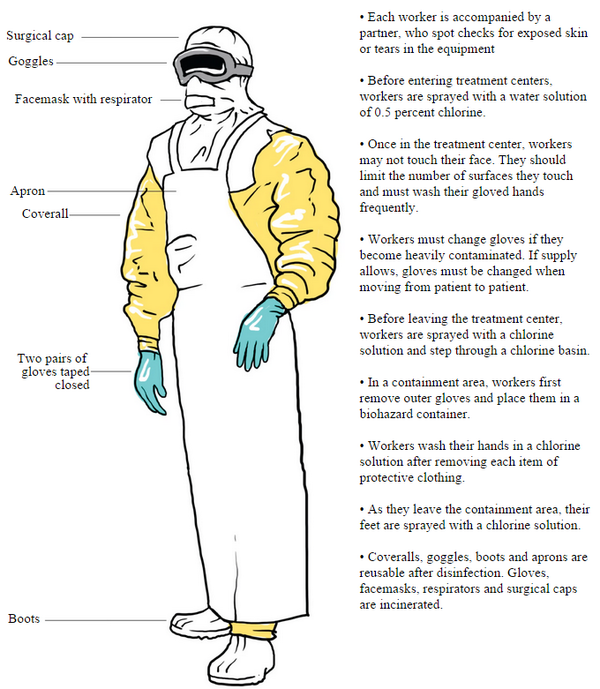
  2. When dealing with patients, the WHO recommends wearing gloves, a disposable impermeable gown to cover exposed skin, a waterproof apron over any gown that is not impermeable or when undertaking strenuous activity, facial protection to prevent splashes to the nose, mouth and eyes including a medical mask + eye protection (visor or goggles) or a face shield and medical mask.[3]
The CIDRAP article's authors claimed a belief that there is scientific and epidemiologic evidence that Ebola virus has the potential to be transmitted via infectious particles. Unfortunately they don't make a convincing argument to support their belief-nor could they, since no data currently exist to for any claim that an Ebola virus is transmitted between humans by an airborne route. So we're left with a commentary based on those beliefs, and some speculation.

Some collaborators and I wrote about Ebola virus not being an airborne virus based on what I know and what's been done to answer this question before.[2] I'll first add that if it were an airborne virus, I would likely be seeing many, many more cases-"Compared to this Ebola outbreak, the H1N1 swine flu had already spread to an estimated 10,000 times as many people in its first 10 months" noted United Kingdom virologist Ben Neuman.[13] H1N1 being an influenza A virus; a real airborne virus. In our post, we noted that big wet droplets (part of an "aerosol"-a messy term that may not be well understood by the public...or some scientists...that includes big wet droplets and the more frequent smaller particles <100µM in diameter) can be propelled at a mucous membrane or fall to the ground to contaminate surfaces.


A schematic of the makeup of an "aerosol".
From [2]
Big wet, propelled droplets can contain infectious Ebola virus and are included in the established risk messaging. Hence the need for droplet precautions.

We also know that from every human aerosol, after the heavy larger droplets fall to the ground or impact on a surface, the many more remaining lighter particles can linger in the air. I know that these small <100µm particles can be made to contain infectious Ebola virus under lab conditions[8] thus droplet nuclei produced by an infected human may contain Ebola virus. I can't say with certainty that they do or do not. However, as far as I have been able to tell, infection of humans and resultant disease from inhaling lingering particles, has not occurred. And when an airborne route was investigated using infected and uninfected non-human primates housed nearby but without direct contact, no infection via an airborne route was found to have taken place.[9]


Most of the studies looking at aerosols of Ebola virus do so in highly temperature and humidity-controlled laboratories with lots of lab-grown virus.


Relying on one added component raises a few questions for us:

  • Could the faith in this one extra precaution threaten the very important, meticulous care required when donning, using, and removing contaminated PPE-of any sort?
  • What role does a lack of the basics, like soap and clean water [10], play in HCW infections?
  • Could an additional extra safety measure really have a major effect on reducing the known risks involved with treating Ebola virus disease (EVD) patients, such as the long hours, tiredness, the constant and pervasive tension of imminent exposure, the oppressive heat, delirious and sometimes violent patients and the ease with which one can self-inoculate?[6]
  • Does the extra safety measure even have a role in reducing risk associated with HCWs who are unknowingly infected while not wearing PPE?[7]
How much do the things listed above, mostly unrelated to having a hi-tech battery-powered breathing apparatus on your hip, contribute to the tally of HCW infections?

The authors overlooked mentioning that early on, many HCWs may have had few or no masks at all and few other essential barriers such as those listed by WHO above, to protect against direct contact. They also did not mention the lack of HCW training in the use of any of that equipment if available, and did not highlight the lack of experience HCWs had dealing with EVD patients. These HCWs had (and may well still have) direct contact with very ill EVD cases, and got infected. What fraction of HCW infections resulted from absent or incomplete PPE and training versus the HCWs that they believe became ill while wearing full droplet precaution PPE?


Embedded image permalink
MSF designed suit of PPE.
Graphic tweeted by the
Washington Post.[5]
Others have also made note of the disparities between the imagery of a biosafety level 4 (BSL4) laboratory researcher working in a negatively pressurized, airlocked laboratory within a tethered, airtight suit (probably unnecessarily high precautions [13]) versus highly biocontained single patients being shipped home on dedicated planes (kept somewhat contamination-free using isolators) to rich nations for specialized support and treatment versus Médecins Sans Frontières (MSF) workers who use respirators (specialized face masks that fit more snugly and contain more layers to better filter what is breathed in) instead of surgical masks versus the WHO recommendations of standard precautions which include a surgical mask. Notably, the WHO recommendations vary according to the type of risk one is exposed to [see pg 96-7 96 of the 113 pg PDF at [3]).[10] There clearly is a range of thinking and messages here. But equally, there are a lot of different applications to cover, and no way for every need to be specifically catered for by one guideline. If everyone could agree on such a thing anyway.

I share the concern of many over the deaths of HCWs in West Africa. They may still be unnecessarily exposed to the virus due to the lack of enough PPE. They may not have enough training to understand how easy it is to become infected. They may not be given the message that during an EVD outbreak as monstrous and different as this one, many heavily populated areas have been included for the first time resulting in very real risks of infection occurring outside the hospital setting, not just inside it. There are also real risks of infection in supposedly EVD-free hospital settings like maternity wards.[11] There are many, many non-airborne related risks for HCWs.


We freely admit that we are not trained in the use of PPE for treating Ebola patients; just for working with actual respiratory and blood-borne viruses in PC2 & PC3 laboratory settings, respectively. Still, some may find this post irrelevant.
This is a blog and not part of any Organization's reference list when they write PPE guidelines...because it's a blog.

But for what it's worth, I would follow the MSF lead if working on the battlefield of a 100+ bed treatment facility. In an ideal world, more effort would be made to provide a more roomy and breezy head covering that allows patients to see your face and which can be worn for longer periods would be useful. You can see an image provided by 3M of this battery-powered air-purifying respirator (PAPR) accompanying the CIDRAP post.


However....first and foremost, and well before we get to this level of hair-splitting based on speculation and belief and no evidence of an airborne virus-I'd be wanting to make sure there was a minimum level of disposable PPE actually available for use, that it was consistently used by every HCW, that appropriate training in its use had been provided, and that HCWs understood about all the risks for acquiring EBOV infection. 

Reasons for HCW infections are many and varied. As much as we may believe or wish it were so, no single act or change will circumvent these risks or these infections.


References..