Showing posts with label Zika fever. Show all posts

Saturday, 2 April 2016

Colombian National Institute of Health speaks about microcephaly and Zika virus...

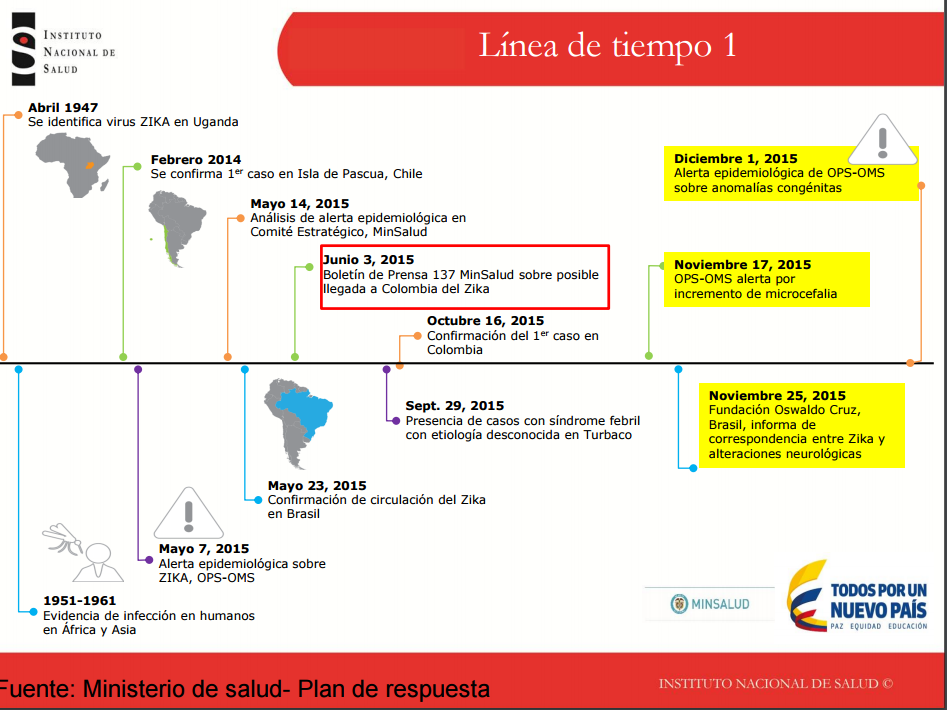
Excerpted from slideset produced by Colombian INS.[2]
The NIH (actually the INS - Instituto de Nacional Salud) of Colombia have reported 50 suspect diagnoses of microcephaly there in 2016.[1] 

18 (36%) of these have been discarded, leaving 32 cases still being investigated.

The remainder represents an increase of 13% compared to what would normally be expected to occur by Week 11 in other years. Annually, Colombia reports 140 microcephaly diagnoses across the entire country.[1] 

These are great data - we are seeing an actual baseline ahead of the predicted microcephaly surge that will be follow, and be caused by the Zika virus (ZIKV) epidemic the country is experiencing. That is of course, all based on what scientific consensus has decided has happened in Brazil following ZIKV infection of pregnant women.

Statistics from the Epidemiological Surveillance System (SIVIGILA) in Colombia have quantified the ZIKV epidemic to date at 2,361 confirmed cases of Zika virus disease (ZVD) and 56,477 suspected cases. Their weekly detailed mega-report should be out soon.
Additionally, there are 997 pregnant women confirmed to have been infected by ZIKV and 9,815 cases of pregnant women who report having had symptoms (suspect) consistent with ZVD.

For the same period 381 neurological syndromes were reported, of which 258 have been diagnosed as Guillain-Barre syndrome associated with ZVD.

""Of the 33 countries that have indigenous virus circulation zika, Colombia is the nation that more laboratory tests carried out according to reports of the Pan American Health Organization. We have a surveillance system that has one to one all people who consult health services with symptoms of this disease, which represents the best statistical series of the region" said Fernando Ruiz Gómez, Deputy Minister of Public Health and Provision of National Health Services."[3]

...and I love the lab testing that is going on in Colombia. Great work indeed... 

Martha Lucia Ospina Martinez, General Director of INS, emphasized that only 14 countries in the region - of the 33 that have indigenous circulation of Zika - log suspect cases into their surveillance systems - Colombia , Brazil, Honduras, Venezuela, Martinique, El Salvador, Suriname, French Guiana, Guadeloupe, Guatemala, Dominican Republic, Haiti, Barbados, Saint Martin and the Virgin Islands. "For this reason it is wrong to compare with the other 18 nations that do not record these cases, as have some critics to the actions taken by the National Government." 

...I presume wrong because the totals will be very different... 

Excerpted from slideset produced by Colombian INS.[2]
The Director reported that other countries in the region have reported an increase in cases of syndrome Guillain-Barre attributed to ZVD. 

However, in cases with microcephaly and other neurological birth defects, only Brazil has reported cases, reporting that 907 cases and Panama have recently reported on one partner that is being studied. 

I'm not sure if the translation and my interpretation are correct on that last section. It reads a little like some competition between Colombia and Brazil around how reporting is being conducted. 

I'd value any local language expert interpretation - or a direct communication from anyone with first-hand knowledge!

Is Colombia doubting the link because it's not yet confirmed its own association? 

Wednesday, 6 January 2016

Zika virus, mosquitoes and a monkey on a platform...

UPDATED: 07JAN2016 AEST
As I noted yesterday the first published description of the isolation of Zika virus was from a study set up in the Zika forest in Uganda. It was described in print by Dr George Dick and colleagues in the September 1952 issue of Transactions of the Royal Society of Tropical Medicine and Hygiene.[1]

Rhesus macaque (Macaca mulatta) [2]
In the first study, which began April 1947, six platforms were set up in the forest canopy and upon each, a caged rhesus monkey was placed. 

The first Zika virus was identified from a monkey...

This was to be a Yellow fever virus (YFV) study since Zika forest was known to harbour a lot of previously YFV infected, antibody-positive monkeys-but stuff happens on the road to completing a good plan.

By the way: placing or penning an animal in a location known to, or under suspicion of, harbouring an infectious agent - a virus in this case - is the precess of creating a sentinel animal.

On 18th April, the daily temperature recording for "Rhesus 766" had increased to 39.7'C, rising to 40'C the next day. It was taken to the lab at Entebbe, a blood sample collected and then the primate was observed for the next month. The only sign or symptom of illness in 766 was the fever.

The blood was injected intraperitoneally (no signs of illness) or intracerebrally (became ill from day 10 post-injection) into mice and underneath the skin of Rhesus 771 (which did not develop any signs of illness).

A filterable "agent" (filters were used to remove everything but very small viruses) was recovered from the brains of the ill mice and also from the serum of 766 - it was later named Zika virus (766 strain). The virus's growth could be hampered by antibodies which developed in the serum of 766 a month later, identifying the that the Zika virus was capable of triggering a specific immune response, despite a mild illness. The more lab-savvy of you may have realised by now, that this all happened before cell culture was being used. The only way to "grow" or amplify more virus was to infect anew a susceptible host animal-which could also reveal whether the agent was capable of causing disease, so long as the experiments were suitably controlled.

A second Zika virus was found among mosquitoes...

A second virus (later called strain E/1) was acquired during a different study, but also set up for YFV. The E/1 was identified from a ground up, unfiltered preparation of Aedes africanus mosquitoes in saline which had been caught 11-12th January 1948 using a variation of the platform system. . The preparation was injected intracerebrally into 6 mice and subcutaneously into Rhesus 758 via 9 inoculations, across 2 weeks. 

Diagnosis of Zika virus by infection of animals...

Primate 758 showed no signs of illness, but the mice had - at the 7th day - so at day 8, 9 and 10 after 758's injection, blood was collected and serum injected intracerebrally into groups of 6 new mice. 
  • From the first primate sample (day 8), 2 injected mice died and virus could be passed on to additional mice from filtered preparations of their infected brain tissue
  • From the second sample (day 9), 1 mouse died (and its brain tissue filtrate could also produce new infections in mice). A second mouse was paralysed but another virus, called Theiler's mouse encephalitis virus [TMEV], a picornavirus, was identified upon further infections 
  • No mice died from the 3rd 758 inoculation of serum
  • The serum from 758 was shown to block infection of animals by Zika virus after it was first preincubated with preparations of:
    • the agent isolated from 758 serum after inoculation with the A. africanus preparation or
    • the E/1 Zika virus strain or
    • the 766 Zika virus strain
The authors concluded Zika virus was a new virus and that it triggered a specific antibody response which did not cross-react with YFV, dengue virus or the TMEV found in the paralysed mouse. 

It was also notable that disease was mild or went unnoticed in primates. Primates are usually considered to be close animal substitutes for humans in studies of disease progression. 

No studies of pregnant primates were conducted which does raise the question of whether we should consider a check-list of things to research for each and every virus capable of replicating in us.

References...
  1. Zika virus. I. Isolations and serological specificity.
    DICK GW, KITCHEN SF, HADDOW AJ.
    Trans R Soc Trop Med Hyg. 1952 Sep;46(5):509-20.
    http://www.ncbi.nlm.nih.gov/pubmed/12995440.
  2. https://www.flickr.com/photos/wild_speedy/4185543087/
Updates..
  1. Added some links and worked out some typos and layout issues.

Tuesday, 5 January 2016

Zika virus briefly...

Update #1. 05JAN2016 2030 AEST
Update #2. 30JAN2016 1430 AEST
Zika (pronounced [zēk′ ə; 1] or zeek-a) virus has been in the news in recent months as it has seemingly spread very quickly from country to country, seemingly at the same time as a rise in cases of an otherwise rare human disease, microcephaly. 

The virus was first grown in the laboratory from samples from a naturally infected sentinel rhesus macaque (monkey) which were placed in cages on variously elevated platforms in the Zika ("overgrown") forest in Uganda in 1947.[18] The virus was not descried in the literature until 1952 although many others from the discoveries in this region were.[18]

I'm new to Zika virus and the study of its spread and disease so I'm on a mission to read up on it. I like to start from the beginning thus I have some of the earliest papers and will gradually read them and share with you any summaries I write up. For now, a general overview of some key bits.

Zika virus causes Zika virus disease (ZVD) or Zika fever - it's that virus versus disease thing that we have for almost all infectious diseases. Zika virus is often abbreviated to ZIKV.

From ViralZone's (www.expasy.org/viralzone,
SIB Swiss Institute of Bioinformatics) excellent
Flaviviridae page at 


ZIKV is a mosquito-borne virus that has an RNA genome (positive sense) and is enveloped by a lipid membrane (with exposed viral bits embedded-see adjacent image) surrounding an icosahedral capsid. Inside the capsid is the genome. This is the same basic structure as that found among other viruses of the family Flaviviridae of which ZIKV is a member; it falls into the genus Flavivirus of the family Flaviviridae to me a bit more precise.

ZIKV replicates in the infected host cell's cytoplasm and first makes a single protein (a polyprotein) which is subsequently cleaved up into different functional peptides.[5,8]


Aedes aegypti mosquito. One of the genus Aedes of 
mosquitoes found to host ZIKV. Other mosquitoes 

Image from CDC via Wikipedia.[9]
Some flaviviruses are borne to us (and other animals) by other arthropods - ticks apart from mosquitoes - infecting us via a virus-laden puncture/bite/injection during which virus is introduced. These viruses are all lumped together under the umbrella term of arthropod-borne viruses or arboviruses

Arboviruses replicate (grow) within the cells of the particular arthropod host, where they are amplified to higher viral loads; for example cells lining the mosquito gut in the case of Dengue virus.[10,11] Some human and animal hosts, as far as we know, cannot amplify the virus enough for it to be sucked back out by and infect the next arthropod that might come along and feed on us - these are called incidental or "dead-end" hosts.[4]

Some flaviviruses have not yet been linked to an insect host. Wikipedia maintains a great long list of flaviviruses, arthropod hosts and their mammalian and avian incidental hosts, as well as those viruses not yet linked to a human or other animal hosts.[4]

Other flaviviruses (members of that genus) you may have heard of include Yellow fever virus (YFV; the prototype virus and from where "flavi", which derives from flavus, meaning yellow/blond/golden in Latin, comes from), Dengue virus (DENV), Japanese encephalitis virus (JEV), Tick-borne encephalitis virus (TBEV), West Nile virus (WNV), St. louis encephalitis virus and Murray valley encephalitis virus (MVEV). But there are 53 species listed in the genus by the International Committee on Taxonomy of Viruses (ICTV) as of 2014 - many of which you won't have heard anything about.[3]

Generally, ZIKV causes a relatively mild illness in a proportion of those infected.[13] Signs and symptoms can include fever, rash, joint (arthralgia) and muscle (myalgia) pain, conjunctivitis, headache and jaundice but with its recent rapid spread - or more rigorous detection - a link is being investigated to a parallel rise in cases of a rare disease, detected at birth or thereafter, called microcephaly. This has been reported in some countries with ZIKV cases, but not from all. At least to date that has been the case - it may change with the new attention this disease and this virus have now attracted. 
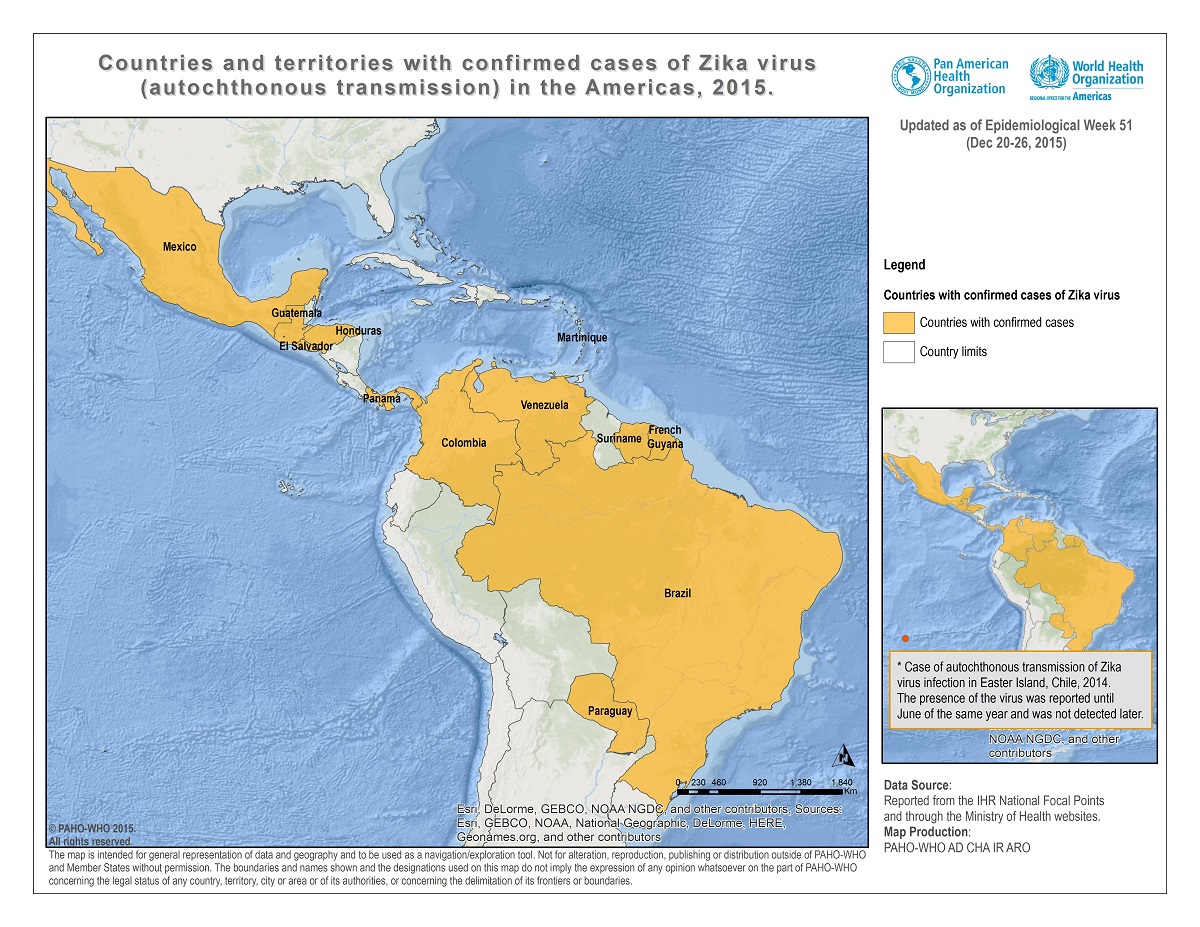
Countries and territories with autochthonous transmission.
Epidemiological Week 51 - 2015. PAHO & WHO.[23]

Microcephaly manifests, as the name suggests, as markedly smaller than normal head size and is linked to reduced brain growth in utero or brain development after birth.[6] While a link between microcephaly and viruses is not new, a link (statistical, supported with data) has yet to be found to ZIKV infection.[7] That is not to say a link will not be found, but it is awaiting the required studies. Three instances report ZIKV in amniotic fluid or in newborn tissues and one case of sexual transmission tentatively described.[19,21] Thousands of ZVD cases have reportedly been accruing on a weekly basis in Colombia alone which found its first local (autochthonous) transmission October 2015.[20] The first autochthonous reports of ZIKV infection in the Americas were confirmed in February 2014 on Easter Island, Chile.[22] In May 2015, Brazil reported discovery of its first autochthonous cases and November 2015 saw the first autochthonous circulation reports by El Salvador, Guatemala, Mexico, Paraguay, Suriname, and Venezuela.[22]

Laboratory confirmation of a suspected or probable case can be by detection of ZIKV RNA using RT-PCR in samples from an acutely infected case and by the finding of IgM antibodies 5 or more days after illness onset.[12,13] ZIKV antibody studies must be considered alongside studies of other flaviviruses which may cross-react or non-specifically flare up during infection by another related, or unrelated, virus.[14,15,16,17] The time during which virus remains in the blood may only be 3 to 5 days.[13]

But other infections can look just like ZVD including:[12]

  • dengue viruses
  • leptospirosis
  • malaria
  • rickettsia
  • group A streptococcus
  • rubella virus
  • measles virus
  • parvovirus
  • enterovirus
  • adenovirus
  • Chikungunya virus
  • Mayaro virus
  • Ross River virus
  • Barmah Forest virus
  • O’nyong-nyong
  • Sindbis viruses
So you can see that a lot of work, time and money is required for a lab asked to confirm the disease, rather than a specific viral infection.

No specific antiviral or vaccine exists for ZIKV infection - or most other viral infections.

References...
  1. http://wwwnc.cdc.gov/eid/article/20/6/et-2006_article
  2. http://viralzone.expasy.org/all_by_species/43.html
  3. http://www.ictvonline.org/taxonomyHistory.asp?taxnode_id=20141996&taxa_name=Flavivirus
  4. https://en.wikipedia.org/wiki/Flavivirus
  5. http://web.stanford.edu/group/virus/flavi/2008/flavi.html
  6. http://www.mayoclinic.org/diseases-conditions/microcephaly/basics/definition/con-20034823
  7. http://www.childrenshospital.org/conditions-and-treatments/conditions/microcephaly/symptoms-and-causes
  8. http://viralzone.expasy.org/all_by_protein/24.html
  9. https://commons.wikimedia.org/wiki/File:Aedes_aegypti_CDC-Gathany.jpg
  10. http://www.sciencedirect.com/science/article/pii/S0042682207006642
  11. http://journals.plos.org/plosntds/article?id=10.1371/journal.pntd.0001385
  12. http://www.cdc.gov/zika/hc-providers/clinicalevaluation.html
  13. http://ecdc.europa.eu/en/healthtopics/zika_virus_infection/factsheet-health-professionals/Pages/factsheet_health_professionals.aspx
  14. http://www.cdc.gov/westnile/healthcareproviders/healthcareproviders-diagnostic.html
  15. http://www.ncbi.nlm.nih.gov/pmc/articles/PMC2732478/
  16. https://books.google.com.au/books?id=73pYBAAAQBAJ&pg=PA1158&lpg=PA1158&dq=flavivirus+infection+triggers+heterologous+antibody&source=bl&ots=UYgmkBSso3&sig=CV1uAEb5NZTGfhD-hd0v6EZ7P4g&hl=en&sa=X&ved=0ahUKEwi8idCd0ZHKAhUMkZQKHXMnBNgQ6AEIOzAD#v=onepage&q=flavivirus%20infection%20triggers%20heterologous%20antibody&f=false
  17. https://books.google.com.au/books?id=BseNCgAAQBAJ&pg=PA1898&lpg=PA1898&dq=flavivirus+infection+triggers+heterologous+antibody&source=bl&ots=0JKxv695TR&sig=hvvhStq7BABzIKhzecMhFRW50cg&hl=en&sa=X&ved=0ahUKEwi8idCd0ZHKAhUMkZQKHXMnBNgQ6AEINjAC#v=onepage&q=flavivirus%20infection%20triggers%20heterologous%20antibody&f=false
  18. Zika virus. I. Isolations and serological specificity.
    DICK GW, KITCHEN SF, HADDOW AJ.
    Trans R Soc Trop Med Hyg. 1952 Sep;46(5):509-20.
    http://www.ncbi.nlm.nih.gov/pubmed/12995440
  19. http://www.forbes.com/sites/judystone/2016/01/04/zika-coming-to-america-through-mosquitoes-travel-and-sex/
  20. http://outbreaknewstoday.com/colombia-averaging-more-than-1000-zika-cases-weekly-for-the-past-month-54367/
  21. http://wwwnc.cdc.gov/eid/article/21/2/14-1363_article
  22. http://www.paho.org/Hq/index.php?option=com_docman&task=doc_download&Itemid=&gid=32405&lang=en
  23. http://www.paho.org/hq/images/stories/AD/HSD/IR/Viral_Diseases/Zika-Virus/2015-cha-autoch-human-cases-zika-virus-ew-51.jpg
Updates...
  1. Grammatical reference and additional location details
  2. Fixed some reference errors