Showing posts with label Ministry of Health. Show all posts

Saturday, 7 May 2016

Brazil's microcephaly and CNS disorder (M&CD) monitoring: Report No. 24, 2016-Week No. 17...

These graphs are made by me using data obtained from epidemiological week (EW) number 17's Brazil Ministry of Health microcephaly and foetal and infant microcephaly and central nervous system (CNS) disorders (M&CD) report.[1]

Brazil reports a total of 120,161 suspected Zika virus detections this EW.[1] Around one thousand of these have been laboratory confirmed.

Suspected M&CD cases...

The total number of suspected M&CD cases increased by 115 to 7,343 this EW.


The graph above shows the number of suspected M&CD diagnoses in Brazil up to 30-April-2016. The cumulative curve (yellow dots; left hand axis) is growing, but slowly. 

This was another slower weekly rise (orange bars; right-hand axis). These bars are based on the difference in total suspected cases reported this EW compared to that reported in the last EW. This method may not reflect the diagnoses that occurred during the past EW (some may have come from days or weeks earlier), but that level of detail is not available in the MOH report.

Confirmed and discarded M&CD diagnoses...

M&CD cases under investigation decreased by 130 to 3,580 this week - the sixth consecutive decrease. This may be occurring for a range of (guessed) reasons including:

  1. improved capacity to address a large volume of request for clinical classification of suspect diagnoses.
  2. streamlining the confirmation processes
  3. retrospective application of changed head circumference definitions resulting in reductions to the number of the microcephaly diagnoses.
    This aspect will not reduce the number of cases with structural brain changes that occur in the absence of a decreased head size - which are reportedly also related to Zika virus and/or other causal influences.
    There is time involved in making these diagnoses because of the need for detailed ultrasound and other diagnostic investigations to identify congenital infection outcomes including intracranial calcifications, dilation of cerebral ventricles or posterior fossa changes and other issues.

In the graph above, we can see that 172 (blue bars; right hand axis) suspected M&CD diagnoses were discarded upon closer investigation with a current total of 2,492 removed.

The rate of these resolved diagnoses (line with blue dots, left-hand axis) continues to outpace the rate of the smaller overall number of confirmed M&CD diagnoses (red dots, left-hand axis). 


As of this EW, 17% of suspected M&CD diagnoses have been confirmed while 34% of suspected diagnoses have been discarded. 


The cumulative number of M&CD diagnoses does continue its climb this EW, growing by 73 new diagnoses (red bars; right-hand axis) to total 1,271


The number of these M&CD diagnoses to be confirmed with a Zika virus infection also grows (green dots; left-hand axis) by 9 new detections to 203 this EW (green bars; right-hand axis). Those confirmed Zika virus infections represent 16% of all confirmed M&CD diagnoses and 3% of all suspect diagnoses - but these are not fair comparisons for a range of reasons I won't go on about here.


References...

  1. http://portalsaude.saude.gov.br/images/pdf/2016/maio/04/coes-microcefalia-informe-epi-24-se17-2016.pdf

Wednesday, 30 March 2016

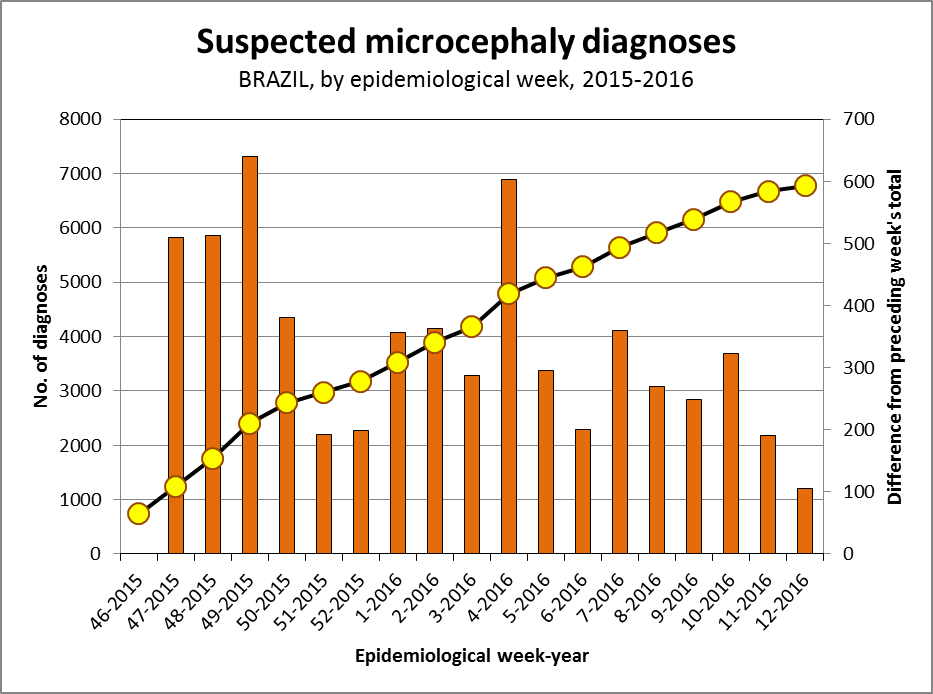
Plotting the Brazil microcephaly data...

These data are obtained from the Brazil Ministry of Health microcephaly reports, which you can also find here.


Above we can see a cumulative curve (black line, yellow dots read using the left-hand axis) which adds each week's cases to the total from the week before. The curve appears to be rounding off in in the last few weeks which might suggest a slowing of the rise in number of microcephaly diagnoses. 

Or it might be too early to say. 

The vertical orange bars (read against the right-hand axis) are the differences between reports. The first bar is the total diagnoses in week 54 of 2015, minus the total from week 46, 2015, and so on. There seem to be fewer new cases each week over the last 3 epidemiological reporting weeks.

In the second chart things get a bit more crowded - but follow the same basic layout  as the first - lines read on the left-hand axis, bars one the right. Colours go together. Lines are totals, bars are differences between weeks. 

We see the rise in discarded suspected microcephaly diagnoses (blue; they were classified as not being microcephaly cases) which became a little steeper between Week 7-10.

Confirmed microcephaly diagnoses (red) did not rise as steeply and seem to have slowed in the last 2 reporting weeks.

The number of laboratory confirmed Zika virus positives (green) among the confirmed microcephaly diagnoses is much smaller and oscillates.

This chart also shows that these extra details didn't start appearing until around Week #2 of 2016.

Thursday, 3 March 2016

Microcephaly: diagnoses and discards and those with Zika virus...Report #15

The latest Brazil MOH report on microcephaly was released 03-MAR-2016 – Report #15. 

The following is a summary of info after translation via Google.
  • There have been 5,909 (+269 since last week) reported suspected diagnoses of microcephaly sometime unspecified in 2015
    • 4,222 (+115) remain under investigation
    • 1,687 (+154) cases have been investigated and classified
      • 641 (+58; 38% of those investigated, 11% of all reported) have been confirmed 
      • 82 (+15; 13% of confirmed microcephaly cases; 1% of suspected cases) have been laboratory confirmed as Zika virus infections (no specifics on method or whether mum/foetus/infant/samples etc)
      • 1,046 (+96; 62% of those investigated, 18% of all reported) have been discarded 
The MOH notes that if a diagnosis of microcephaly was confirmed, then the mother was most likley infected by ZIKV and that the figure of 82 is an inadequate representation of the number of cases related to the virus.[2]

Saturday, 27 February 2016

Microcephaly: diagnoses and discards and those with Zika virus...Report #14

The latest Brazil MOH report on microcephaly was released earlier in the week – Report #14. 

The following is a summary of info after translation via Google.

·         There have been 5,640 reported suspected diagnoses of microcephaly sometime unspecified  in 2015
o    4,107 remain  under investigation
o   1,533 cases have been investigated and classified
  • 583 (38% of those investigated, 10% of all reported) have been confirmed
    • 67 (11% of confirmed microcephaly cases; 1% of suspected cases) have been laboratory confirmed as Zika virus infections (no detail provided on method or whether mum/foetus/infant/samples etc.
  • 950 (62% of those investigated, 17% of all reported) have been discarded

·        The MOH notes that if a diagnosis of microcephaly was confirmed, then the mother is to be considered ZIKV positive whether laboratory data are available/provided or not

References…
  1. http://portalsaude.saude.gov.br/images/pdf/2016/fevereiro/23/coes-microcefalia-informe-epidemiologico14-se07-2016-fev2016-14.pdf
  2.  http://portalsaude.saude.gov.br/index.php/o-ministerio/principal/secretarias/svs/noticias-svs/22296-casos-suspeitos-chegam-a-4-107-em-todo-o-pais#

Sunday, 29 March 2015

Where did the MERS-CoV comorbidity and animal contact fields go...? [UPDATED]

Is this the work of the US CDC and other visitors helping the Kingdom of Saudi Arabia (KSA) Ministry of Health (MOH) resolve their Middle East respiratory syndrome coronavirus (MERS-CoV) problem? Is it an arbitrary reporting change by the Command and Control Center (CCC)? Is it someone forgetting to unhide the relevant columns in their spreadsheet?
Changes to the KSA MOH MERS-CoV public 
reporting detail after 17-March-2015.
1. The MERS-CoV graph changed scale and caught up.
2. Three fields disappeared: pre-existing disease, 
animal exposure and contact with a known cases 
within a hospital setting
3. The promise of weekly updates was dangled-
without reference to a host site.
Click on image to enlarge.

I don't know why, but since 17th March, the KSA MOH MERS-CoV reports have stopped posting information about whether each newly announced MERS case had a comorbidity and whether they had animal contact. Granted, the last field was almost always "No" or "Under Investigation" - and thus of little use (we rely almost exclusively on the World Health Organization reports to provide useful animal data) - but I wonder why the MOH has chosen to stop posting even the heading this month? 

The much more epidemiologically significant description of whether the case was an "expat" or a "Saudi" citizen remains - whew! 

And the MOH has continued to do away with all of that pesky detail that might allow an observer to link a death to a previously announced case. Thank goodness we don't have that clutter to deal with - or the details from the found113 which I presume are now completely lost in the sands of time. 

I guess the removal of these latest 2 data fields is just all part of providing the world with more of that full transparency and up-to-date information about this emerging pathogen - like the MOH "News" page - all the latest info you could want from August and earlier is to be found there. 

Oh well, at least you can get the latest from the weekly updates...if Google Translate's efforts can be understood.

It really isn't as hard as it is being made to look to get the reporting aspects right.

Wednesday, 25 February 2015

A new Middle East respiratory syndrome coronavirus (MERS-CoV) table of graphs stacks up...

My new favourite graphic. 

This shows MERS-CoV detection by month since the virus was identified in 2012. Detections are further broken down by each region of the Kingdom of Saudi Arabia (KSA) in which they were reported  by the KSA Ministry of Health website here.

At the moment its highlights that the KSA has a real problem in the Eastern region (Ash Sharqiyah) and growing issue in Ar Riyad (as always with MERS-CoV detections) but that Al Quassim region is also of growing concern.

This table of graphs is part of my MERS-CoV static page to be found at... http://virologydownunder.blogspot.com.au/2014/08/mers-cov-daily-monthly-and-cumulative.html

I try and update these data as often as possible - at the moment detection are rising and February is currently the 4th largest month for new detections - updates occur every day or two.


References...
  1. Kingdom of Saudi Arabia Ministry of Helath MERS-CoV data http://www.moh.gov.sa/en/CCC/pressreleases/pages/default.aspx

Friday, 26 September 2014

MERS-CoV data request: A response from the Ministry of Health

Four days after I posted a blog requesting missing data on retrospective Middle East respiratory syndrome coronavirus (MERS-CoV) detections and deaths, I received a response. 

Dr Anees Sindi, Deputy Commander of the Command and Control Centrer, Ministry of Health, Saudi Arabia replied. With his permission, I have reproduced his reply below.
______________

Sent: Tuesday, 23 September 2014 6:36 PM
To: Ian M Mackay
Subject: Re: your request for missing data on retrospective MERS-CoV detections

Dear Dr. Mackay,

I’m writing in response to your blog posting entitled “A request for missing data on retrospective MERS-CoV detections.”

Thank you for acknowledging the steps that the Ministry of Health’s Command & Control Center has taken to ensure members of the public -- including researchers around the world -- have access to real-time information about MERS-CoV cases in the Kingdom of Saudi Arabia.

These daily postings are a small step on our journey toward full transparency. We want scientists to have access to the data they need to produce meaningful publications that advance our understanding of this disease for the benefit of mankind.

With that in mind, I am happy to inform you that the Ministry of Health is in the process of preparing additional data for public release. I will follow up with you once we have a confirmed release date.

Collaboration with the international research community is a key pillar of our work. In addition to sponsoring more than 30 research projects focused on MERS-CoV, the Ministry of Health has opened its doors to academics and experts from the World Health Organization and U.S. Centers for Disease Control & Prevention. MOH shares more data with the WHO than is required under the International Health Regulations, and we stand ready to support other scientists with an interest in better understanding coronavirus.

Thank you again for your interest in our work.


Best Regards,

Dr. Anees A. Sindi
Deputy Commander
Command and Control Center, Ministry of Health
Saudi Arabia


______________

This is fantastic news and I am very excited to hear that we may soon be able to complete the data picture for MERS-CoV. 

I am most grateful to Dr Sindi, the Minister and the Ministry for taking my request seriously and for replying to it so quickly.


With these data in hand, many of us will be able to build better epidemiological picture of the timing, spread and impact of MERS-CoV over the past 2 years as well as more specifically quantify MERS among fatal cases. 

These data do not answer all the questions we have of course, but they definitely answer some, and for that I'm thankful.

This social media thing does seem to have some impact.