Showing posts with label cluster. Show all posts

Saturday, 13 June 2015

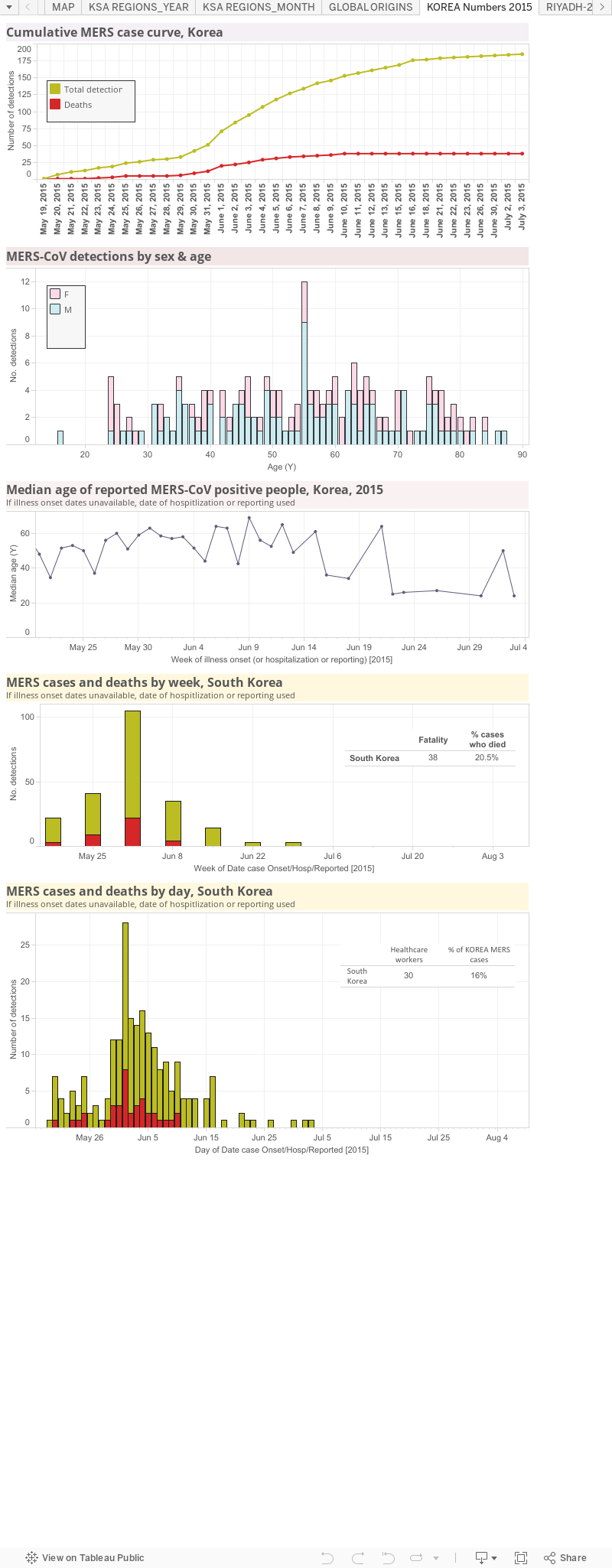
Middle East respiratory syndrome (MERS) coronavirus: Outbreak maps and graphs, South Korea

This static data visualization was created using data from FluTrackers, the World Health Organization and the Korean Broadcasting System (KBS).

Wherever possible, the dates are those for a case's onset of illness, but if that is unavailable then the date for hospitalization or if that is unclear, the date that case was reported.

Because the WHO obviously have more detailed information, I recommend you keep an eye on their site, so long as it is being maintained, for more accurate epidemic curves.


References...

2. The Korean Broadcasting System's News websites
http://dj.kbs.co.kr/resources/2015-06-08/ &
http://dj.kbs.co.kr/resources/2015-06-04/
3.  World Health Organization pages
Main landing page on MERS and MERS-CoV (includes link to WHO line list under General Information)
http://www.who.int/emergencies/mers-cov/en/
Disease Outbreak News pages
http://www.who.int/csr/don/don_updates/en/
 
News on the current situation
http://www.wpro.who.int/outbreaks_emergencies/wpro_coronavirus/en/
Summary of Korean statistics-rapidly updated

http://www.wpro.who.int/outbreaks_emergencies/summary.of.MERS.stats/en/

Sunday, 7 June 2015

South Korean MERS cluster keeps growing..

version 3.
This cluster of hospital-related infections in South Korea has now reached 64 Middle East respiratory syndrome (MERS) cases. And no camel meat or milk, no route of ingestion yet fond in fact not even a camel to be seen - except the ones quarantined in the South Korean zoo - I can't even....

Anyway, thanks to a week long internet outage in my house (yes, I do these blogs from home) I've been unable to blog on any of this. 

Surprisingly though, after a week, the cluster is still going pretty strong. The recent tallies include 6 cases then 5, then 5, then 6, 9 and last night 14. These include 5 deaths (10%). 

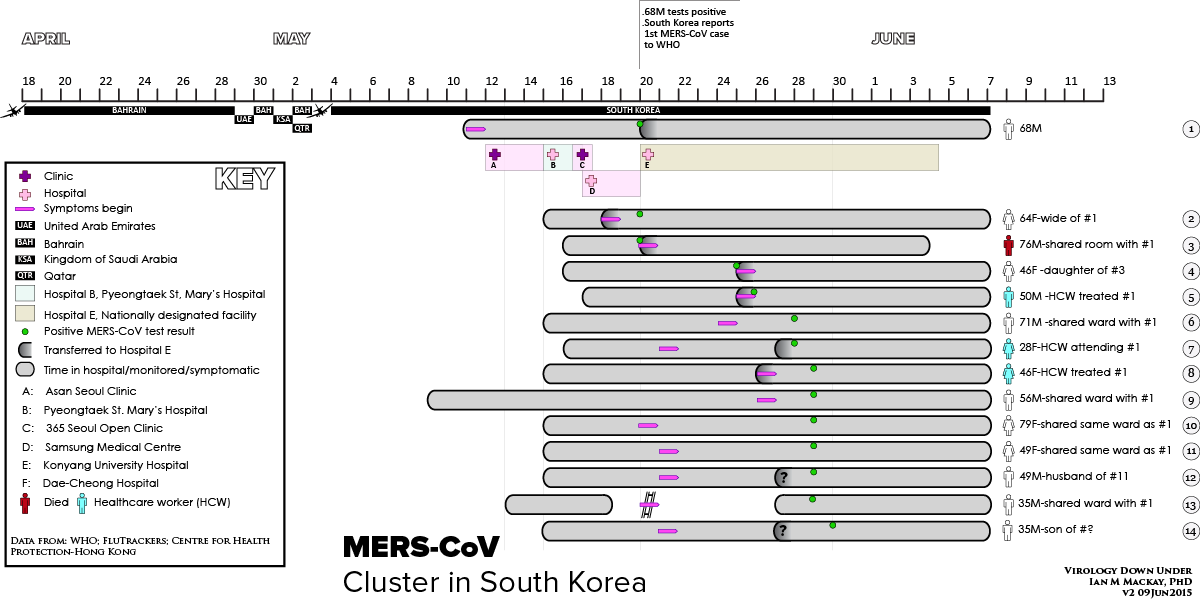
As you'll see from the first 11 cases I've plotted below, this is similar to a bunch of incidents we've followed in Saudi Arabia in 2013 to today (Hafoof seems to have a pretty good cluster going at the moment). They have usually been the result of poor infection prevention and control creating a perfect storm of circumstance for viral spread. 

Timelines of the first 11 cases of MERS-CoV infection in South Korea.Click on image to enlarge based on World Health Organization and  FluTrackers information with help from this timeline. Hospital names have been published here and here - I'm not sure if this is how they are ordered so please consider this a work in progress.
Click on image to enlarge

It's looking like this will be the case in South Korea too. 

A couple of interesting things to note:

  1. Cases are still popping up - a month later
  2. A viral genome sequenced in China (ChinaGD01), from a South Korean case that flew out of South Korea to Guangdong, does not show any obvious genetic differences compared to other MERS-CoV genome sequences. Its sequence identity falls in the range that we can fit around all the MERS-CoV genomes - whether from humans, camels, from Saudi Arabia, Qatar or the United Arab Emirates, 2012 or 2015.
  3. MERS cases in South Korea are tightly linked to hospitals - healthcare workers feature prominently as do other "close contacts" including relatives who stay at the hospital to help care for their loved ones. There are no indications of escape outside those hospitals so the closing of schools, the wearing of masks (which don't cover eyes) and the increased border measures offered to North Korea have no support from science or facts
  4. Some incubation times are pretty short - just 3 or 4 days between exposure (in whatever form that is taking) and symptom onset - yet we haven't seen any not-so-close contacts come down with infections, despite that same time frame having passed long ago for them.
    Spread of virus is not very different to what we've observed in Saudi Arabia for 3 years
  5. A few people have called the index case a "super-spreader" because of all the contacts he's had that have developed MERS (what about those who haven't developed disease by the way, are they being tested?) - I've come to loathe that term. It lazily defines the person as super-spreader while ignoring the context in which that person has been managed - namely whether infection control measures are well used, or in place at all. A super spreading event I like a little more - but even that makes something, special scary or different  out of what may be something completely normal in infectious disease biology
  6. Testing times are all over the place - in just those first 11 cases it could be 9 days before a test result confirmed MERS-CoV infection. Therein may lie a reason for why MERS cases are still appearing now - no-one knew then, nor for a decent while, what they had. Although...they did know that they had an acute respiratory infection and I can't for the life of me work out why these viruses seem to get away from us time and time, and time again. Well, yeah I do - it's because people.

"Are we ready for the next pandemic?" is a question that has been asked a lot since the peak of the peak of Ebola virus disease epidemic in West Africa. The answer is that there is no way in a million years we're ready.

Version history.
  • v2-fixed graphic's transparent background & changed case tally from 50 to 64
  • v3-added in hospital names and a few more cases.


Saturday, 19 April 2014

MERS-CoV cases continue steep climb thanks most to 2 healthcare-related clusters...

Click on image to enlarge.
Data are for lab-confirmed cases only, and 

from FluTrackers, Ministries of Health
and the World Health Organisation Disease Outbreak
News reports.
The Jeddah cluster | Jeddah | Kingdom of Saudi Arabia. 

It is the biggest of any of the clusters of MERS-CoV cases within the Kingdom of Saudi Arabia, MERS-central (0 to date. It has seeded at least 2 internationally exported cases (a fatal case in Malaysia and now a case in Greece). It totals 53 cases so far; the tally for this cluster began after the onset of illness in the first case, 6-Apr.

The paramedic cluster | Abu Dhabi | United Arab Emirates

Happening simultaneously and right next door is a cluster of cases that began 28-Mar. It stands at 14 cases as I compose this; most recent with an onset of 14-Apr.

These dates, starting points and information are all up in the air of course. 

There have been no solid answers from either site on how each cluster commenced, so we don't know the actual 1st case nor how they became infected, what their status is or what type of contact occurred (animal or human-to-human). 

We don't know how many cases are linked together or even whether the 2 sites are linked. We don't know whether these focal outbreaks are ongoing nor just how so many healthcare workers (HCWs) can be infected by a respiratory virus that was already well known to the region and its hospitals (Wk 109, 2.1 years since first MERS cases). 

We don't know if this outbreak is just bad infection prevention and control at some hospitals/among some people. We are all wondering how this has continued among HCWs as it seems to be? After a couple of confirmed cases wouldn't masks and gloves and gowns be standard fare - if they weren't already in the management of unknown acute respiratory disease cases? Whether a "super spreader" is involved or not, such measures should have prevented so many healthcare workers becoming infected shouldn't they? 

Is this MERS-CoV Mk II - now with the ability to transmit efficiently and rapidly (before extra prevention measures are in place)? We have no MERS-CoV sequences to answer that. Spike gene sequences would at least help us understand he virus aspects? I don't really care about complete genomes-they are for phylogeny more so than public health; changes in Spike yielded information of value in the SARS-CoV event and for coronavirus in general, and could do so again. Just sequence that region guys! Do it quickly and release that info now. It's something informative. Don't wait for a scientific paper. Start a blog and put the results on there. Not just in Arabic and then in English some time later; with Yemen, the Philippines, Malaysia and Greece picking up cases in the past week, these 60+ cases are not just a Saudi thing (although the case numbers say otherwise-but you know what I mean), it's global village thing. Just tell us what's going on with the virus! 

So many things we don't know. "So what?" you ask Go and Google "MERS SARS" and limit it to the past 24-hours. That's so what. The media are starting to heavily lean towards the "MERS is the next SARS" story again and that stirs up concern at many levels. Is that concern justified. At the moment who the heck knows??? If there is no change in Spike, while not the be-all and end-all for change in the virus, it will allow the experts to make comments that inform the media that may calm a rapidly progressing situation with economically damaging potential for the world, and the region.

For crying out loud Ministry of Health|Saudi Arabia, get ahead of this thing.

Sources...

  1. The world's greatest resource for tracking MERS-CoV cases, the FluTrackers line list
    http://www.flutrackers.com/forum/showthread.php?t=205075