Showing posts with label risks. Show all posts

Thursday, 5 November 2015

It was the camel, in the library, with the MERS-CoV...

In a paper out overnight, which is assigned to the January 1st 2016 edition of Emerging Infectious Diseases (why do you do this to us EID?!), Alraddadi and colleagues (overwhelmingly from the Kingdom of Saudi Arabia with help from the Centers for Disease Control and Prevention in the United States) have published Risk Factors for Primary Middle East Respiratory Syndrome Coronavirus Illness in Humans, Saudi Arabia, 2014. 

This is a long awaited case control study. Long awaited.


From [2]
It tells us that direct contact with dromedary camels (including the act of milking them) in Saudi Arabia, in the 2 weeks prior to symptoms ascribed to a confirmed MERS-CoV infection, is a significant risk factor for developing Middle East respiratory syndrome (MERS) disease. Cattle contact also fell out as a significant risk. 

However, cases were no more likely than controls to report exposure to bats, goats, horses, sheep or consumption of fruits, vegetables, or animal products, including uncooked meat, unpasteurized animal milk, or dromedary urine. 

The study also reminds us that the host factors of diabetes, heart diseases and smoking are associated with MERS (the disease, not how likely you are to get infected). If you do not have these then you may be more likely to have mild or asymptomatic outcomes if you were to be exposed and infected by MERS-CoV.

These are astounding findings that will take many by surprise and revolutionize out understanding of MERS (the disease) and MERS-CoV (the virus) throughout the Arabian Peninsula. 

Said no-one. Ever.


Ridiculous sarcasm aside though, much kudos to the Saudi research community! This case-control study, a long-awaited piece of work, was a camel that had to be broken by them for them, and now it has been. A win for science and for the region's science.

I hope the study helps to confirm the sizable pool of research that has come before.

But let's not lose sight of the camel in the room; most human cases of MERS come from other human infections closely associated with healthcare settings.

Defeating MERS and MERS-CoV requires battles on many fronts. As usual for any emerging viral disease. 

But then, it's a OneHealth kinda world.


References...
  1. http://wwwnc.cdc.gov/eid/article/22/1/15-1340_article
  2. http://virologydownunder.blogspot.com.au/2014/05/camels-at-centre-aerosol-all-around.html

Monday, 22 September 2014

Ebola virus, HCWs infections and personal protective equipment..

No one could offer anything but our deepest and most heartfelt thanks and a feeling of pride in the selfless, essential and humanitarian work being done by healthcare workers (HCWs), both local and international, in West Africa.

But they have paid a high price for this work, as they always do in emerging disease outbreaks.


WHO Ebola virus disease
numbers up to
14-Sept-2014
Of the >5,300 people reported as infected by the West African variant of Zaire ebolavirus (EBOV) to date, around 315 have been HCWs. Both numbers are very likely an underestimate. Half of the HCW cases have died. I don't know just how many HCWs there are in Guinea, Liberia and Sierra Leone who are dealing with the EBOV outbreak. I do know that these deaths are as horrible as each of the losses among non-HCWs, and are also worrying for those trying to recruit the many more HCWs needed to expandthe  care of ill patients.


This week a commentary article on the Centre for Infectious Disease Research and Policy (CIDRAP) website delves into this issue by suggesting an improvement to HCW respiratory protection.[1]


Two quick things first:

  1. The World Health Organization (WHO) defines human transmission of Ebola virus as being by direct contact (between mucous membranes or a break in the skin and the blood and other body fluids of an infected individual via physical contact or by wet material being propelling onto mucous membranes or skin breaks) and by indirect contact via contaminated surfaces.[3,4]
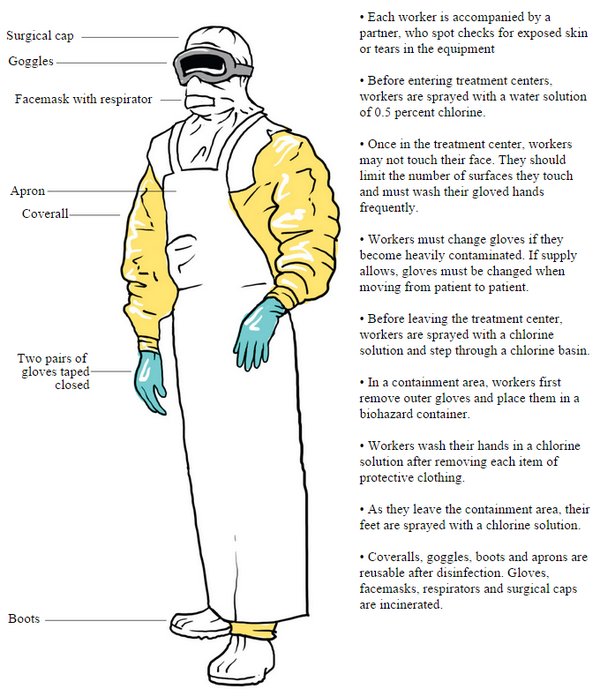
  2. When dealing with patients, the WHO recommends wearing gloves, a disposable impermeable gown to cover exposed skin, a waterproof apron over any gown that is not impermeable or when undertaking strenuous activity, facial protection to prevent splashes to the nose, mouth and eyes including a medical mask + eye protection (visor or goggles) or a face shield and medical mask.[3]
The CIDRAP article's authors claimed a belief that there is scientific and epidemiologic evidence that Ebola virus has the potential to be transmitted via infectious particles. Unfortunately they don't make a convincing argument to support their belief-nor could they, since no data currently exist to for any claim that an Ebola virus is transmitted between humans by an airborne route. So we're left with a commentary based on those beliefs, and some speculation.

Some collaborators and I wrote about Ebola virus not being an airborne virus based on what I know and what's been done to answer this question before.[2] I'll first add that if it were an airborne virus, I would likely be seeing many, many more cases-"Compared to this Ebola outbreak, the H1N1 swine flu had already spread to an estimated 10,000 times as many people in its first 10 months" noted United Kingdom virologist Ben Neuman.[13] H1N1 being an influenza A virus; a real airborne virus. In our post, we noted that big wet droplets (part of an "aerosol"-a messy term that may not be well understood by the public...or some scientists...that includes big wet droplets and the more frequent smaller particles <100µM in diameter) can be propelled at a mucous membrane or fall to the ground to contaminate surfaces.


A schematic of the makeup of an "aerosol".
From [2]
Big wet, propelled droplets can contain infectious Ebola virus and are included in the established risk messaging. Hence the need for droplet precautions.

We also know that from every human aerosol, after the heavy larger droplets fall to the ground or impact on a surface, the many more remaining lighter particles can linger in the air. I know that these small <100µm particles can be made to contain infectious Ebola virus under lab conditions[8] thus droplet nuclei produced by an infected human may contain Ebola virus. I can't say with certainty that they do or do not. However, as far as I have been able to tell, infection of humans and resultant disease from inhaling lingering particles, has not occurred. And when an airborne route was investigated using infected and uninfected non-human primates housed nearby but without direct contact, no infection via an airborne route was found to have taken place.[9]


Most of the studies looking at aerosols of Ebola virus do so in highly temperature and humidity-controlled laboratories with lots of lab-grown virus.


Relying on one added component raises a few questions for us:

  • Could the faith in this one extra precaution threaten the very important, meticulous care required when donning, using, and removing contaminated PPE-of any sort?
  • What role does a lack of the basics, like soap and clean water [10], play in HCW infections?
  • Could an additional extra safety measure really have a major effect on reducing the known risks involved with treating Ebola virus disease (EVD) patients, such as the long hours, tiredness, the constant and pervasive tension of imminent exposure, the oppressive heat, delirious and sometimes violent patients and the ease with which one can self-inoculate?[6]
  • Does the extra safety measure even have a role in reducing risk associated with HCWs who are unknowingly infected while not wearing PPE?[7]
How much do the things listed above, mostly unrelated to having a hi-tech battery-powered breathing apparatus on your hip, contribute to the tally of HCW infections?

The authors overlooked mentioning that early on, many HCWs may have had few or no masks at all and few other essential barriers such as those listed by WHO above, to protect against direct contact. They also did not mention the lack of HCW training in the use of any of that equipment if available, and did not highlight the lack of experience HCWs had dealing with EVD patients. These HCWs had (and may well still have) direct contact with very ill EVD cases, and got infected. What fraction of HCW infections resulted from absent or incomplete PPE and training versus the HCWs that they believe became ill while wearing full droplet precaution PPE?


Embedded image permalink
MSF designed suit of PPE.
Graphic tweeted by the
Washington Post.[5]
Others have also made note of the disparities between the imagery of a biosafety level 4 (BSL4) laboratory researcher working in a negatively pressurized, airlocked laboratory within a tethered, airtight suit (probably unnecessarily high precautions [13]) versus highly biocontained single patients being shipped home on dedicated planes (kept somewhat contamination-free using isolators) to rich nations for specialized support and treatment versus Médecins Sans Frontières (MSF) workers who use respirators (specialized face masks that fit more snugly and contain more layers to better filter what is breathed in) instead of surgical masks versus the WHO recommendations of standard precautions which include a surgical mask. Notably, the WHO recommendations vary according to the type of risk one is exposed to [see pg 96-7 96 of the 113 pg PDF at [3]).[10] There clearly is a range of thinking and messages here. But equally, there are a lot of different applications to cover, and no way for every need to be specifically catered for by one guideline. If everyone could agree on such a thing anyway.

I share the concern of many over the deaths of HCWs in West Africa. They may still be unnecessarily exposed to the virus due to the lack of enough PPE. They may not have enough training to understand how easy it is to become infected. They may not be given the message that during an EVD outbreak as monstrous and different as this one, many heavily populated areas have been included for the first time resulting in very real risks of infection occurring outside the hospital setting, not just inside it. There are also real risks of infection in supposedly EVD-free hospital settings like maternity wards.[11] There are many, many non-airborne related risks for HCWs.


We freely admit that we are not trained in the use of PPE for treating Ebola patients; just for working with actual respiratory and blood-borne viruses in PC2 & PC3 laboratory settings, respectively. Still, some may find this post irrelevant.
This is a blog and not part of any Organization's reference list when they write PPE guidelines...because it's a blog.

But for what it's worth, I would follow the MSF lead if working on the battlefield of a 100+ bed treatment facility. In an ideal world, more effort would be made to provide a more roomy and breezy head covering that allows patients to see your face and which can be worn for longer periods would be useful. You can see an image provided by 3M of this battery-powered air-purifying respirator (PAPR) accompanying the CIDRAP post.


However....first and foremost, and well before we get to this level of hair-splitting based on speculation and belief and no evidence of an airborne virus-I'd be wanting to make sure there was a minimum level of disposable PPE actually available for use, that it was consistently used by every HCW, that appropriate training in its use had been provided, and that HCWs understood about all the risks for acquiring EBOV infection. 

Reasons for HCW infections are many and varied. As much as we may believe or wish it were so, no single act or change will circumvent these risks or these infections.


References..

Sunday, 31 August 2014

Ebola: Blood, sweat and tears...

This post follows up the recent one on convalescent semen being able to harbour infectious Ebola virus (EBOV; although I am not aware of any infection resulting from this route of transmission there has been at least one report for Marburg virus [4]).

I thought I'd give the same treatment to tears and sweat which are also fluids intermittently listed as possible sources of EBOV infection for humans. Some examples of the scientific literature which support the risk messaging, follow.

Blood...

I think we are all pretty clear that the blood of an advanced case of Ebola virus disease (EVD) is heavily laden with virus and is the most serious of the risk factors for acquiring infection by an ebolavirus.

Viral loads (amount of virus in the sample) in blood can be above 106-108 plaque forming units or copies (pfu; a measure of infectious virus present using a lab test that measure the impact of virus on infected cells; copies measure viral genome and cannot prove infectious virus is present) per millilitre of blood in acute phase disease patients and non-human primates.[5,6]

Sweat...

There is not a lot on sweat containing signs of an ebolavirus.
  • Bausch and colleagues found no trace of EBOV in a single acute sweat sample.[1]
  • Jaax and colleagues found that in experimentally infected non-human primates (NHPs; rhesus macaques), that connective tissues next to hair follicles and sweat glands in the skin as well as the cells lining ducts of glands in the skin were sometimes positive for EBOV antigens (proteins).[2]
  • Davis and colleagues infected NHPs (African green monkeys) and found signs of EBOV antigens in the cells lining the sweat gland ducts and in cells in the connective tissues next to hair follicles, but no virus particles by electron microscopy.[3]
  • Zaki and colleagues found heavy signs of EBOV antigens (proteins) in the tissues around the sweat glands, but rarely also within sweat glands and ducts.[8] No virus particles were seen in the sweat glands or ducts when examined by electron microscopy.
Tears...

There is also very little I have found on this one.

  • Bausch and colleagues found EBOV RNA in tears from 1 sample, but no infectious virus could be isolated.[1]
  • Jaax and colleagues found some signs of virus in macrophages in the ciliary body of the eye of experimentally infected NHPs
Spit...
  • Bausch and colleagues found infectious EBOV in 1 of 12 acute saliva samples (from 10 patients; none from 4 convalescent samples) and EBOV RNA in 8 of 12 (67%) of acute samples (none from convalescent samples).[1] RT-PCR positivity was significantly associated with fatal outcome.
  • Formenty and colleagues found EBOV antigens and EBOV RNA in oral fluids from fatal cases and those who survived infection.[7]
References...
  1. http://www.ncbi.nlm.nih.gov/pmc/articles/PMC2395567/pdf/bullwho00439-0113.pdf
  2. http://www.ncbi.nlm.nih.gov/pubmed/8712894
  3. http://www.ncbi.nlm.nih.gov/pubmed/9278608
  4. http://link.springer.com/article/10.1007/BF01734141
  5. http://www.sciencemag.org/content/suppl/2014/08/27/science.1259657.DC1/Gire.SM.pdf
  6. http://www.nature.com/nature/journal/vnfv/ncurrent/pdf/nature13777.pdf
  7. http://www.ncbi.nlm.nih.gov/pubmed/16652308
  8. http://www.ncbi.nlm.nih.gov/pubmed/9988163


Tuesday, 20 May 2014

Camels at the centre, aerosol all around...

v2 12JUN2015
A droplet (and perhaps airborne)-centric view of how the camel could be a source of sporadic human infection by MERS-CoV, a virus that is genetically very similar whether found in camels or humans.


The inner ring (orange) is more about bigger wetter droplets and aerosols-if you must differentiate on size. 

These are potential routes by which a human in contact with, or near to, camels might acquire virus from them, when those camels are actively infected. Keep this in context though- because of a number of large hospital-based outbreaks, most cases of MERS seem to have occurred by virus transmission between humans and their environments rather than from camels to humans.

Camels are not all infected all the time. This is probably why there wasn't a rash of camel herdsmen coming down with MERS after the YouTube camel-kissing outbreak...at least as far as we know there wasn't.

Camels have been found to be actively infected more often when young, but adult camels have also been found actively infected by MERS-CoV as well so there is risk of exposure to camels at any age, when they are infected.

Sometimes camels do not show signs of illness (e.g. no runny nose) but other times they do, so illness alone cannot be used as a warning sign.

There are also some data to suggest adult camels can be reinfected. This makes sense if you remember that MERS-CoV is well entrenched among camels spread over large areas of the Arabian Peninsula and Africa. The virus would disappear if there were no susceptible hosts left among the adults to maintain it in the herds between camel breeding seasons. Plus, there is nothing to physically stop a new infection anyway. That's a conversation about whether that infection leads to notable or debilitating disease or not.

The outer (Blue) ring in the picture above is more about consumption of camel products. As you can see in the inner ring, some of these activities could also generate aerosols and it is important to think about, and recognize, that avoiding consuming of camel products may still be about reducing your risk of exposure to virus that you can breathe in during the process of preparing the camel products to consume, when the camel is infected.

We don't yet have any evidence that the virus can infect after eating/drinking material contaminated with it. Or whether many camel products are contaminated with it. I tend to think that if eating/drinking were a route to acquiring MERS, then a lot more people would be infected by such a deliberate process of viral delivery. Plus. the disease almost always shows up as a respiratory tract illness with gut issues thrown in sometimes, not the other way around. And the physiology underpinning a virus being ingested, disseminating systemically and mostly showing up as pneumonia? Plus the few exported cases that have forward transmitted probably weren't consuming camel products at their destinations. Meh. Droplets. Respiratory

So we still need to find out which bits of the camel actually have virus in them. No milk testing has been done yet but nasal swabs and faeces have been positive for MERS-CoV RNA and have had infectious virus grown from them.

On cleaning this blight from the camels, I'd like to see more talk about quarantine and isolation processes now. Can camel herds be kept separated for long enough that the virus is "burned out" of each herd by limiting its ability to infect new herds? It would be a huge job but it may be a way to rid areas, countries and perhaps the Peninsula of MERS-CoV while routine animal testing can be put in place for imported camels. Just a thought. In the meantime, finding ways to perhaps do this on a small scale for the incoming pilgrims so that they could still visit with "safe" camels, might be a matter of priority.

Make no mistake, camels host this virus and they have done so for at least 20-years.

That's not the end of the story - but it's one chapter of it and it's written in stone.


Version history.

  • v2-changed some use of the term 'airborne' as my understanding of the word has mutated over the past year

Thursday, 10 October 2013

Avian influenza A(H7N9) virus re-emergence risk factors...

Hard to believe it was over 6-months ago that we heard so much about H7N9. Papers are still coming out thick and fast describing all manner of aspects of the virus, its impact, transmission and ways to intervene in its replication.

There have been no new cases reported since July and the tally remains at 136 (including Taiwan case) with 44 deaths.

In a recent article in Scientific Reports, Fang and colleagues from China look into risk factors. 

It's hard to know how broadly applicable these data can be given the massive area and population covered and the relatively few cases identified.

Nonetheless the authors main predictors of re-emergence of H7N9 infections in humans are:
  1. Poultry markets and their environments
  2. Human population density
  3. Irrigated lands (exposed to waterfowl; carried by waterfowl)
  4. Built-up areas (see #2)
  5. High humidity
  6. Temperature around 15°C (citing drop in cases with rise in temperatures)