This post has been moved to the new Virology Down Under platform on Wordpress.
You can get to this specific post by clicking on the link below...
https://virologydownunder.com/h7n9-virus-in-humans-in-china-just-how-big-is-this/
Please adjust your bookmarks.
Apologies for any inconvenience.
Showing posts with label China. Show all posts
Showing posts with label China. Show all posts
Tuesday, 21 February 2017

Friday, 27 January 2017
H7N9 is having a big season...Happy New Year!
My how things can change in 5 weeks.
If you look back a few posts you'll see that in late December, the data suggested avian influenza A(H7N9) virus was having a wimpy season - its slowest to date.
Well, thanks to 100+ cases in China which have been bulk reported by the ever vigilant Hong Kong Centre for Heath Protection (CHP) - and captured and listed by FluTrackers - the situation has changed dramatically.
Never take your eye off influenza virus - especially during its favourite season. And this season is a particularly active one for avian influenza all over the world.[4]
H7N9 is an avian influenza virus (hence the "bird flu" moniker) that to date has been localised to China - especially but not exclusively to its eastern coast provinces - and it's a flu virus that doesn't make the birds it infects noticeably sick.
These "low pathogenic" influenza viruses can sneak silently through poultry flocks because infections are mild - they don't cause infected birds to get sick or die.
The H5 avian influenza viruses on the other hand - H5N1, H5N8, H5N5 or H5N6 for example - are called "high pathogenicity" avian influenza viruses because they kill off infected birds. Thankfully, H5N1 is the only H5 avian influenza that has caused a sizable number of human infections. H5N6 is gaining some ground though. The other H5s do not reportedly cause much impact in humans. Whether this is because they are not found or not sought in humans who have had contact with infected animals is unclear.
Disease in an H5-infected flock can serve as a sentinel for an outbreak of the virus.
With H7N9 though, it's humans falling ill that set of the alarm that H7N9 (or another influenza virus) is in the house...or the market. And there are a sizable number of deaths among those - often male - who already have some sort of underlying illness and then acquire an H7N9 infection.
Most human cases of H7N9 result from contact with a "wet" market, also called a live bird market (LBM) in which chickens and ducks can be chosen, killed and dressed to provide a super-fresh meal. These tasty treats are especially in demand around this time of year as Chinese New Year is upon us.
Chinese New Year is also a time when we observe the largest seasonal migration of humanity in the world. [2] Loved ones travel across a massive country to visit each other, share stories, traditions, meals - and the occasional respiratory virus like influenza.
In the coming weeks, as the gatherings disperse, it will be very interesting to see whether the current spike in human H7N9 infections is reflected by a steep rise in human cases acquired during the New Year celebrations - some of which include contact (direct or indirect) with infected poultry in backyard farms or LBMs.
Stay tuned. And don't forget to wash your hands often and cough/sneeze into the crook of your elbow.
References...
If you look back a few posts you'll see that in late December, the data suggested avian influenza A(H7N9) virus was having a wimpy season - its slowest to date.
Well, thanks to 100+ cases in China which have been bulk reported by the ever vigilant Hong Kong Centre for Heath Protection (CHP) - and captured and listed by FluTrackers - the situation has changed dramatically.
Never take your eye off influenza virus - especially during its favourite season. And this season is a particularly active one for avian influenza all over the world.[4]
H7N9 is an avian influenza virus (hence the "bird flu" moniker) that to date has been localised to China - especially but not exclusively to its eastern coast provinces - and it's a flu virus that doesn't make the birds it infects noticeably sick.
These "low pathogenic" influenza viruses can sneak silently through poultry flocks because infections are mild - they don't cause infected birds to get sick or die.
 |
| Data on human infections with avian influenza A(H7N9) virus. Data from [1] Click on image to enlarge. |
Disease in an H5-infected flock can serve as a sentinel for an outbreak of the virus.
With H7N9 though, it's humans falling ill that set of the alarm that H7N9 (or another influenza virus) is in the house...or the market. And there are a sizable number of deaths among those - often male - who already have some sort of underlying illness and then acquire an H7N9 infection.
Most human cases of H7N9 result from contact with a "wet" market, also called a live bird market (LBM) in which chickens and ducks can be chosen, killed and dressed to provide a super-fresh meal. These tasty treats are especially in demand around this time of year as Chinese New Year is upon us.
Chinese New Year is also a time when we observe the largest seasonal migration of humanity in the world. [2] Loved ones travel across a massive country to visit each other, share stories, traditions, meals - and the occasional respiratory virus like influenza.
 |
| From [3]. |
Stay tuned. And don't forget to wash your hands often and cough/sneeze into the crook of your elbow.
References...
Monday, 26 December 2016
Snapdate: influenza H7N9 cases in humans, by the numbers...
An updated chart.
[SNAPDATE'S are snap updates that don't have lots of detail and chat...although they almost always end up having lots of chat!]
References...
[SNAPDATE'S are snap updates that don't have lots of detail and chat...although they almost always end up having lots of chat!]
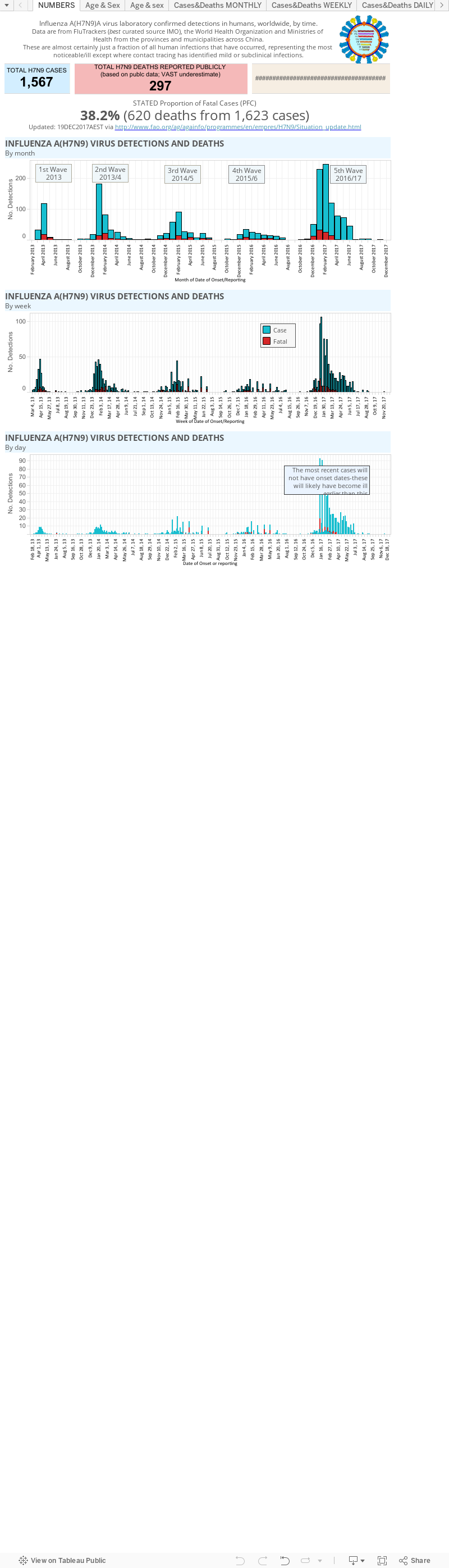
A summary of the monthly, weekly and daily data graphing human avian influenza A(H7N9) virus infections in humans reported from the hotzone, China.
 |
| Daily weekly and monthly H7N9 numbers, taken from the FluTrackers curated line list [1] and the World Health Organization disease outbreak news reports. Click on image to enlarge. |
References...
Friday, 23 December 2016
H7N9:2016 has been the most quiet year to date...
Influenza A(H7N9) virus, or 'H7N9', has had a quiet year when compared to past outbreaks.
All human cases to date have been linked to China. The majority of human cases have had some link with poultry - chickens or ducks - although we do hear of human-to-human transmission, this seems to be limited. H7N9 has been found in poultry from backyard farms and in live poultry markets (LPMs) in China - sometimes in the company of other influenza viruses, like H9N2.[1]
 |
| Cases and deaths each month over the 4 years we have known about human cases of H7N9 infection. Click on image to enlarge. |
Time, and testing data - which China generates lots of but does not seem to enjoy publicly reporting - will tell.
In 2016 - 2 new regions were added for the first time - Tianjin municipality and Liaoning province - both in the north-eastern coastal region of China.
In 2013, no sustained human-to-human transmission had been reported [2] - this remains true up until today.
References...
Friday, 18 September 2015
MERS around the world...
China was the 26th country to host a MERS-CoV infected person, when a 44-year old symptomatic male (onset 21-May-2015) travelled from South Korea, through Hong Kong to Huizhou in Guangdong Province, China on 26-May-2015.[1]

Monday, 4 May 2015
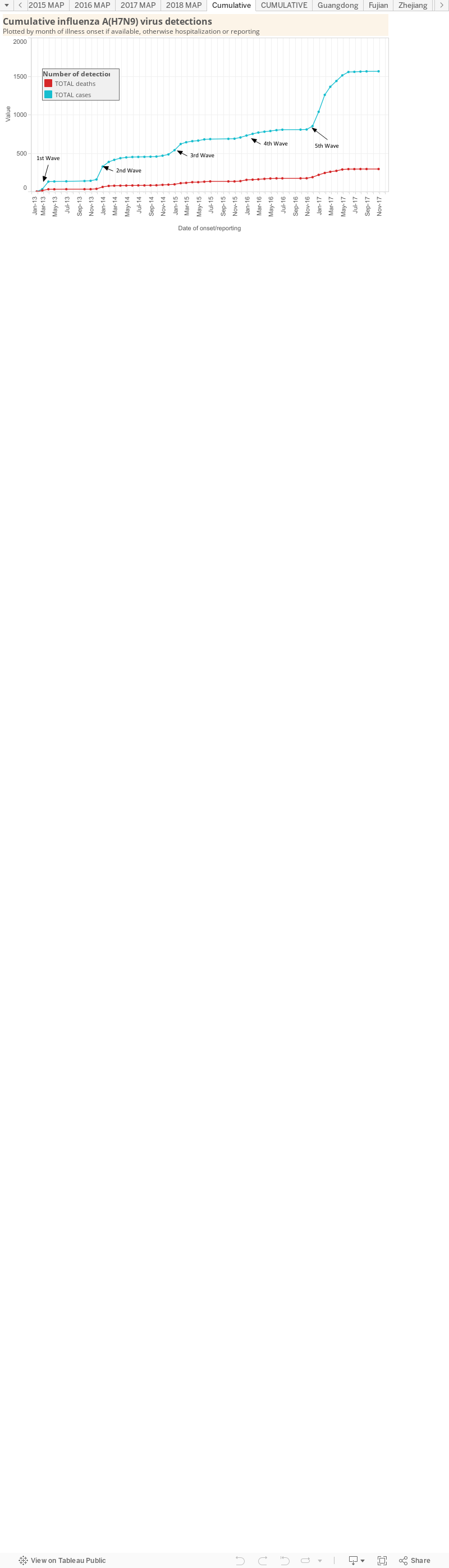
The third outbreak of influenza A(H7N9) virus seems to be over...
 |
| Cumulative curves of reported H7N9 cases and deaths in humans. Click on graph to enlarge. |
If we get into the nitty gritty, as I have below, there are a couple of interesting things to see. First though - let us remember that these are just reported data:
- there may have been some cases that were not reported for whatever political, medical, social or personal reasons - these data are an idea of what happened - look at the rends and don't get hung up on the specific values
- the overwhelming majority of the cases have reported to a healthcare facility with respiratory disease due (presumably) to either infection - we have no idea how many other people have been infected, what proportion were mild or asymptomatic (as I've discussed e.g. here and here, so we know it is possible). It could be half as many again, or 100 or 1,000 times as many.
- these are only cases that have been examined with a laboratory test (as far as we know) - there may have been many other cases of "influenza-like illness" that did not get sampled and tested but were managed under (or not) the assumption that they were influenza of some type, subtype or strain.
Please note-the graphs used here can all be found on my fixed interactive H7N9 page at:http://virologydownunder.blogspot.com.au/2014/11/influenza-ah7n9-virus-detection-numbers.html
The interesting stuff includes:
- For the 2 outbreaks we have continuous data for - 2013-14 and 2014-15, the start of the outbreak seems to be around October/November, with the peak around January/February.
- Outbreak 3 did not seem to reach the heights of the preceding year however, from what we could glean from pretty poor data, the link to poultry exposure was as strong as ever. Perhaps market closures in response to deaths were a little more effective/efficient/wide-ranging in Outbreak #3? Pure speculation
 |
| Click on graphs to enlarge. |
- Most of the cases in 2015 (bottom maps) were on the east coast of China
 |
| Click on map to enlarge |
- Most of the activity in the 3rd outbreak was focussed in Guangdong, Fujian and Zhejiang provinces (the red ones above)
- Xinjiang Uyghur Autonomous region (in the far west) and Guizhou and Hubei provinces joined the list of host regions in Outbreak #3
- Xinjiang joined Guangxi and Jilin provinces (which reporting cases in Outbreak #2) as regions of China that share a border with another country - heralding the movement of this H7N9 variant beyond China's borders possibly into Vietnam, North Korea, or a -stan
 |
| Click on graphs to enlarge. |
Keep an eye out for H7N9 Outbreak #4 - coming to a colder China around November 2015.
But for now, it might be time to hit the FluTrackers line lists (okay, I've had 4 tabs open for ages) and graph the course of another source of concern - H5N1 cases in humans.
Hubei province listed its first H7N9 case in April...some rare detail
Of course reporting does not mean capturing. Reporting has been weak this season. The cases that have shown seem to be just those who were ill enough to visit a Doctor/hospital and get a laboratory test. This is the same story for most infectious agents. We see just the tip of the iceberg, the beginning, the head of the arrow, we only scratch the surface, the glycoprotein on the envelope of the virus as it leaves the...okay, you get the picture.
This year has seen a very disappointing effort by China to provide useful public data that could permit tracking of what has become the annual outbreak of human cases of avian influenza A(H7N9) virus infection.
The human H7N9 case hotzone, at least since we heard about the virus infecting a human in February of 2013, have been on the east coast of China. We currently stand at 659 reported human cases, and over 200 deaths. Very. Roughly.
 |
| Click on image to enlarge. |
I remember fondly a time when there were scads of data on H7N9-related human cases and deaths. Okay, China did over-share on a number of occasions....
 |
| Click on image to enlarge. Story to be found here. |
 |
| Click on image to enlarge. Story to be found here. |
|
| Click on image to enlarge. Story to be found here. |
..but things have changed.
For a comparison take the Kingdom of Saudi Arabia's Ministry of Health and their efforts to provide public data on Middle East respiratory syndrome (MERS) and its coronavirus (MERS-CoV). While there are a few gaping holes in the data set (c'mon guys-fill these in!), there can be as many typos as on this blog (but I'm not a public health Ministry - in case you were wondering) and the data can be intermittent, it represents the best public source of detailed, yet deidentified, human data on an ongoing zoonotic viral emergence. And that's saying something. But congratulations nonetheless!
I'm not including Ebola virus disease data-gathering here - the fact that we have had so much data - despite the initial lack of infrastructure and people trained to collect, collate and report that detail - is a fantastic testament to the efforts of those on the ground in Guinea, Sierra Leone and Liberia.
But this season H7N9 data that have been reported by public health sources have been released in blocks and lack any consistent or useful detail, except the province. Some detail is available when harvested from media reports by the ever assembled FluTrackers team. I rely heavily on their line list (to be found here).
One example of the poor data quality this season, take a look at this text from a recent Disease Outbreak News provided by BigBlue (that's the World Health Organization, or WHO, for those not accustomed to my street groove)...

No-one will be reading that and feel overly informed.
One is left to assume that this is how these data are coming out of China - infrequently and without detail. We regularly see that when better data are provided - and again, I hold up MERS-CoV case descriptions here - they get publicly listed by BigBlue.
And before you head to your keyboard to ask "Why should we have access to these data?"...I will first ask you - why shouldn't we? They are collected and collated internally. They are of interest to epidemiologists, model builders, public health planners and data tinkerers the world over. And it's not as though the details are subsequently released in peer-reviewed publications. They are not.
It's just disappointing.
Thursday, 19 February 2015
Avian influenza H7N9 human infection emerged 2 years ago...

Now - it's another year later.
While we have studied, written, read and learned much, much more about this emerging respiratory virus than we have about the Middle East respiratory syndrome coronavirus - even after its 3 years among us - we are still watching a new outbreak of human H7N9 cases spread across China.
Each year more provinces are added to the list to report human infections - more infections likely go unnoticed, unrecorded and/or unreported. Gaps in the reporting is not unexpected and not unusual.
Each outbreak with its accompanying economic damage, financial losses, human illness and death is because of the desire to maintain a tradition, namely the consumption of freshly extinguished poultry.
We're really good at getting ourselves into pickles. And we seem to be doomed to repeat the patterns, playing catchup and never getting in front of our new and emerging infectious diseases problems. And each time we seem amazed at what we learn, but really, we learn the same thing over, and over and over again. Eventually we'll run out of infectious threats I guess.
Or they'll run out of hosts in which to incubate in and spread from.
Happy Lunar New Year.
Saturday, 3 January 2015
H7N9 outbreak #3 underway?
What better way to start 2015 than a snapdate!! For those who are new to them here on VDU, they were initiated here and defined here as snap updates - posts that don't have lots of detail and chat...although they almost always end up having lots of chat!
This one is an update of the situation of one of the many avian influenza viruses ("bird flus" if you must) around again - avian influenza A(H7N9) virus, or just 'H7N9'.
In Figure 1, I've taken the huge liberty of adding in the start and end dates of the 3 outbreaks of H7N9 to date; and in doing so, I've said that China is in the early stages of one right now. I may well be wrong of course - this is a blog and these are my opinions - but it looks that way to me.
The case numbers for H7N9 in Figure 1 have been above zero for a little while and in particular November looked like a busy month (see weekly and monthly tallies here). Keep in mind that there is also a reporting lag - the time between date of onset (obtained from more detailed World Health Organization data) and the date the case was publicly reported (I rely on FluTrackers line list for these details). That delay can be a month or more on occasion; up to 38-days in late December. I suspect this is because China reports cases to the WHO in batches, something instigated toward the end of the 1st and 2nd outbreaks. So I suspect we will see more cases assigned to December, during reports that come out in January.
But it look like 'tis the season for influenza in humans in China (see figure 2 and the Chinese National Influenza Centre [2]) - and as some of us have discussed on Twitter, this is most probably due to the changes in weather (environmental conditions) which result in sustained viral survival on cough and sneeze-contaminated surfaces and in wet and dry propelled droplets and droplet nuclei; in both man and bird (see Hong Kong avian influenza detection report dates [3]).
That sustained survival may well be all it takes for more of us to pick up an infectious viral dose.
Once the seasonal influenza viruses get a foothold in us, they spread well, causing disease in those who are susceptible and probably a bunch of unnoticed infections in those with previous exposure to that strain plus a healthy immune memory of that intrusion. By "seasonal influenza virus, I mean those that replicate in and circulate efficiently among humans, as opposed to the relatively inefficient avian subtypes.
So stay tuned to H7N9; it's not yet very good at spreading between humans but its established in birds and has been spilling over into humans since at least the beginning of 2013. We know how influenza can deal us a rough hand if the stars and its genetic segments align favourably (for it). Oh, and the continued reliance on fresh chicken obtained from and killed at live poultry markets. The majority of cases have very clearly had contact with poultry as defined by the WHO.
References...
 |
| Figure 1. H7N9 cases by week of onset (or hospitalisation or reporting dates of the preferred onset date was not made public). Click on image to enlarge. |
In Figure 1, I've taken the huge liberty of adding in the start and end dates of the 3 outbreaks of H7N9 to date; and in doing so, I've said that China is in the early stages of one right now. I may well be wrong of course - this is a blog and these are my opinions - but it looks that way to me.
 |
| Figure 2. China's northern laboratory network influenza surveillance data up to Week 51 of 2014. [1]. Click on image to enlarge. |
But it look like 'tis the season for influenza in humans in China (see figure 2 and the Chinese National Influenza Centre [2]) - and as some of us have discussed on Twitter, this is most probably due to the changes in weather (environmental conditions) which result in sustained viral survival on cough and sneeze-contaminated surfaces and in wet and dry propelled droplets and droplet nuclei; in both man and bird (see Hong Kong avian influenza detection report dates [3]).
That sustained survival may well be all it takes for more of us to pick up an infectious viral dose.
Once the seasonal influenza viruses get a foothold in us, they spread well, causing disease in those who are susceptible and probably a bunch of unnoticed infections in those with previous exposure to that strain plus a healthy immune memory of that intrusion. By "seasonal influenza virus, I mean those that replicate in and circulate efficiently among humans, as opposed to the relatively inefficient avian subtypes.
So stay tuned to H7N9; it's not yet very good at spreading between humans but its established in birds and has been spilling over into humans since at least the beginning of 2013. We know how influenza can deal us a rough hand if the stars and its genetic segments align favourably (for it). Oh, and the continued reliance on fresh chicken obtained from and killed at live poultry markets. The majority of cases have very clearly had contact with poultry as defined by the WHO.
References...
- http://www.cnic.org.cn/eng/show.php?contentid=738
- http://www.cnic.org.cn/eng/surveillance.php
- http://www.chp.gov.hk/files/pdf/global_statistics_avian_influenza_e.pdf
Sunday, 2 November 2014
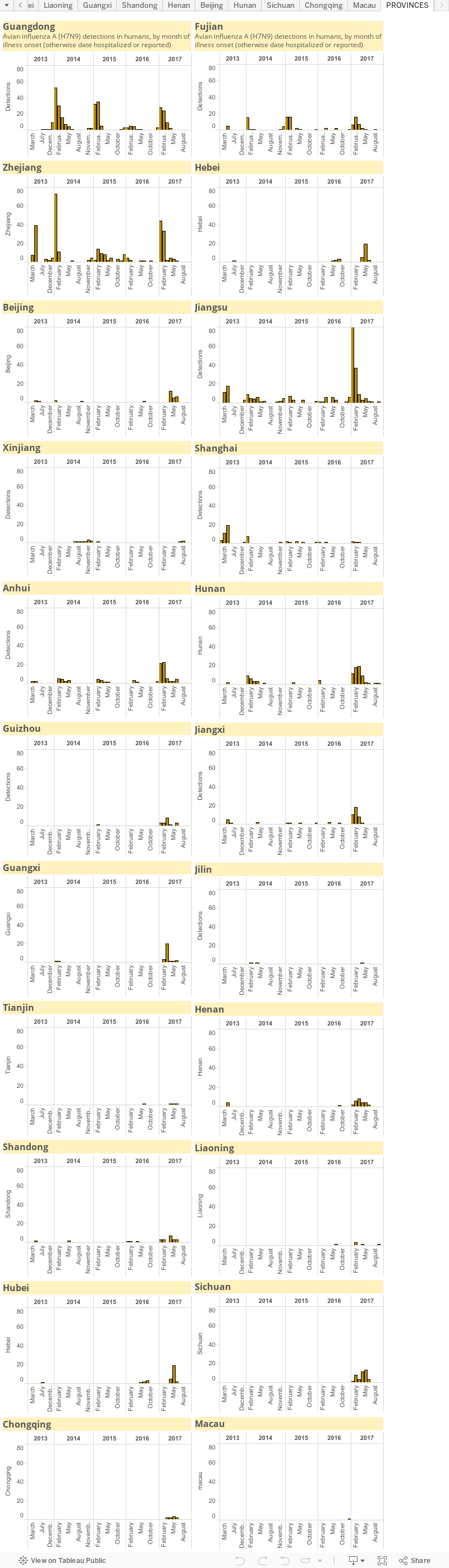
Influenza A(H7N9) virus: detection numbers and graphs...
This is a static page that houses my graphs of influenza A(H7N9) virus ("H7N9") numbers produced by the various Ministries of Health for the provinces and municipalities of China, Hong Kong's Centre for Health Protection (CHP) the World Health Organization and FluTrackers.
Please be aware that these numbers are in flux during the winter epidemic. They are a guide only.
There is also an accompanying map page which for now is located here.
Please be aware that these numbers are in flux during the winter epidemic. They are a guide only.
There is also an accompanying map page which for now is located here.
Reminders:
- The graphs above, as with all on VDU, are made for general interest only. They are also freely available for anyone's use, just cite the page and me please. The data can be downloaded by clicking on the "Download" link at the bottom-right of each dashboard. It may be that I have misinterpreted the language in the reports (sometimes a little tricky to wade through) or miscalculated some totals based on the way data have been presented.
- In any outbreak, epidemic or pandemic caused by a know or emerging pathogen, the numbers presented publicly, and used in these graphs, are expected to represent only a fraction of all the cases that have and are occurring. This is just the nature of the imperfect biological'ness of these events.
- I am only able to plot what is publicly available-you could do this too. No secret associations or back-room deals provide me with these data.
Sunday, 20 July 2014
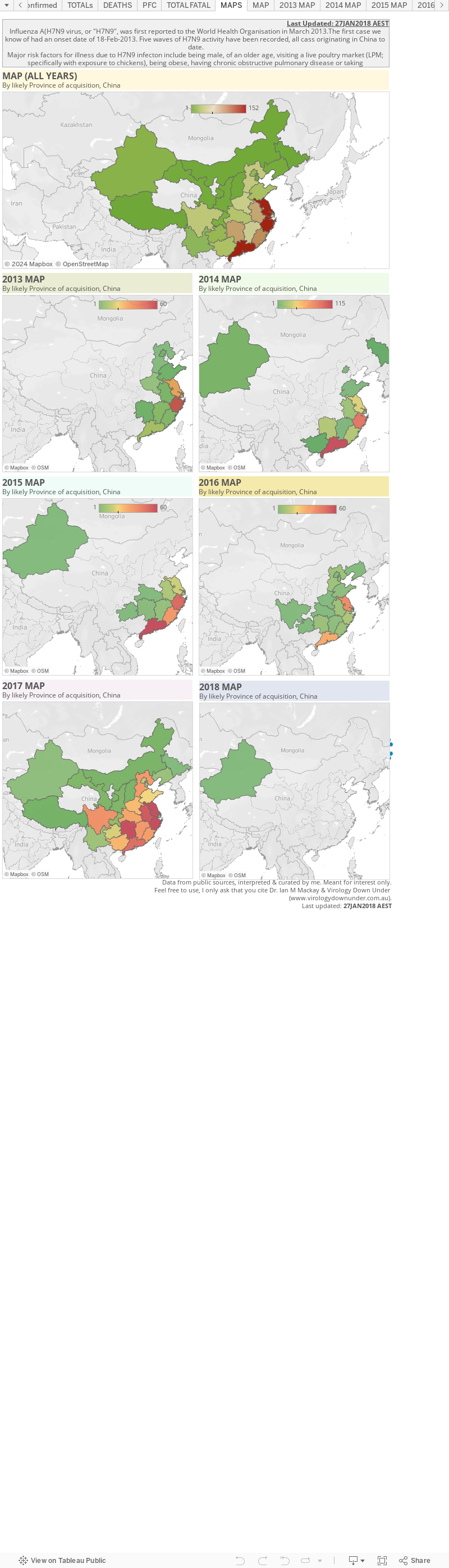
Now for something (not so) completely different: H7N9 maps...
Now it's time to mess around with influenza A(H7N9) virus mapping using Tableau.
I've (only just) realised the my esteemed peer, Shane Granger has been using Tableau to do this for ages (see here), and that this will be duplicating his excellent work. So I'll try my best to consciously differentiate my maps from his - but there's only so far you can go with that and there will be overlap.
The page below is a very early first play with H7N9. It's just detections broken across 2013 and 2014, by province most likely to have been the source of the infections (as far as I can tell) in mainland China.
If I can master this I'll try and add more details in the future. For now, these numbers a a little out of date but he trends are similar. This charts 449/452 detections.
Monday, 28 April 2014
H7N9 Snapdate: some quick charts...
 |
| Click on image to enlarge. |
 |
| Click on image to enlarge. |
Guangdong is where H7N9 is still most active and it is this province that is the source of the continued cases trickling off Wave 2's peak.
Most H7N9 cases overall have been in Zhejiang and Guangdong provinces but lately, post-peak of Wave 2, there has been continued activity in Jiangsu province including a recent healthcare worker with no mention of "contact with poultry"; the absence of which stands out in World Health Organisation (WHO) reports because most cases are followed by affirmation of that phrase.
 |
| Click on image to enlarge. |
In the survival chart above we see that most of the fatal cases, shown in red, are defined by an older age. Unfortunately, a lot more of the fatalities have been reported through the media without identifying details (48 of 128), than have come through official Chinese channels and out via the WHO. This lack of detail makes it impossible to clearly link a lot of the deaths to the case announcements. Only the custodians of these data know what this chart should really look like. NB: Since making the chart this morning I've found a handful more case details at FluTrackers, but public detail on fatal cases remains the weakest of any of the H7N9 data.
 |
| Click on image to enlarge. |
We can see in the weekly chart on the right that the two H7N9 waves differed in timing, the width of their bases (more cases in Wave 2) as well as how "tight" their peaks were. Wave 2 has tailed off, but continues to spit out cases, while Wave 1 comprised both a steep climb and a steep decline in human cases.
 |
| Click on image to enlarge. |
If we zoom in on Wave 2 we can see by looking at cases per day in the chart on the left, that between 0-4 illness onsets per day are being reported, as they have been since late Feb-2014.
Is this the legacy of those regions whose live bird markets remained open or were only shut temporarily for disinfecting and restocking? Those regions with markets that were shut for much longer, or for good, do not seem to have contributed much to the continuing leak of H7N9 infections despite being key contributors during the peak periods before markets were closed.
Is this the legacy of those regions whose live bird markets remained open or were only shut temporarily for disinfecting and restocking? Those regions with markets that were shut for much longer, or for good, do not seem to have contributed much to the continuing leak of H7N9 infections despite being key contributors during the peak periods before markets were closed.
 |
| Click on image to enlarge. |
In zooming in on Wave 2's cases by week, but this time based on the region of likely acquisition of infection, we see that Guangdong province (brown line) has been the most consistent contributor of human H7N9 infections both late during the 2nd of the Wave 2 peaks, but also after the peak's decline almost everywhere else in south-east China. There was considerable publicised unwillingness from poultry producers to permanently close markets in this Province, a location with a major role in the nations poultry production. And so this little experiment incubates further and I have little doubt we will see the impact of that unwilingness late in 2014.
 |
| Click on image to enlarge. |
As noted above, public H7N9 death data do not allow good linkage with official case announcement data for about 48 fatalities, so my second-last chart tonight uses both public and media-release numbers to try and illustrate how the proportion of fatal cases (PFC) has changed across both Waves. The PFC seems to be holding fairly steady now between 17% and 30% (depending on source of numbers).
And finally we see that the age and sex distribution across all cases (both Waves) is skewed to wards older males. Same as usual. If we look at this distribution (ran out of time to put in here) for the fatal cases, it is much more tightly grouped around the >60-year olds, but that females appear to dominate males in deaths during Wave 2, whereas it was the other way around for Wave 1.
 |
| Click on image to enlarge. |
Saturday, 15 March 2014
H7N9: the dotted lines that make sense of things...[CORRECTED]
 |
| Click on image to enlarge. |
 |
| Click on image to enlarge. |
Instead of the precipitous decline we saw back in 2013, we're seeing a drop down to ~10 cases per day, but then a slower decline the rest of the way. Is this because we started human cases from more sites this time around?; because markets took longer to close after the cases numbers began to climb?; is it related to markets being closed at different times, in different ways, in different locales? Who knows?
 |
| Cases by region acquired, per week, with different regions highlighted by coloured lines and the total case number in the background (grey). Wave 1 and Wave 2.Click on image to enlarge. |
Dr Katherine Arden suggested I have a look at what's happening in each Province or Municipality and see whether any particular place can shoulder the blame for the shouldering. And that does seem to be the case if you look at the adjacent chart. Guangdong province seems to be the major culprit contributing to the shoulder effect.
 |
| Cases by region acquired, per week, with different regions highlighted by coloured lines and the total case number in the background (grey). Wave 2 only. Click on image to enlarge. |
It's all speculation beyond the data we can actually plot.
Tuesday, 11 March 2014
H7N9 and human infections: not just a paltry matter

But before I note the good bits of their study, this paper is one of importance for adding a lot to our understanding of how H7N9 is jumping to people from poultry/live bird/wet markets. It's also a great reference if you want to better understand influenza and birds overall.
We've read much about human cases of this avian virus having had contact with "poultry" and bird markets and from that we assume that poultry are the pool in which H7N9 is swimming (reservoir); but where did the poultry get it from (source/natural host)? Its also interesting to note that:
- Very few poultry test positive for the virus; may simply be because of a test-based problem including using a test that is insensitive or sampling from the wrong end of the bird (testing the cloaca instead of throat as was discussed ).
- Looking at the sequences of the H7N9 gene segments suggested that wild birds (bramblings) played a part in the evolution of the virus currently infecting humans in south east China (4)
- Pigeons have tested H7N9-positive (2,3)
The authors of this latest article note the songbirds are common pets and so are in close contact with their owners. In the wild, such birds are likely to interact with farm birds.
Some key findings of this new study are:
- A/Anhui/1/2013 was the strain used for H7N9 studies; it was an isolate from a human but early on and similar to bird (6) strains. H5N1 (A/Vietnam/1203/05) and H3N8 (A/songbird/Hong Kong/SV102/2001) were also used for comparisons
- Zebra finches (Taeniopygia guttata), society finches (Lonchura striata domestica), parakeets (Melopsittacus undulates) and wild-caught house sparrows (Passer domesticus) were kept isolated for 3-weeks prior to experiments to let any naturally acquired infections burn out; none of the birds had antibodies suggestive of previous infection by an H3, H5, H7 influenza A virus (is that low prevalence normal?)
- Birds were inoculated with 105 50% egg infectious doses of virus via nose, eye and mouth (that should do it) and then put in the same cages, sharing water and food, with uninfected birds
- Virus testing was by growth using eggs (3/sample collected)
- All inoculated birds shed virus (only) from the oropharynx; finches shed most virus at 2-days post inoculation (dpi); parakeet viral shedding could be detected by culture for 2-days and from finches for 6-days
- Communal water troughs yielded culturable virus; zebra finches shed most virus but water consumption and drinking frequency were not measured and may have differed among bird species
- No virus could be detected at 8dpi
- 1 sparrow showed signs of disease and died; 1 zebra finch died without signs of disease (some loss of appetite)
- Birds in contact with infected birds did not often acquire infection but when they did, they also shed via the oropharynx
- In finches that were killed for organ testing, virus was mostly found in the trachea; some was isolated from brain and eye tissues of 1 society finch and in the small and large intestine and a high titre form the lung of the other. H7N9 was grown from the brain, lung and intestines of zebra finch. H7N9 was not found in surviving sparrow organ tissues; in the dead sparrow, some H7N9 was found only in the lungs
- Nearly all inoculated birds mounted a specific antibody response to H7N9 after inoculation. Among the contact birds, 3/3 zebra finches, 1/3 society finches (had highest amount of antibody), 2/3 sparrows and 0/2 parakeets mounted a response to virus indicating that they were infected but did not show signs of illness nor did they shed virus, at least at culture-detectable levels
So songbirds, can be infected by a human H7N9 isolate, they can shed the virus into the environment, they can die (presumably) due to H7N9 infection, 33-66% of songbirds in contact with an experimentally infected songbird acquire aninfection (even if it was rare to grow infectious virus from that contact which may be a sensitivity issue of the testing) and they mount an immune response to the infection. Given that H7N9 acquisition seems to be a numbers among humans, this degree of transmission among birds fits well.
It was also very interesting that water troughs often contained lots of shed H7N9 virus. This is not new in the world of influenza virus but its nice to cross the 't' for H7N9. The authors note that studies of transmission from songbirds to poultry via communal water sources are yet to be conducted. Seems like this would be a very important piece of the influenza puzzle and with broad application to future outbreaks and seasonality in birds via migration.

Add to all of this that songbirds are present in many markets (thanks to @Crof, @Laurie_Garrett and @debmackenzie1 for supporting info via Twitter this morning; also see refs from Jones et al (1) and a related story from New Scientist (8)) and that older males are a key demographic for keeping songbirds as luck-enticing (and cute) pets. They are also over-represented among H7N9 cases (see adjacent chart). A good fit.
Another recent study (7) shows chickens and quail (a possible amplification host helping bridge the gap between wild birds and poultry) shed a lot of H7N9 after experimental inoculation via an intranasal route. Also, quail (but not pigeons) shed enough H7N9, for long enough, to pass it along to their contacts; less so ducks.
None of this may be very new to some of you, but it's nice to see data that confirm it all for H7N9. After all, as someone reminded me recently on Twitter, data is just how we roll.
It's not hard to see the circle of life for influenza viruses is there for the interpreting and that non-poultry birds may be important intermediate hosts of H7N9 and act as a source of other influenza A viruses.
Just how many human cases of H7N9 are acquired by songbirds vs chickens/ducks/quail/geese remains unquantified....perhaps unquantifiable.
References...
- Possible Role of Songbirds and Parakeets in Transmission of Influenza A(H7N9) Virus to humans.
http://wwwnc.cdc.gov/eid/article/20/3/pdfs/13-1271.pdf - A summary of Influenza A(H7N9) virus findings in birds and humans
http://virologydownunder.blogspot.com.au/2013/10/a-summary-of-influenza-ah7n9-virus.html - Emergence of avian influenza A(H7N9) virus causing severe human illness - China, February-April 2013.
http://www.cdc.gov/mmwr/preview/mmwrhtml/mm6218a6.htm - Sunny summer or birds on the wing?
http://virologydownunder.blogspot.com.au/2013/05/sunny-summer-or-birds-on-wing.html - Origin and diversity of novel avian influenza A H7N9 viruses causing human infection: phylogenetic, structural, and coalescent analyses
http://press.thelancet.com/H7N9genetics.pdf - Genetic analysis of novel avian A(H7N9) influenza viruses isolated from patients in China, February to April 2013http://www.eurosurveillance.org/ViewArticle.aspx?ArticleId=20453
- Role of poultry in spread of novel H7N9 influenza virus in Chinahttp://jvi.asm.org/content/early/2014/02/20/JVI.03689-13.long
- Budgies may be behind latest spread of H7N9 bird flu
http://www.newscientist.com/article/mg22129542.000-budgies-may-be-behind-latest-spread-of-h7n9-bird-flu.html#.Ux5CnvmSx8F
Subscribe to:
Posts (Atom)