Friday, 3 October 2014

The richer end of the world finds creative ways to spread Ebola virus... [UPDATED x2]

ProMED MODERATOR JW SUGGESTED SOME ASPECT OF THIS WAS A HOAX (HEADLINE). 
http://promedmail.org/direct.php?id=20141004.2832236

Amendment: It has been quite correctly noted below, by the moderator in a personal communication (or 4) and by others, that this image was posted or taken from a Dallas/Fort Worth TV (WFAA) station's chopper on 2-Oct. The infected man vomited 28-Sept, as he headed to hospital. 
So let's say about 72-hours had passed while the vomit sat outside on a non-ceramic/steel surface (these are used in controlled lab experiments to show virus stability-perfect world stuff) through multiple cycles of Texan day/night, high/low temperatures. Okay. The power-washing process is thus extremely unlikely to have generated infectious droplets. Risky and ridiculously long period to leave potentially Ebola-laden vomit out in the open of course, but extremely unlikely to be a source of infection during the power-spraying (water-blasting/gurneying). Apologies for adding to the fear-mongering.  -IanM

This from a Tweet sent to me by @LonnieRhea thanks) 

So far the Dallas Ebola virus disease case has been a great learning experience for the United States. 

It really does serve to highlight that humans are what make virus outbreaks...become outbreaks. 

Viruses are nothing without us. And we are so eager to oblige in spreading them around.

Hopefully the virus in that vomit had been inactivated by heat, or the nature of the surface it was on or by drying out before being stirred up by a high pressure water blaster. And hopefully they sterilized their shoes and clothes and...sigh.

It's what falls out of the aerosol that matters....

v2 031014
"Aerosol" is a messy word. It means different things to different people. So does "airborne".

What's in an aerosol?
Here we're talking about a mixture of different sized stuff. Think  of the size range in a handful the sand from a shelly beach.

A cough/sneeze includes big, wet, heavy propelled droplets that quickly fall to the ground or hit your windscreen (hate it when that happens) or your friend's face (they hate it when that happens) down to dried or gel-like "droplet nuclei" that can float in the air for hours, travelling where the wind blows them; and every size in between.


I've also talked about this before, here.

The public rightly get confused about aerosols. And science and physics and medicine have their own defined meanings - sometimes at odds with each other - that may well be out of step with what the public think.

I do wish the the big public health entities would settle on some definitions for these and other words. It would make everyone's life a lot easier.

Direct contact.

When we talk about "direct contact" and Ebola virus transmission, we do include the bigger wetter heavier droplets that might be propelled from of a sick person during vomiting, or coughing as a risk for transmitting virus. 

Even though that is not physical direct contact, and even though the droplets travel across a gap between people - through the air - it is still a direct line from person A (red in the graphic below) to B (blue). If B is too far away, then those droplets fall to the ground before they hit B. The droplets may remain infectious on the ground. That depends on temperature, humidity, surface type and the type and amount of virus.

The airborne route.

Even though it involves a short period of travel through the air, coughing wet droplets directly onto someone's mucous membranes is not an airborne thing. The term "airborne" is reserved for floaty clouds of droplet nuclei. In humans droplet nuclei have not, to the very best of our knowledge and observations and tests, been found to contain doses of Ebola virus that cause disease in humans. Too little virus coughed into the cloud perhaps or too little that survives..it's not known why, but it is pretty clear that in households where a case of Ebola virus disease was residing, only those household members who had direct contact developed disease, and those that breathed the same air but did not have direct contact, did not develop disease. 

While Ebola viruses may be present in floaty clouds of droplet nuclei, or forced to be in a floaty clouds of droplet nuclei under lab conditions with lab viruses at lab virus concentrations, a floaty cloud of droplet nuclei has not been shown to act as a source of acquisition for Ebola virus and resulting disease among humans. Sorry, did I just repeat myself?

Rest in peace.

Please don't say Reston ebolavirus or the Hot Zone. That (by all accounts riveting) book was not a scientific work, it is a dramatized work and the language is colourful and emotive and scary. The Reston ebolavirus event in non-human primates was never proven to be airborne.

Lastly and most recently, an airborne route was not found to play any role in causing disease or infection when Ebola virus infected and uninfected non-human primates were caged near each other. I've written about this and other non-human primate studies here.

To summarize.

Healthcare workers wear face protection(masks and goggles) to prevent their eyes and mouth being hit by wet droplets of virus-laden body fluids while they are in close contact with ill Ebola virus diseases patients. The also wear all-over gowns so that they don't have to sterilize their clothes between each room they move between. Use of protective equipment doesn't need to convey confusing messages about the type of route Ebola virus uses to spread but it's just lacking in enough public discussion via forums the public attend/view. Knowledge is a bit like vaccination - when coverage reaches a certain level, the community is safe (or it's understanding is complete anyway).

And why wouldn't healthcare workers protect themselves from ill patient fluids-however they come into contact with them? For a healthcare worker, body fluids from ill people they are in close and often prolonged contact with, should generally be considered infectious. This is the case whether we're talking about Ebola virus disease, HIV, measles, influenza or something else. Some of those are caused by airborne viruses, some, like Ebola virus and HIV, not.

Below is my latest attempt at trying to make all those words into a picture. 

If you have ways that can help me make this even simpler - please pass them along (thanks @chrisfharvey).


Wednesday, 1 October 2014

Australia's response to Ebola virus disease in West Africa: is too little enough?

Written by Dr. Katherine E. Arden and Dr. Ian M. Mackay

The outbreak of Ebola virus disease (EVD) began in December 2013 in Guinea. It spread to Sierra Leone, Liberia, Nigeria and Senegal. The last two countries on that list were able to contain EVD because they had functioning healthcare systems with doctors and nurses, protective equipment and hospitals that work. The United States of America (US) had its first imported cases arrive 30th September. To some extent, these final three countries could “see it coming”. None of these preparations were in place or possible in Guinea, Sierra Leone or Liberia. They are hosting the largest EVD outbreak in recorded history.

Help wanted.

On August 8th, this epidemic was labelled by the World Health Organization (WHO) as a Public Health Emergency of International Concern (PHEIC). The time for help to arrive and be effective is now. Before 70% of the predicted hundreds of thousands of cases to become infected by this variant of Zaire ebolavirus die. Money is required, and Australia has now donated eight million dollars. Three weeks ago a one billion dollar cost was forecast; a ten-fold increase in a month.[6] But what is really needed urgently are people. People to create beds through the building of treatment facilities, people to staff those facilities to provide the best supportive care possible under the circumstances, people to be trained to safely care for the sick and dying and to trains others, people to track cases, people to help educate family members in how to care for a sick loved one, people to help the psychologically traumatised try and deal with the loss of their children, their parents, siblings, cousins and friends. People are what’s needed. The United Nations (UN), which includes Australia, unanimously adopted Resolution 2177(2014) on the 18th of September within which it provided some instructions to member states. One of those is:
“8.   Urges Member States, as well as bilateral partners and multilateral organizations, including the AU, ECOWAS, and European Union, to mobilize and provide immediately technical expertise and additional medical capacity, including for rapid diagnosis and training of health workers at the national and international level, to the affected countries, and those providing assistance to the affected countries, and to continue to exchange expertise, lessons learned and best practices, as well as to maximize synergies to respond effectively and immediately to the Ebola outbreak, to provide essential resources, supplies and coordinated assistance to the affected countries and implementing partners and calls on all relevant actors to cooperate closely with the Secretary-General on response assistance efforts;”
Australian Prime Minster Tony Abbott noted to the UN that “We were one of the first countries to arrive with help in Japan after the 2011 earthquake; and in the Philippines after the 2013 typhoon.”[5] Why haven’t we arrived in West Africa yet?

Australian Foreign Minister Julie Bishop said on 29th of September, that Australia has not been specifically asked by the WHO to provide healthcare professionals to help.[2] But we a member state of the UN and the WHO is the United Nations’ public health arm. In that article the Minister was quoted as saying that we were unable to repatriate infected Australians safely, with this being an integral reason behind our limited response to the Resolution. 

Lightbulb Moment.

Until the Foreign Minister’s comment, the importance of the US concept of building a smaller, healthcare worker-specific treatment facility in West Africa was perhaps lost on the two of us. Such an elitist construction looked bad to the people of the region and, without sufficient background, to others outside it. However, if such a facility reduces or removes the need to spend tens to hundreds of thousands of dollars per person [3] to send them home for treatment, then it seems like a brilliant plan. That money could be better spent, and the added healthcare should help attract more international healthcare workers to the region. In fact, why doesn’t Australia assemble the components and airlift a similar facility, flat-packed, to one of the regions in need of our help? This could be done in a jiffy with Australian military precision. Once built, this facility may well remove the need to repatriate any Australian healthcare professional who may get infected. This may be a better and faster solution than us trying to use British or US facilities or doing a deal with them to evacuate our people. 

A good global citizen.

Prime Minister Abbott noted “That is what you’d expect from a country such as Australia which always wants to be the best global citizen”.[4] We are currently not being the best global citizens that we could be.

Let’s not hide behind excuses. Do we want our national character to be stingy and afraid or strong, generous and willing to give a fair go to those in need? We pride ourselves on our innovative character. We can use this to find a way around problems, real or perceived, in answering the UN’s call for help. Help we are able to provide. 

It would be difficult, heartbreaking, hard work. We know that Aussies are more than capable of doing that. In fact, the more people on the ground, helping, the easier the burden would be. There may be some problems, and it would be naive to expect otherwise. That is why the UN has called for help. If there were no risk, and everything was simple and easy, this situation would not exist in the first place. Should a healthcare worker fall ill, there is a high chance they would die. A tragedy for their family, friends and workmates. And let’s be real, there are more risks to healthcare workers than just Ebola virus disease in these countries. There are scared and sometimes violent villagers, as well as plenty of other diseases like malaria to contend with. 

The lucky country.

Australians have the wealth, the innovation, the ability, the equipment and the skills in our excellent health care workers, engineers, keepers of the peace and logistical organisers. We have the willing volunteers. 

How much of our global village has to burn down before we do more than buy a bucket? Why must we focus on security threats, economic impact, terrorism and political stability when it is the humanitarian aspects that should our priority? Yes, this seems to be the only way to communicate with politicians. But is the way forward for us as a nation that something has to be become a direct threat to us and our lucky country way of life before we lend a hand? Is that who we want to be? Can we not expect a more human perspective from our leaders and ourselves? We think we can. 

References

  1. http://www.who.int/mediacentre/news/statements/2014/ebola-20140808/en/
  2. http://www.theguardian.com/world/2014/sep/29/australia-cannot-bring-health-workers-home-from-african-ebola-zones
  3. http://www.cidrap.umn.edu/news-perspective/2014/09/very-few-aircraft-equipped-evacuate-ebola-patients
  4. http://www.news.com.au/national/medecins-sans-frontieres-slams-australias-ebola-response/story-fncynjr2-1227061379772
  5. http://www.pm.gov.au/media/2014-09-25/address-united-nations-general-assembly-united-nations-new-york
  6. http://www.unmultimedia.org/radio/english/2014/09/one-billion-dollars-needed-to-contain-ebola-outbreak/#.VCv3i_na6-0


The United States of America is the 6th country to host a 2014 West African Ebola virus variant..

v4 08102014 07:00am AEST
First thing...
CALM DOWN!

This (announced 30-Sept) is the first case of Ebola virus infection to arrive in the United States that was not deliberately flown in. Its not the first viral haemorrhagic fever case though (1 case of Marburg virus disease and at least 4 Lassa virus infections and the Reston ebolavirus outbreak among imported animals[3,5]), and none of the earlier infections resulted in secondary transmission among humans; no-one else got infected from by the case.[4]
Countries that have hosted people infected
with the Ebola virus variant causing the
& 2014 West African Ebola virus
disease epidemic.
Click on image to enlarge.

The male is in critical condition.
When he flew from Liberia to the United States (finally arriving in Dallas,Texas). The man was not showing signs of disease when leaving Liberia or on the plane or immediately after arriving.[6]

This means that the man was not infectious - he could not spread it to fellow travellers or airport workers - because it is well known that disease in another does not develop due to virus being shed before disease is obvious in the infected person.

Briefly[1,2]:
  • 19th: Departed Liberia, checked and found to be symptom-free
  • 20th: Arrived in Dallas, US (Brussels to Washington on United Airlines 951, then to Dallas Fort Worth on 822 [7])
  • 24th: Started to develop symptoms
  • 26th: Initially sought care for fever and abdominal pain (not vomiting). Sent home with antibiotics.[8]
  • 28th: Admitted to Texas Health Presbyterian hospital in Dallas, Texas. Vomited as leaving home to get into ambulance.
  • 30th: Texas public health laboratory found Ebola virus this morning of 30th Sept. CDC received samples, tested and confirmed as Ebola virus disease
  • 1st Oct: WHO announced case
  • Patient is ill and is under intensive care

US family and community contacts (a "handful") are known or being traced and will be under observation/monitoring for 21-days (~21-Oct) for fever. Will any become positive for Ebola virus? Perhaps. I look to Port Harcourt (Nigeria) for some comfort. There were around 60 "high risk" contacts of there and they did not all become ill.

The man identified his country of recent origin, Liberia-the country carrying more cases of Ebola virus disease than any other in history, to a triage nurse on the 26th when he first reported to the Texas Health Presbyterian Hospital. That the information was not passed along sufficiently.[7] While the signs and symptoms were non-specific-all sorts of infectious agents could cause fever and gut issues-the travel history should have been a very important red flag. 

He was sent home with antibiotics. Many acute febrile illnesses are viral  in nature, and antibiotics do not treat viral infections, just bacterial ones but do a great job at helping out antibiotic resistance. Sigh.

So now we have evidence that supports all those talking heads (me included) who noted that it was possible for sporadic cases of EVD to be imported into countries outside of those in West Africa (Guinea, Liberia, Sierra Leone, Nigeria, Senegal). It also, sadly, shows how human infectious disease are - literally by infecting us and using us to cough, vomit and bleed the bug onto to another person, but also figuratively in the roles we play in helping that spread to happen.

Soon, I very much believe, we will also have evidence that in richer countries with functioning healthcare systems, a good knowledge of what is needed to contain virus infections spread by all possible routes, stocks of the necessary personal protective equipment needed to protect healthcare workers from nosocomial infections and the training to use those stocks...that even when unexpected Ebola virus disease cases arrive or incubate and emerge, they will not result in outbreaks.

References...
  1. https://www.youtube.com/watch?v=6Bxencye1cg&feature=youtu.be
  2. http://www.nytimes.com/2014/10/01/health/airline-passenger-with-ebola-is-under-treatment-in-dallas.html?partner=rss&emc=rss&smid=tw-nytimes
  3. http://scienceblogs.com/aetiology/2014/08/02/ebola-is-already-in-the-united-states/.
  4. http://blogs.scientificamerican.com/molecules-to-medicine/2014/09/30/ebola-in-usno-need-to-panic/?WT.mc_id=SA_sharetool_Twitter
  5. http://www.cdc.gov/media/releases/2014/s930-ebola-confirmed-case.html
  6. http://news.sciencemag.org/health/2014/09/one-more-ebola-question-dr-frieden-answers-journalists-would-have-first-u-s-case?rss=1
  7. http://www.usatoday.com/story/news/nation/2014/10/01/hospital-ebola-patient/16527143/
  8. http://www.usatoday.com/story/news/nation/2014/10/01/texas-ebola-patient/16525649/

Monday, 29 September 2014

The numbers are underestimates...

Ebola virus numbers.

Sorry but D'uh - yes the numbers during the Ebola virus disease (EVD) outbreak happening since December in Guinea then progressing to Sierra Leone, Liberia, Nigeria and Senegal....are an underestimate. 

Of course they are! 

How could they possibly not be?

Have you not watched a single documentary or news video detailing how heartbreakingly difficult it is to visit and help the people of West Africa, to characterize and gather those case numbers, to take, transport and test samples?

The suspect cases are an underestimate. 
The probable cases are an under-estimate. 
The fatal cases are an under-estimate. 

The only thing that is spot on is the laboratory confirmation numbers, because they are what they were when someone wrote them down having had some semblance of control over the steps to acquire them. 

But let's put that underestimation into context. 

"The tip of the iceberg"
Image originally provided by Gregory Haertl, WHO.
Click to enlarge
Influenza case numbers each year are also an under-estimate. 

In fact, some of those, the subtyping numbers, are deliberately so because it's too expensive and wasteful to subtype every single laboratory confirmed case - so a sample of cases are tested and that is assumed to reflect the subtype distribution for that region during that period. 

But seasonal influenza case numbers as a whole are a huge underestimate. Influenza does not drive everyone to a general practitioner nor to a hospital. Some infections with influenza virus don't even produce noticeable symptoms at all. They are still infections. They just don't get counted. So influenza A virus, possibly the most tracked of any respiratory virus, is underestimates. And that's okay. 

Well, measles too, in the respiratory virus department. 

The latest big bad is the species D enterovirus 68 (EV-D68). But the paltry few detections of it (identified by genotyping) that have reported across the United States are likely a monstrous underestimate. In fact we have very little idea of a normal denominator for EV-D68 detections so it's hard to even know if 2014 is seeing all that big a change in its spread and distribution. Usually the enteroviruses (includes rhinoviruses) cause common cold-like illnesses and only get sought out in the great detail from a research point of view.

Middle East respiratory syndrome coronavirus (MERS-CoV) cases or the emerging influenza A(H7N9) virus cases are all underestimated as well. 

The population of your state or country is an underestimate too you know?

This is because we cannot capture every single case of infection, or person, at once. 

So the next time you are about to say "the WHO numbers are an underestimate" as if that is a revelation or an unexpectedly horrible thing you can also lay at their doorstep - please just don't. It's not smart, new or unusual.

You might as well say the world is round; underestimation of infection numbers is just that well established a fact. It's just by how much, and frankly that doesn't even matter too much because the trends can usually be easily seen, or quickly extrapolated.

Perhaps you did not know all that before. But if you have read to here, you do now.

The control gap...

This post has been moved to the new Virology Down Under platform on WordPress.

You can get to this specific post by clicking on the link below...

https://virologydownunder.com/i-have-a-theory/

Please adjust your bookmarks.

Apologies for any inconvenience.

Friday, 26 September 2014

MERS-CoV data request: A response from the Ministry of Health

Four days after I posted a blog requesting missing data on retrospective Middle East respiratory syndrome coronavirus (MERS-CoV) detections and deaths, I received a response. 

Dr Anees Sindi, Deputy Commander of the Command and Control Centrer, Ministry of Health, Saudi Arabia replied. With his permission, I have reproduced his reply below.
______________

Sent: Tuesday, 23 September 2014 6:36 PM
To: Ian M Mackay
Subject: Re: your request for missing data on retrospective MERS-CoV detections

Dear Dr. Mackay,

I’m writing in response to your blog posting entitled “A request for missing data on retrospective MERS-CoV detections.”

Thank you for acknowledging the steps that the Ministry of Health’s Command & Control Center has taken to ensure members of the public -- including researchers around the world -- have access to real-time information about MERS-CoV cases in the Kingdom of Saudi Arabia.

These daily postings are a small step on our journey toward full transparency. We want scientists to have access to the data they need to produce meaningful publications that advance our understanding of this disease for the benefit of mankind.

With that in mind, I am happy to inform you that the Ministry of Health is in the process of preparing additional data for public release. I will follow up with you once we have a confirmed release date.

Collaboration with the international research community is a key pillar of our work. In addition to sponsoring more than 30 research projects focused on MERS-CoV, the Ministry of Health has opened its doors to academics and experts from the World Health Organization and U.S. Centers for Disease Control & Prevention. MOH shares more data with the WHO than is required under the International Health Regulations, and we stand ready to support other scientists with an interest in better understanding coronavirus.

Thank you again for your interest in our work.


Best Regards,

Dr. Anees A. Sindi
Deputy Commander
Command and Control Center, Ministry of Health
Saudi Arabia


______________

This is fantastic news and I am very excited to hear that we may soon be able to complete the data picture for MERS-CoV. 

I am most grateful to Dr Sindi, the Minister and the Ministry for taking my request seriously and for replying to it so quickly.


With these data in hand, many of us will be able to build better epidemiological picture of the timing, spread and impact of MERS-CoV over the past 2 years as well as more specifically quantify MERS among fatal cases. 

These data do not answer all the questions we have of course, but they definitely answer some, and for that I'm thankful.

This social media thing does seem to have some impact.

Monday, 22 September 2014

Ebola virus, HCWs infections and personal protective equipment..

No one could offer anything but our deepest and most heartfelt thanks and a feeling of pride in the selfless, essential and humanitarian work being done by healthcare workers (HCWs), both local and international, in West Africa.

But they have paid a high price for this work, as they always do in emerging disease outbreaks.


WHO Ebola virus disease
numbers up to
14-Sept-2014
Of the >5,300 people reported as infected by the West African variant of Zaire ebolavirus (EBOV) to date, around 315 have been HCWs. Both numbers are very likely an underestimate. Half of the HCW cases have died. I don't know just how many HCWs there are in Guinea, Liberia and Sierra Leone who are dealing with the EBOV outbreak. I do know that these deaths are as horrible as each of the losses among non-HCWs, and are also worrying for those trying to recruit the many more HCWs needed to expandthe  care of ill patients.


This week a commentary article on the Centre for Infectious Disease Research and Policy (CIDRAP) website delves into this issue by suggesting an improvement to HCW respiratory protection.[1]


Two quick things first:

  1. The World Health Organization (WHO) defines human transmission of Ebola virus as being by direct contact (between mucous membranes or a break in the skin and the blood and other body fluids of an infected individual via physical contact or by wet material being propelling onto mucous membranes or skin breaks) and by indirect contact via contaminated surfaces.[3,4]
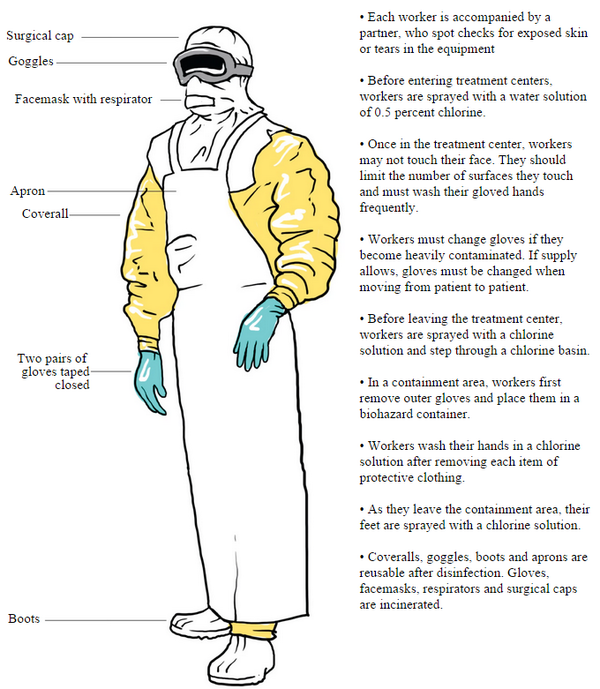
  2. When dealing with patients, the WHO recommends wearing gloves, a disposable impermeable gown to cover exposed skin, a waterproof apron over any gown that is not impermeable or when undertaking strenuous activity, facial protection to prevent splashes to the nose, mouth and eyes including a medical mask + eye protection (visor or goggles) or a face shield and medical mask.[3]
The CIDRAP article's authors claimed a belief that there is scientific and epidemiologic evidence that Ebola virus has the potential to be transmitted via infectious particles. Unfortunately they don't make a convincing argument to support their belief-nor could they, since no data currently exist to for any claim that an Ebola virus is transmitted between humans by an airborne route. So we're left with a commentary based on those beliefs, and some speculation.

Some collaborators and I wrote about Ebola virus not being an airborne virus based on what I know and what's been done to answer this question before.[2] I'll first add that if it were an airborne virus, I would likely be seeing many, many more cases-"Compared to this Ebola outbreak, the H1N1 swine flu had already spread to an estimated 10,000 times as many people in its first 10 months" noted United Kingdom virologist Ben Neuman.[13] H1N1 being an influenza A virus; a real airborne virus. In our post, we noted that big wet droplets (part of an "aerosol"-a messy term that may not be well understood by the public...or some scientists...that includes big wet droplets and the more frequent smaller particles <100µM in diameter) can be propelled at a mucous membrane or fall to the ground to contaminate surfaces.


A schematic of the makeup of an "aerosol".
From [2]
Big wet, propelled droplets can contain infectious Ebola virus and are included in the established risk messaging. Hence the need for droplet precautions.

We also know that from every human aerosol, after the heavy larger droplets fall to the ground or impact on a surface, the many more remaining lighter particles can linger in the air. I know that these small <100µm particles can be made to contain infectious Ebola virus under lab conditions[8] thus droplet nuclei produced by an infected human may contain Ebola virus. I can't say with certainty that they do or do not. However, as far as I have been able to tell, infection of humans and resultant disease from inhaling lingering particles, has not occurred. And when an airborne route was investigated using infected and uninfected non-human primates housed nearby but without direct contact, no infection via an airborne route was found to have taken place.[9]


Most of the studies looking at aerosols of Ebola virus do so in highly temperature and humidity-controlled laboratories with lots of lab-grown virus.


Relying on one added component raises a few questions for us:

  • Could the faith in this one extra precaution threaten the very important, meticulous care required when donning, using, and removing contaminated PPE-of any sort?
  • What role does a lack of the basics, like soap and clean water [10], play in HCW infections?
  • Could an additional extra safety measure really have a major effect on reducing the known risks involved with treating Ebola virus disease (EVD) patients, such as the long hours, tiredness, the constant and pervasive tension of imminent exposure, the oppressive heat, delirious and sometimes violent patients and the ease with which one can self-inoculate?[6]
  • Does the extra safety measure even have a role in reducing risk associated with HCWs who are unknowingly infected while not wearing PPE?[7]
How much do the things listed above, mostly unrelated to having a hi-tech battery-powered breathing apparatus on your hip, contribute to the tally of HCW infections?

The authors overlooked mentioning that early on, many HCWs may have had few or no masks at all and few other essential barriers such as those listed by WHO above, to protect against direct contact. They also did not mention the lack of HCW training in the use of any of that equipment if available, and did not highlight the lack of experience HCWs had dealing with EVD patients. These HCWs had (and may well still have) direct contact with very ill EVD cases, and got infected. What fraction of HCW infections resulted from absent or incomplete PPE and training versus the HCWs that they believe became ill while wearing full droplet precaution PPE?


Embedded image permalink
MSF designed suit of PPE.
Graphic tweeted by the
Washington Post.[5]
Others have also made note of the disparities between the imagery of a biosafety level 4 (BSL4) laboratory researcher working in a negatively pressurized, airlocked laboratory within a tethered, airtight suit (probably unnecessarily high precautions [13]) versus highly biocontained single patients being shipped home on dedicated planes (kept somewhat contamination-free using isolators) to rich nations for specialized support and treatment versus Médecins Sans Frontières (MSF) workers who use respirators (specialized face masks that fit more snugly and contain more layers to better filter what is breathed in) instead of surgical masks versus the WHO recommendations of standard precautions which include a surgical mask. Notably, the WHO recommendations vary according to the type of risk one is exposed to [see pg 96-7 96 of the 113 pg PDF at [3]).[10] There clearly is a range of thinking and messages here. But equally, there are a lot of different applications to cover, and no way for every need to be specifically catered for by one guideline. If everyone could agree on such a thing anyway.

I share the concern of many over the deaths of HCWs in West Africa. They may still be unnecessarily exposed to the virus due to the lack of enough PPE. They may not have enough training to understand how easy it is to become infected. They may not be given the message that during an EVD outbreak as monstrous and different as this one, many heavily populated areas have been included for the first time resulting in very real risks of infection occurring outside the hospital setting, not just inside it. There are also real risks of infection in supposedly EVD-free hospital settings like maternity wards.[11] There are many, many non-airborne related risks for HCWs.


We freely admit that we are not trained in the use of PPE for treating Ebola patients; just for working with actual respiratory and blood-borne viruses in PC2 & PC3 laboratory settings, respectively. Still, some may find this post irrelevant.
This is a blog and not part of any Organization's reference list when they write PPE guidelines...because it's a blog.

But for what it's worth, I would follow the MSF lead if working on the battlefield of a 100+ bed treatment facility. In an ideal world, more effort would be made to provide a more roomy and breezy head covering that allows patients to see your face and which can be worn for longer periods would be useful. You can see an image provided by 3M of this battery-powered air-purifying respirator (PAPR) accompanying the CIDRAP post.


However....first and foremost, and well before we get to this level of hair-splitting based on speculation and belief and no evidence of an airborne virus-I'd be wanting to make sure there was a minimum level of disposable PPE actually available for use, that it was consistently used by every HCW, that appropriate training in its use had been provided, and that HCWs understood about all the risks for acquiring EBOV infection. 

Reasons for HCW infections are many and varied. As much as we may believe or wish it were so, no single act or change will circumvent these risks or these infections.


References..

Saturday, 20 September 2014

MERS risk reduction and signs of illness to watch for during hajj and umrah...

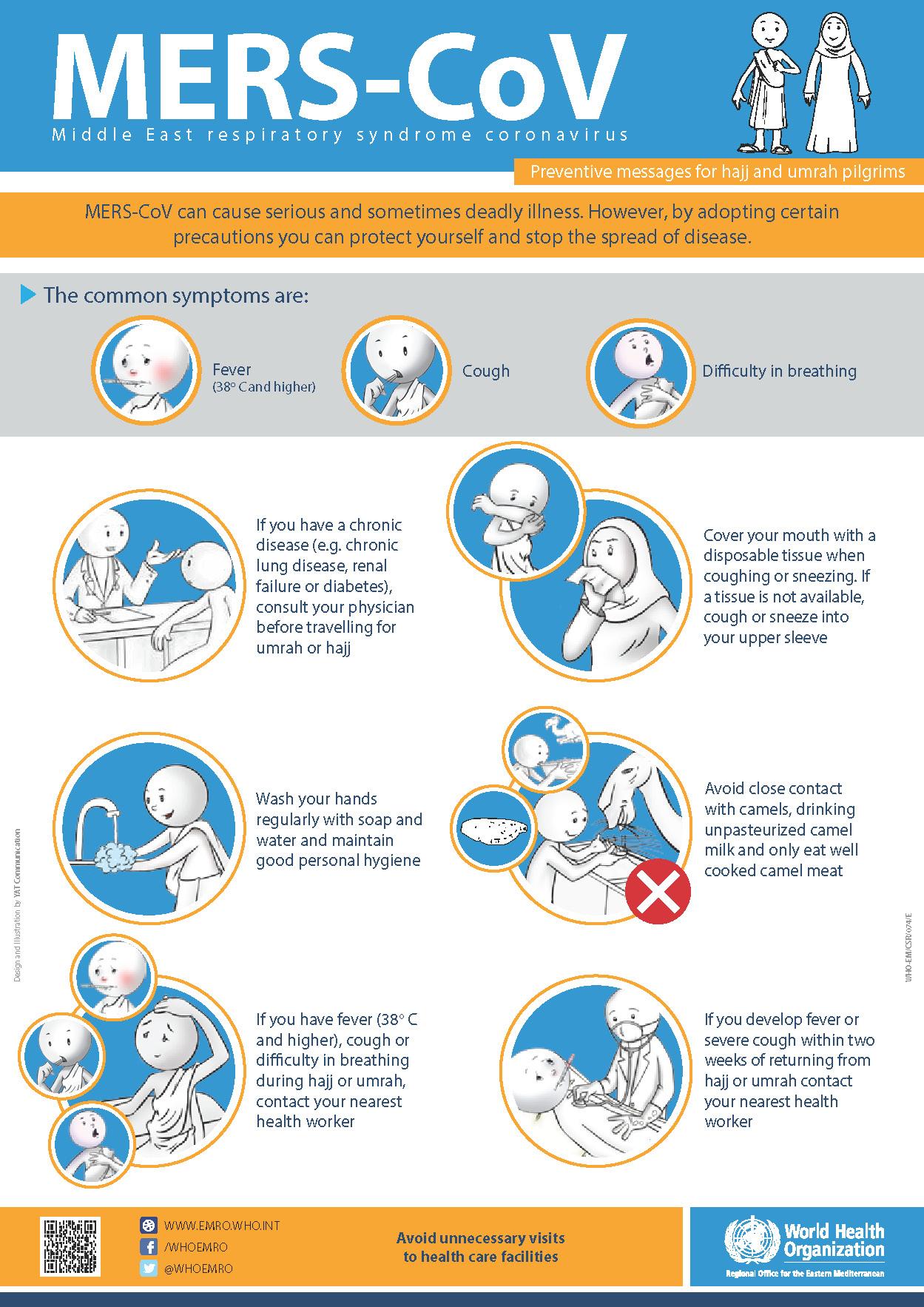
I love a good infographic and this one ticks a lot of boxes for getting a clear message out about the Middle East respiratory syndrome (MERS) disease and how to avoid catching and spreading the MERS-coronavirus (MERS-CoV).

Thanks World Health Organization.


World Health Organization poster describing risk of infection
 and how to identify when you might have MERS.
Of course, I'd be happier if the poster specifically suggested putting more distance between people and potentially infected camels, rather than just avoiding "close contact".

Granted, close contact can include spending time in the close, but not physically connected, "personal space" of a camel. But "close contact" is, in my opinion, one of those infectious disease terms that needs to be made more simple and clear. Like "aerosol" and "airborne", "close contact" gets a little lost when translated to the people who are at actual risk from infection.

Friday, 19 September 2014

To the Saudi Arabian Ministry of Health: A request for missing data on retrospective MERS-CoV detections

From: Ian M Mackay

To: The Office of the Minister of Health, Kingdom of Saudi Arabia

I write to humbly ask for your help on a matter of infectious disease communication. I ask that you please consider completing the already near-complete public data picture for all retrospectively confirmed cases of Middle East respiratory syndrome coronavirus (MERS-CoV) that have occurred on your soil. I ask that this be publicly released for analysis, and suitably acceptable citation, by all. The Ministry of Health has already made a number of advances in tracking and communicating new cases of MERS-CoV, addressing criticisms along the way. But there remain some small but epidemiolgically important gaps in an otherwise complete set of data that could be easily closed.

Today, the 19th of September, I make note of the Command and Control Center announcement of the discovery of 19 MERS-CoV cases, identified after retrospective analysis of cases.[1] This adds to the 113 MERS-CoV detections announced 3rd June 2014.[2] I also note the reference to removal of a duplicate case and two false positive cases. In addition to these items, there have been many identified deaths that cannot be linked to publicly announced cases because key date data are no longer published along with the time of death announcements, as they once were (see example [3]).

So I ask if it is possible for you to publish a minimum set of deidentified details from cases that have not been fully described by the World Health Organization Disease Outbreak News reports. I suggest an open access spreadsheet on the CCC website.  I do not ask that any compromising or identifying data be included nor do I believe there is a need for identification of hospital or treatment facility. I would be happy to help identify these cases if that could be of use. 

These data include:

  • Age
  • Sex
  • Date when symptoms began
  • Date of hospital admission
  • Date when a fatal case was first reported (allowing a link to be made)
  • City where case likely acquired

The Command and Control Center website and its updates on contemporary MERS cases have evolved into an essential global asset for many international researchers and for the global public, each of whom are still trying to understand this emerging virus. What I suggest here would add even more reach and value to your efforts to keep us all informed. 

As the custodian of over 90% of MERS case data, the world wholly relies upon your transparency, good will, expertise and willingness to openly share it. I believe a complete set of MERS-CoV data have great potential to engage more researchers from around the globe. These links may help identify new and interesting patterns that could be of use to Saudi Arabia and other Middle East and African nations trying to improve control of MERS-CoV now and in the future.

Thank you for reading this.

Yours sincerely,

Ian M. Mackay, Ph.D.
Virologist
Science communicator
ian.mackay.im (at) gmail.com


NB. A response was received and is posted here [4]
  1. http://www.moh.gov.sa/en/CCC/PressReleases/Pages/Statistics-2014-09-18-002.aspx
  2. http://www.moh.gov.sa/en/CCC/PressReleases/Pages/mediastatement-2014-06-03-001.aspx
  3. http://www.moh.gov.sa/en/CCC/PressReleases/Pages/mediastatement-2014-05-24-001.aspx
  4. http://virologydownunder.blogspot.com.au/2014/09/mers-cov-data-request-response-from.html