Showing posts sorted by relevance for query measles. Sort by date Show all posts

Monday, 8 June 2015

MERS-CoV and opportunity to spread...

1,500 people were exposed via direct or indirect contact, to one Doctor who was already ill and later tested positive for the Middle East respiratory syndrome coronavirus (MERS-CoV).[1]

So what?

If this were measles virus - that sort of exposure could spell disaster for infection control and measles containment. In measles, every infected person can infect about 18 other people...but that's an average of course and on an individual basis, the number of new cases can move around that value depending on the number of contacts each person has...and the type of contact...and how much virus the index case sheds... and everyone's their immune function...etc, etc, etc.

But MERS-CoV ain't no measles virus. 

Time and again we've seen that MERS-CoV does not pass easily to new people. Around 4% of household contacts were deemed infected, across 26 households,  in a study from 2014.[2] About 2-3% in some other analyses.[3] And by 'easily' I mean lots and lots of contact becoming ill from each case they are exposed too. If 4% of those 1,500 hundred contacts of the South Koran Doctor had been exposed to an infectious dose of MERS-CoV from this Doctor - who really does get around - and the incubation period is as short as the 3 or 4 days it has been in some cases in South Korea...then any minute now, we'll expect to see 60 more cases in the community and in hospitals, all with links to this health professional. 

I'm not holding my breath (pardon the pun) for this though, because I doubt the contact was often very close. I also won't go into the fact that there maybe no actual testing of contacts happening - we have no idea of that aspect of the South Korean incident. I really hope the South Koreans are testing. It would be a great study producing some valuable transmission data outside of Saudi Arabia. And not just PCR testing but collecting blood for serology (antibody studies) testing later too.

Google tells me that South Korea has a population of 50,220,000 in 2013. So there have been 87 cases of MERS since May...about 0.0002% of the population are infected. At this point, perhaps we should start assembling a list of how many people went through the hospitals with the most cases, that did not acquire MERS-CoV...just to provide some added context to the cluster. In other words - the past few days have seen case numbers growing day on day - but infections are still contained within the hospital setting. Close contact. No community spread. No camels infected in zoos.

Tomorrow is another day and we'll see what is added to the tally resulting from the arrival of a single infected traveller.

References..

  1. http://www.koreaherald.com/view.php?ud=20150604001315 
  2. MERS-CoV around the house-yes, it does transmit at home
    http://virologydownunder.blogspot.com.au/2014/08/mers-cov-around-house-yes-it-doers.html
  3. If this is what MERS-CoV detections look like with more testing...what is the "normal" community level of virus?? [UPDATED]
    http://virologydownunder.blogspot.com.au/2014/04/if-this-is-what-mers-cov-detections.html

Wednesday, 18 March 2015

Catching Ebola: mistakes, messages and madness [amended]

Written by Dr. Ian M. Mackay and Dr. Katherine E. Arden

Despite obvious community and media fear, speculation and exclamation that Ebola virus would enter and spread widely within countries outside the hotzone, such an event did not come to pass in 2014. The early public health messaging on Ebola virus and disease were, for the most part, spot on. 

In 2014 and 2015, thousands of cases of Ebola virus disease (EVD) ravaged Guinea, Sierra Leone and Liberia in 2014 (the "hotzone"). A smaller outbreak was defeated in Nigeria [8] and another distinct Ebola virus variant drove an outbreak of EVD in the Democratic Republic of the Congo[7] - they too controlled spread of the virus. Ebola virus travelled from the hotzone to other countries including Senegal, Nigeria, the United States of America (USA), Mali and most recently, the United Kingdom. It did this by hitching a ride in a usually unknowingly infected human host. 


Over 40 people have been intentionally evacuated or repatriated for observation or more aggressive supportive care - and perhaps the use of experimental therapies - to France, the USA, Spain, Sweden, Norway, Denmark, Germany, Netherlands, Italy, Switzerland and the United Kingdom.[1,18] 


Recently, the last country outside of Africa to have unintentionally acquired a case of EVD, the United Kingdom, passed a milestone; 42 days since the last ill patient tested negative for Ebola virus. They were declared free of known virus transmission.[17]


Containing the spread of each imported case has relied upon stringent infection prevention and control measures and the identification and monitoring of each and every contact of an Ebola virus infected person. And these have been used with great success. No country, apart from the three in which transmission has been widespread and intense, has seen the appearance of multiple and continuing rounds of new EVD cases. A rough calculation of the numbers of contacts falling ill from each EVD index case who travelled outside the hotzone is shown in the table. It only includes those with data available publicly.


On average, fewer than 1 in 100 contacts (0.8%) came down with EVD. Not the easiest virus to catch? If you compare that to measles, 9 in 10 non-immune people close to an infectious measles case will acquire disease (90%).[19]


Table 1. Index cases and the proportion of contacts they infected
a-man travelled overland from Guinea while infected; b-man with EVD repatriated from Liberia; c-man who flew while symptomatic to Lagos, Nigeria with a stopover in Lome, Togo; d-man flew from Liberia while infected; e-male healthcare worker returned from Guinea; f-a 2 year old girl travelling overland while infected; g-male travelled by car to a clinic in Bamako, Mali from Guinea (assumed Ebola case); h-female healthcare worker returning from deployment in Sierra Leone; i-this figure may indicate all contacts for  both Mali cases
The extent of the fear inspired by the first imported EVD case was especially clear from the massive spike in social media content from the United States which followed the arrival from Liberia of an individual with EVD; far more social media activity than had been seen in the United States to that point, or since.[14,10] This month, even though 11 contacts/associates are being flown back to the United States for observation; on the heels of the index case, social media activity has barely responded – in fact Twitter is possibly more positive/neutral about Ebola in the US in March 2015 than in August 2014, rather than excessively fearful, mean or just plain hysterical.[10] 

Some of the heat may have been taken out of the emotional response to Ebola outside Africa because it is now clear that a catastrophic pandemic is not going to happen. Kinda like we were told. I know; it;s so uncool to be reminded that you were told something by a grown up - and it was right! 


Well...THEY TOLD YOU SO!!! 


Nations with better (some!) healthcare infrastructure, preparedness, healthcare to patient ratios and those who got advice and help quickly, curtailed the spread of EVD. Kicked it out. Stomped on it. Terminated it. This was true even when contacts had been classified as at high risk of getting sick.[15] 


Public health messaging made some big calls early on. Some examples include tweets by Head of Public Relations for the WHO, Gregory Härtl, and later by the Centers for Disease Control and Prevention’s Director, Dr Tom Freiden.[11] They made it clear that Ebola virus was not easy to catch and that measures to stop an outbreak were known.[16] At the time, this didn't jibe with other voices and the unprecedented number of EVD cases and deaths, especially from August onwards, that were tallying up at an exponential rate in west Africa. But those messages, while technically correct, probably didn't convey enough of some of the biggest factors in a disease outbreak - fear, ignorance (meant only in the sense of no specific knowledge of Ebola virus and EVD), tradition and history - the human factors rather than the viral ones. Some comments about transmission suggested essentially no chance of even a single new case happening on the home soil of richer countries - they were overly enthusiastic. They were unjustifiable and when some hospital workers in non-African countries became infected, they were ultimately seen for the mistake in message crafting that they were.


Much of the science of the Ebola epidemic is yet to be written, but what we know today is that it is unlikely that Ebola transmission is any different from what was observed decades ago. Direct, physical contact with a very ill person’s fluids is the overwhelmingly biggest risk factor to target in reducing disease spread. And even then there's no guarantee that disease will result from all instances of contact. We still have much to learn.


What has changed since the bad old days? We’ve learned how to better manage and support EVD cases. EVD is a disease that caught us a little unawares in its combination of "skills" - it spreads by care and through direct contact, accrues a lot of virus in the blood but also vast quantities in explosively propelled fluids produced from "both ends"; virus that remains infectious for even longer in urine and semen than in blood. Quite the mix of issues to deal with.


EVD is no longer a death sentence, and this needs to become part of the new messaging paradigm. It's a message that may still be highly relevant to those in Guinea and Sierra Leone who seemingly would still rather risk death than seek care at a treatment unit. Post-mortem detection of EVD cases is ongoing, although may be on the decrease but also nearly a third of cases in Guinea and Sierra Leone are arising from unknown human sources.[21] Contextual communication is needed from within each country and region. That aspect cannot be allowed to wane. 

With early care, and active care, rather than the palliative model that seemed to occur when the ratio of EVD cases to healthcare workers was too high, patients mostly surviveThe EVD treatment center at the Hastings Police Training School near Freetown, Sierra Leone stands as a model for successful life saving and is the best described example of this from the west Africa epidemic to date.[20]

Ebola virus infection is not easy to catch, it can be survived much more often than was generally accepted and its spread can indeed be stopped. Stopping an Ebola outbreak quickly seems to be helped mostly by prior education, ongoing communication, forewarning and preparation but also needs ongoing surveillance, functional healthcare infrastructure, a range of experienced workers and all of that must all be under-written by money.

But even with all that help in place, mistakes will be made and lessons will be learned, by everyone, all the time. Embrace that. We're all human.


References 

  1. http://www.nytimes.com/interactive/2014/07/31/world/africa/ebola-virus-outbreak-qa.html
  2. http://apps.who.int/iris/bitstream/10665/137510/1/roadmapsitrep_5Nov14_eng.pdf 
  3. http://www.who.int/mediacentre/news/ebola/20-november-2014-mali/en/ 
  4. http://www.who.int/mediacentre/news/ebola/17-october-2014/en/ 
  5. http://www.nyc.gov/html/doh/html/pr/press-statements.shtml 
  6. http://www.cdc.gov/vhf/ebola/outbreaks/2014-west-africa/united-states-imported-case.html 
  7. http://www.nejm.org/doi/full/10.1056/NEJMoa1411099 
  8. http://www.eurosurveillance.org/ViewArticle.aspx?ArticleId=20920 
  9. http://apps.who.int/ebola/en/status-outbreak/situation-reports/ebola-situation-report-14-january-2015 
  10. http://www.symplur.com/blog/the-life-cycle-of-ebola-on-twitter/ 
  11. http://www.foxnews.com/opinion/2014/08/09/truth-about-ebola-us-risks-and-how-to-stop-it/ 
  12. http://www.nytimes.com/interactive/2014/10/20/us/cascade-of-contacts-from-ebola-case.html 
  13. https://www.gov.uk/government/news/ebola-contact-tracing-underway
  14. http://www.thelancet.com/pdfs/journals/lancet/PIIS0140-6736(14)62016-X.pdf
  15. http://www.who.int/mediacentre/news/ebola/3-september-2014/en/ 
  16. http://www.bloomberg.com/news/videos/b/4a798222-3666-446d-81ff-f21412a3f068?cmpid=yhoo
  17. http://www.euro.who.int/en/health-topics/emergencies/pages/news/news/2015/03/united-kingdom-is-declared-free-of-ebola-virus-disease/_recache
  18. http://ecdc.europa.eu/en/healthtopics/ebola_marburg_fevers/Pages/medical-evacuations.aspx
  19. http://www.cdc.gov/measles/about/transmission.html
  20. http://www.nejm.org/doi/full/10.1056/NEJMc1413685
  21. http://apps.who.int/iris/bitstream/10665/156273/1/roadmapsitrep_18Mar2015_eng.pdf?ua=1&ua=1

Thursday, 5 September 2013

Measles, vaccination and infectious disease communication in Queensland...

This post has been moved to the new Virology Down Under platform on Wordpress.

You can get to this specific post by clicking on the link below...

Monday, 23 February 2015

Transmission of Ebola viruses: What we know and jumping the black swan

Last week a review was released entitled Transmission of Ebola Viruses: What We Know and What We Do Not Know. The review, which is listed in the Opinion / Hypothesis section of mBio, was penned by by Michael T Osterholm and a large team of Ebola experts. You may know him from such articles as What We’re Afraid to Say About Ebola and What we should — and shouldn't — be worried about regarding Ebola or his entertaining seminar at the Johns Hopkins Bloomberg School of Public Health Ebola forum.

First up a few random points from me...
  • This is basically a good review of the historical literature on transmission of Ebola virus and some other ebolaviruses. By the way, this literature is based on real experience, observation and experimentation, defining our understanding of how Ebola virus has transmitted among humans.
    It's worth noting that there have been no concerns made public, nor any new transmission data from the epidemic in West Africa, which indicate changes in the way Ebola virus spreads from person to person
  • This review is an opinion/hypothesis piece so it has a lot of room to move. The language fairly clearly defines where the thinking strays into areas without any actual data to support them. Look for phrases with words like "possible", "could", "postulated", "may", "suggesting" and "can"
A quote from the new review by Osterholm
and experts. Highlighting is mine.
  • Does anyone actually care whether we use words like aerosol, airborne, droplet, droplet nuclei, wet droplets or propelled to mean "not by touch"? I'm not sure any more, but I think they should. Words have meaning and slightly different words carry subtley, yet importantly different meanings. It's important to keep in mind who the messages relating to public health should ultimately try and reach - that would be the public. Experts, comparatively few in number, already have an innate sense of the differences between the words above, right? Right?! Well, many do anyway. Trying to change language or redefine a target in the midst of an epidemic, is at best bad timing and at worst it seems self-serving (although to what end I cannot guess). 
Suggested ways in which an ebolavirus can spread from a known EVD case to a new person. The most likely route is suggested by the thickest arrows with solid outlines while the least likely or most improbable route is indicated by the thinnest arrow with a dashed outline.
Click on image to enlarge.

  • Ebolaviruses are not just blood-borne viruses in humans like HIV is for example; they are not just gastrointestinal viruses like norovirus (although droplets play a role here too); they are not considered by anyone to be airborne viruses like influenza virus
    What they are, in a transmission sense, is a hybrid of the first two - reaching high loads in the blood and the gastrointestinal system. To me, these shared features make it more clear why a different level of personal protective equipment (PPE) is needed than would be considered essential for caring with patients with just one or other type of virus
  • One distinct viral group may remain infectious for a longer period, shorter period, or not at all compared to another distinct viral group, in droplet nuclei - the air-dried (gel-like mix of proteins and salts..and infectious or non-infectious virus) form of droplets that have not yet hit an object or the ground.
  • The figure of just 1-10 viruses being required for an infection to take hold has generously been bandied about during the Zaire ebolavirus (the EBOV|Mak variant) epidemic of 2014/2015. But some overlook a simple component of this apparently easy infection process; 1-10 viruses landing on a cell is not the same as 1-10 intact infectious viruses being emitted from an infected host, travelling out of the host's infected cells in a drop of blood, semen, urine, sweat, saliva, diarrhoea or vomit, retaining infectivity while passing through various environmental conditions, onto a new host's mucosal surface, perhaps indirectly via a hard surface, getting past that body's innate immune defences and eventually attaching onto and gaining entry into that new host's cell, successfully replicating within it and then infecting neighbouring cells to establish a new infection. It may take thousands or hundreds of thousands of viruses in that initial drop of infection material to get those 1-10 infectious virus particles to start a productive, symptomatic human infection.
    We know little about this part of the story outside of the laboratory
  • On that theme, there is much in general we still do not know about the ebolaviruses and Ebola virus disease (EVD). Direct contact with virus-laden fluids or a needle-stick injury are still considered to be major routes for acquiring an ebolavirus infection but direct mucosal contact with propelled droplets may occur at distance further away than the old 3ft/1m rule.(6)
    Truly airborne dried or semi-dried droplets that contain sufficient infectious Ebola virus, can be inspired and can result in an upper or lower respiratory tract infection that progresses to become systemic EVD in humans....have yet to be found. They may contribute to infections, but it will be very hard to prove that this is a transmission pathway that exists as a thing separate from droplet transmission. The authors sort of note this difficulty too; both droplets and droplet nuclei result from coughs, sneezes and explosive vomiting and diarrhoea.
    The suggestion that droplets are produced from the respiratory tract and then inhaled by another person (6) resulting in EVD is really straining the use of "improbable"
  • I've written about some of this stuff before - on the distinct issue of Ebola virus and pigs here, on droplets and droplet nuclei here, the complexities of contact here, on seeking some better words here and on previous versions of this theme by some authors of this latest review here and here and I'm not going to rehash all of that here! I invite you to read those posts
Mixed messages..

A problems I have with this review is this line in the abstract..
We also hypothesize that Ebola viruses have the potential to be respiratory pathogens with primary respiratory spread.
While Osterholm and expert colleagues round off the review by clearly stating that airborne ebolavirus transmission is an "improbable scenario", and that droplet transmission is plausible (I don't disagree with the latter statement), parts of the rest of the review struggle to tow that line quite so clearly. The media seemed to have struggled to find that message too..

It is 'very likely' that the Ebola virus will spread through airborne particles, experts say
Daly Mail

Limited airborne transmission of Ebola is ‘very likely,’ new analysis says
Washington Post


..although one bright light in the gloom managed extremely well..

No, A New Scientific Report Does Not Say That Ebola Is Now Airborne
Vice News

Prof Vincent Racaniello noted in his blog post about the review that we understand what viruses do now, by what we have observed them to be capable of doing in the past

Do ebolaviruses actually have the potential to shift to a primary method of spread that occurs via droplets or droplet nuclei and spread like a rhinovirus, influenza virus or the measles..to name a few? If no virus which we humans have ever watched has changed its method of spread so dramatically before, why would this particular one do it now? Well, why wouldn't it, you may well ask? Because it takes more than some genomic mutations and drift to do this. At some point we need to remember that each virus comes with its own toolset and it doesn't usually have a lot of replacement parts or upgrades in a satchel over its capsid. It can only tweak its component parts so much and so far before it reaches the limit of what it "is". Could one virus become another virus? Maybe it could. I look forward to becoming Superman myself. What would it take to overcome whatever biological throttles have existed on the ebolaviruses prior to so much human spread, for a virus to stop spreading primarily by fluids resulting from certain host disease processes, to being spread mostly by inspiration of respirable droplets? Certainly something we've never seen before and something in need of a utility belt and  can of bat EBOla repellent. Again, we're not just talking about some "genotypic changes"; the ebolaviruses would need to accumulate a plethora of stable genetic changes to make that sort of transition, possibly in combination with changes in the disease processes within its host...us.

An opinion by any other title...

Despite the review being an opinion piece, it seems to have some trouble owning up to its own real opinion; that Ebola viruses can spread by a new route and cause new disease. The title really should have reflected the content better in this regard. In approximate number 5,800 words included 440 (8%) on animal transmission studies which are mostly about aerosol spread; 925 (16%) devoted to defining aerosols and droplets and trying to change the paradigm; 670 (12%) about what we need to learn, which includes some content on aerosol transmission; 670 (12%) on a respiratory transmission hypothesis. So a sizable chunk, nearly half of the content, is heavily focussed on educating us abut Ebola and aerosol transmission. The topic is additionally reinforced within every other section as well. So why hide what the article was really focussed on; not the general transmission of ebolaviruses, but transmission via an as yet unproven-route? The authors note that an "aerosol" contains all the different droplet sizes and degrees of droplet wetness and that this entire range is propelled out of us via cough, vomit, diarrhoea and by  aerosol generating mechanical procedures. We agree on that bit. But once the bigger wetter droplets fall away and one is not standing unprotected within their range, is there an infectious virus left in the drier smaller droplet nuclei which are held aloft by air currents until they impact with something or someone? 

Have we ever seen Ebola virus infections caught by people walking into a room after an infected case has left it...as is the case for measles or rhinovirus, truly airborne transmissible viruses? Or is droplet spread only occurring in close proximity to the source? This is another point the authors raise-that being close to someone who just vomited may result in breathing in larger droplets that are infectious but have not yet fallen to the ground. How will we ever know that this is not a propelled droplet instead? Explosively coughed or vomited material can travel a sizable distance as well? So we still await some evidence to support the musing that inhaled droplets carry infectious ebolavirus in them, and that they are distinct from the more likely impacting of propelled droplets. Propelled droplets are likely a key reason that updated PPE guidelines recommend against any exposed skin and the use of eye protection, gloves, boots and a respirator; the yellow suits that will forever be linked to EVD in West Africa. But even those suits don't support that Ebola virus has been, or is showing new signs of, spreading primarily via a respiratory route?

What I could not find in this new review was a more thorough discussion - and some hypothesis and opinion - of the risk associated with how healthcare workers acquired their infections when outside of Ebola treatment units or in western hospitals. Also absent was opinion on the practical risks of semen remaining infectious, or harbouring viral RNA as was found in 2014 in a returning asymptomatic convalescent man [3] (sexual transmission has not been documented [11]). I would very much have liked to read some hypotheses on the role infectious urine might play in urban settings lacking no sewers and with densely co-located populations, since urine has been shown to remain infectious for longer than blood, in a detailed case study from Germany in 2014.[3]

Wrap up...

So to summarize, coming into contact with virus-laden body fluids either by touch, perhaps via an intermediate surface (a fomite; unproven) or by having these fluids propelled onto you (as yet unproven), are considered the main risk factors that comprise the overwhelming majority of human-acquired ebolavirus infections. Current PPE guidelines are designed to combat these and if western hospitals are any guide, they work well - although it's a tough comparison given the different carer-to-patient ratios in western hospitals compared to outbreak conditions in west Africa. 

What role "respirable droplets" or droplet nuclei play in transmitting ebolaviruses between humans awaits evidence but nothing points to a role for an airborne route of infection in west Africa.[6] Hopefully some studies will be looking very hard at this question. Nothing hints at any changes in  EBOV/Mak that could result in it becoming a "respiratory pathogen with primary respiratory spread" capability.

I recommend reading a few other recent reviews and articles to get a more rounded view [7,8,10,12] and if you want to see droplet, aerosol and airborne get smooshed together into an undifferentiated mess, that's in print too.[9]

References...
  1. Transmission of Ebola Viruses: What We Know and What We Do Not Knowhttp://mbio.asm.org/content/6/2/e00137-15
  2. Experts suspect Ebola virus sometimes spreads by air
    http://www.cidrap.umn.edu/news-perspective/2015/02/experts-suspect-ebola-virus-sometimes-spreads-air
  3. A Case of Severe Ebola Virus Infection Complicated by Gram-Negative Septicemia.
    Kreuels B, Wichmann D, Emmerich P et al.  N Engl J Med. 2014 Dec 18;371(25):2394-401
    http://www.nejm.org/doi/full/10.1056/NEJMoa1411677
  4. Ethical issues in isolating people treated for Ebola
    http://www.ncbi.nlm.nih.gov/pubmed/25588871
  5. 2007 guideline for isolation precautions: preventing transmission of infectious agents in health care settingshttp://www.ajicjournal.org/article/S0196-6553(07)00740-7/pdf
  6. Ebola virus disease in Africa: epidemiology and nosocomial transmissionhttp://www.ncbi.nlm.nih.gov/pubmed/25655197
  7. Understanding Ebola Virus Transmission
    http://www.mdpi.com/1999-4915/7/2/511
  8. Chains of transmission and control of Ebola virus disease in Conakry, Guinea, in 2014: an observational study
    http://www.thelancet.com/journals/laninf/article/PIIS1473-3099(14)71075-8/abstract
  9. Ebola, through air or not through air: that is the question
    http://www.ncbi.nlm.nih.gov/pubmed/25646157
  10. Review of Human-to-Human Transmission of Ebola Virus from the US CDC
    http://www.cdc.gov/vhf/ebola/transmission/human-transmission.html
  11. Sexual transmission of the Ebola Virus : evidence and knowledge gaps
    http://www.who.int/reproductivehealth/topics/rtis/ebola-virus-semen/en/
  12. What we know about transmission of the Ebola virus among humans from the WHO
    http://www.who.int/mediacentre/news/ebola/06-october-2014/en/

Monday, 29 September 2014

The numbers are underestimates...

Ebola virus numbers.

Sorry but D'uh - yes the numbers during the Ebola virus disease (EVD) outbreak happening since December in Guinea then progressing to Sierra Leone, Liberia, Nigeria and Senegal....are an underestimate. 

Of course they are! 

How could they possibly not be?

Have you not watched a single documentary or news video detailing how heartbreakingly difficult it is to visit and help the people of West Africa, to characterize and gather those case numbers, to take, transport and test samples?

The suspect cases are an underestimate. 
The probable cases are an under-estimate. 
The fatal cases are an under-estimate. 

The only thing that is spot on is the laboratory confirmation numbers, because they are what they were when someone wrote them down having had some semblance of control over the steps to acquire them. 

But let's put that underestimation into context. 

"The tip of the iceberg"
Image originally provided by Gregory Haertl, WHO.
Click to enlarge
Influenza case numbers each year are also an under-estimate. 

In fact, some of those, the subtyping numbers, are deliberately so because it's too expensive and wasteful to subtype every single laboratory confirmed case - so a sample of cases are tested and that is assumed to reflect the subtype distribution for that region during that period. 

But seasonal influenza case numbers as a whole are a huge underestimate. Influenza does not drive everyone to a general practitioner nor to a hospital. Some infections with influenza virus don't even produce noticeable symptoms at all. They are still infections. They just don't get counted. So influenza A virus, possibly the most tracked of any respiratory virus, is underestimates. And that's okay. 

Well, measles too, in the respiratory virus department. 

The latest big bad is the species D enterovirus 68 (EV-D68). But the paltry few detections of it (identified by genotyping) that have reported across the United States are likely a monstrous underestimate. In fact we have very little idea of a normal denominator for EV-D68 detections so it's hard to even know if 2014 is seeing all that big a change in its spread and distribution. Usually the enteroviruses (includes rhinoviruses) cause common cold-like illnesses and only get sought out in the great detail from a research point of view.

Middle East respiratory syndrome coronavirus (MERS-CoV) cases or the emerging influenza A(H7N9) virus cases are all underestimated as well. 

The population of your state or country is an underestimate too you know?

This is because we cannot capture every single case of infection, or person, at once. 

So the next time you are about to say "the WHO numbers are an underestimate" as if that is a revelation or an unexpectedly horrible thing you can also lay at their doorstep - please just don't. It's not smart, new or unusual.

You might as well say the world is round; underestimation of infection numbers is just that well established a fact. It's just by how much, and frankly that doesn't even matter too much because the trends can usually be easily seen, or quickly extrapolated.

Perhaps you did not know all that before. But if you have read to here, you do now.

Tuesday, 10 December 2013

Flu bad, MERS a diversion?

In an "Infection hot topic" article in Clinical Microbiology and Infection, the Editor, Prof. Didier Raoult writes of the importance of not letting our excessive pride or self-confidence drive our desire to understand a rare and poorly transmissible (slowly-growing epidemic?) virus like the Middle East respiratory syndrome coronavirus (MERS-CoV) and distract us from "real infectious disease epidemics that are well known" at times of mass gatherings like the Hajj.

Because why not?

He notes that the recommendation for influenza vaccination during the recent Hajj probably prevented thousands of influenza cases and that 9% of returning French pilgrims returned an influenza virus positive throat sample. An example of some good communication then.

I wasn't aware that the scientific press, World Health Organization or governments had dropped any other balls in order to give MERS the attention any potentially new human pathogen, with or without pandemic potential, well and truly deserves.

I guess in hindsight, it might look like a lot of wasted effort went into MERS-related reporting. Readers of this blog would be aware of my own opinion on that matter - not nearly enough effort has gone into solving a number of questions about the MERS-CoV and certainly not enough data has been described and reported to make it easy to track and present new cases.

Far from being distracted, the developed nations have continued their fight against flu (so long as their governments aren't shut down), reporting heavily on it and other vaccine preventable diseases that are reappearing in the population (measles and polio for example). Many science communicators of all types in many locations around the world have also been discussing and describing in detail the oncoming wave of antibiotic resistant bacteria and many other viral and bacterial pathogens that can be considered rare depending, on the denominator you choose at the time. SARS-CoV infections were pretty rare (~8,200 confirmed cases) but the social, economic and healthcare impact of that little outbreak was incredibly disproportionate. Or perhaps it was perfectly proportionate? Remembering the SARS outbreak began in the dark without suitable coverage and communication to illuminate the early stages. 

What is the evidence that reporting on MERS has displaced any other efforts to monitor, debate or describe more endemic human infectious diseases?

Thankfully Prof. Raoult didn't call out the scientific community who are working hard to add new knowledge about "rare" human infections; work that will hopefully ensure they stay as rare as possible, for as long as possible if they are not halted at the source forever. 

I'm personally in no rush to read the bazillion Editorials that will follow in the wake of a pandemic due to infection by MERS-CoV, H7N9 or any other viruses with "little known effect on the human population".

Hindsight can be a harsh mistress but communication fosters preparedness.

Friday, 3 October 2014

It's what falls out of the aerosol that matters....

v2 031014
"Aerosol" is a messy word. It means different things to different people. So does "airborne".

What's in an aerosol?
Here we're talking about a mixture of different sized stuff. Think  of the size range in a handful the sand from a shelly beach.

A cough/sneeze includes big, wet, heavy propelled droplets that quickly fall to the ground or hit your windscreen (hate it when that happens) or your friend's face (they hate it when that happens) down to dried or gel-like "droplet nuclei" that can float in the air for hours, travelling where the wind blows them; and every size in between.


I've also talked about this before, here.

The public rightly get confused about aerosols. And science and physics and medicine have their own defined meanings - sometimes at odds with each other - that may well be out of step with what the public think.

I do wish the the big public health entities would settle on some definitions for these and other words. It would make everyone's life a lot easier.

Direct contact.

When we talk about "direct contact" and Ebola virus transmission, we do include the bigger wetter heavier droplets that might be propelled from of a sick person during vomiting, or coughing as a risk for transmitting virus. 

Even though that is not physical direct contact, and even though the droplets travel across a gap between people - through the air - it is still a direct line from person A (red in the graphic below) to B (blue). If B is too far away, then those droplets fall to the ground before they hit B. The droplets may remain infectious on the ground. That depends on temperature, humidity, surface type and the type and amount of virus.

The airborne route.

Even though it involves a short period of travel through the air, coughing wet droplets directly onto someone's mucous membranes is not an airborne thing. The term "airborne" is reserved for floaty clouds of droplet nuclei. In humans droplet nuclei have not, to the very best of our knowledge and observations and tests, been found to contain doses of Ebola virus that cause disease in humans. Too little virus coughed into the cloud perhaps or too little that survives..it's not known why, but it is pretty clear that in households where a case of Ebola virus disease was residing, only those household members who had direct contact developed disease, and those that breathed the same air but did not have direct contact, did not develop disease. 

While Ebola viruses may be present in floaty clouds of droplet nuclei, or forced to be in a floaty clouds of droplet nuclei under lab conditions with lab viruses at lab virus concentrations, a floaty cloud of droplet nuclei has not been shown to act as a source of acquisition for Ebola virus and resulting disease among humans. Sorry, did I just repeat myself?

Rest in peace.

Please don't say Reston ebolavirus or the Hot Zone. That (by all accounts riveting) book was not a scientific work, it is a dramatized work and the language is colourful and emotive and scary. The Reston ebolavirus event in non-human primates was never proven to be airborne.

Lastly and most recently, an airborne route was not found to play any role in causing disease or infection when Ebola virus infected and uninfected non-human primates were caged near each other. I've written about this and other non-human primate studies here.

To summarize.

Healthcare workers wear face protection(masks and goggles) to prevent their eyes and mouth being hit by wet droplets of virus-laden body fluids while they are in close contact with ill Ebola virus diseases patients. The also wear all-over gowns so that they don't have to sterilize their clothes between each room they move between. Use of protective equipment doesn't need to convey confusing messages about the type of route Ebola virus uses to spread but it's just lacking in enough public discussion via forums the public attend/view. Knowledge is a bit like vaccination - when coverage reaches a certain level, the community is safe (or it's understanding is complete anyway).

And why wouldn't healthcare workers protect themselves from ill patient fluids-however they come into contact with them? For a healthcare worker, body fluids from ill people they are in close and often prolonged contact with, should generally be considered infectious. This is the case whether we're talking about Ebola virus disease, HIV, measles, influenza or something else. Some of those are caused by airborne viruses, some, like Ebola virus and HIV, not.

Below is my latest attempt at trying to make all those words into a picture. 

If you have ways that can help me make this even simpler - please pass them along (thanks @chrisfharvey).


Wednesday, 19 February 2014

I care what the H7N9 numbers are...


This was the Tweet from Crawford Kilian (hereafter "Crof") a couple of days ago. 

I respect Crof. He has been as much of a mentor in my year doing this as has anyone. He even sent me his book on "Writing for the Web". I immediately changed a few things that I did after reading parts of it. Unfortunately nothing can help my appalling typing skills.

So when I saw that Tweet I thought it must have been a hook to get people to come read the full story. Twitter is a great way to attract readers to my blog; its a top referring site. Among other things, it's an important tool for promoting what we write to a wider audience. Sometimes a catchy title can be as good a bait as something more straight down the line. So, hooked, I dutifully read on.

What I found has been disappointing me ever since I read it 2 days ago, because I care about these numbers, and I thought you did too, Crof.

The article is of a type that I have read several times from Crof. It reminds those of us getting carried away with small, confined disease outbreak that hey, it's a great big world of misery out there and many more people are suffering and dying of all manner of diseases, a lot of which we forget about. Sometimes we don't forget though, we just focus on other things for a time.

I think it is a very valid point to make; and to make it over and over again is also fine with me. Points made in a blog post are very quickly forgotten, if they are ever read in the first place. At least a search engine may lead some back to that post or online newspaper story, unlike a printed newspaper which if not read may never have existed.

What really disappointed me I think...and I've been trying to work out why this has stuck with me for 2-days now, even causing me to give up on writing this last night or on blogging about viruses at all...is that Crof's post never did back away from the message of that original Tweet. Who cares about those numbers? It continued to hammer home that to follow such small numbers of deaths needed a special kind of justification, even for Crof. He said....
When I see WHO's H7N9 updates extending to 10 or 15 cases, it looks a bit alarming, I grant you. But let's put it in proportion.
and
Yes, I pay more attention to avian flu than to lung cancer and malaria. So, unfortunately, does everyone else...if you define "everyone else" as affluent, educated, vaccinated individuals living in countries with excellent public health systems and drinkable tap water.
and 
For us, it's the implicit threat of some clever virus that holds our attention: we don't have a vaccine for this one, so we ourselves are as vulnerable as some kid in Cité Soleil or Asunción or Gorakhpur.
and
I suppose we can justify our interest by arguing that by studying these new diseases, we learn more about other diseases, and ourselves, as well. And that's a plausible argument.

Finishing with
Meanwhile, since I posted a few minutes ago that 768 mothers died in childbirth today, the number has risen to 775.

So Crof, are there so few people on the planet that some cannot keep an eye on one disease, some on another? I get that we do have to prioritise certain diseases over others. We have limited resources and human nature seems such that we never get everyone to pull in the same direction for long enough to truly solve our problems. But there is no definition of a suitably attention-worthy number of lives lost to infection. Every infection that takes a life, or even those that make life miserable, are worthy of our attention, our study, our understanding and eventually, our efforts in defeating it. I care about those numbers.

You cited a number of examples of other causes of far greater human death and disease. I remember a post or comment of yours with similar information that has always sat in the back of my mind as a check and balance of over-reacting.  Yet I have also read many other posts from you that champion the need for better information about MERS and MERS-CoV cases, for example. You often provide "granular" (my word of the month) detail on individuals with infections. You followed the story of a single French MERS patient for many weeks. And so did we because of you. So I simply don't "get" how this post fits, if not to remind us that ALL the numbers are always worthy of our care. 

Yes. There are very few cases of H7N9 compared to the world’s population. But there could be many more, as I know you are more aware than many, with only a few bits of bad luck and circumstance lying between "sporadic" and "sustained". Why not have more eyes rather than fewer on such risks?

There were very few cases of SARS, H5N1 or even now, few new cases of polio or measles compared to such a huge denominator. But each and every one of those diseases has been and should be watched, followed, tracked and its every aspect quantified. 

Every death that could be prevented now with vaccination or in the future by better education, better research, better understanding of the patterns and changes to those patterns, and better awareness by the public themselves, is one more person who remains a living family member. I don't dwell on every death I've reported but I know what it would be like if it happened to someone close to me.  


So I leave you with these 2 thoughts...

And if a little pandemic porn helps all of us protect our health, and outgrow the need for such porn, then maybe it's worthwhile.
..the attention we pay to these fringe viruses is certainly worth the effort..

...and I hope to read many more like them in the future Crof. 

Just like you care about the words that you masterfully write, I think you like me, also really do care about what the H7N9 number are.

Tuesday, 5 January 2016

Zika virus briefly...

Update #1. 05JAN2016 2030 AEST
Update #2. 30JAN2016 1430 AEST
Zika (pronounced [zÄ“k′ É™; 1] or zeek-a) virus has been in the news in recent months as it has seemingly spread very quickly from country to country, seemingly at the same time as a rise in cases of an otherwise rare human disease, microcephaly. 

The virus was first grown in the laboratory from samples from a naturally infected sentinel rhesus macaque (monkey) which were placed in cages on variously elevated platforms in the Zika ("overgrown") forest in Uganda in 1947.[18] The virus was not descried in the literature until 1952 although many others from the discoveries in this region were.[18]

I'm new to Zika virus and the study of its spread and disease so I'm on a mission to read up on it. I like to start from the beginning thus I have some of the earliest papers and will gradually read them and share with you any summaries I write up. For now, a general overview of some key bits.

Zika virus causes Zika virus disease (ZVD) or Zika fever - it's that virus versus disease thing that we have for almost all infectious diseases. Zika virus is often abbreviated to ZIKV.

From ViralZone's (www.expasy.org/viralzone,
SIB Swiss Institute of Bioinformatics) excellent
Flaviviridae page at 


ZIKV is a mosquito-borne virus that has an RNA genome (positive sense) and is enveloped by a lipid membrane (with exposed viral bits embedded-see adjacent image) surrounding an icosahedral capsid. Inside the capsid is the genome. This is the same basic structure as that found among other viruses of the family Flaviviridae of which ZIKV is a member; it falls into the genus Flavivirus of the family Flaviviridae to me a bit more precise.

ZIKV replicates in the infected host cell's cytoplasm and first makes a single protein (a polyprotein) which is subsequently cleaved up into different functional peptides.[5,8]


Aedes aegypti mosquito. One of the genus Aedes of 
mosquitoes found to host ZIKV. Other mosquitoes 

Image from CDC via Wikipedia.[9]
Some flaviviruses are borne to us (and other animals) by other arthropods - ticks apart from mosquitoes - infecting us via a virus-laden puncture/bite/injection during which virus is introduced. These viruses are all lumped together under the umbrella term of arthropod-borne viruses or arboviruses

Arboviruses replicate (grow) within the cells of the particular arthropod host, where they are amplified to higher viral loads; for example cells lining the mosquito gut in the case of Dengue virus.[10,11] Some human and animal hosts, as far as we know, cannot amplify the virus enough for it to be sucked back out by and infect the next arthropod that might come along and feed on us - these are called incidental or "dead-end" hosts.[4]

Some flaviviruses have not yet been linked to an insect host. Wikipedia maintains a great long list of flaviviruses, arthropod hosts and their mammalian and avian incidental hosts, as well as those viruses not yet linked to a human or other animal hosts.[4]

Other flaviviruses (members of that genus) you may have heard of include Yellow fever virus (YFV; the prototype virus and from where "flavi", which derives from flavus, meaning yellow/blond/golden in Latin, comes from), Dengue virus (DENV), Japanese encephalitis virus (JEV), Tick-borne encephalitis virus (TBEV), West Nile virus (WNV), St. louis encephalitis virus and Murray valley encephalitis virus (MVEV). But there are 53 species listed in the genus by the International Committee on Taxonomy of Viruses (ICTV) as of 2014 - many of which you won't have heard anything about.[3]

Generally, ZIKV causes a relatively mild illness in a proportion of those infected.[13] Signs and symptoms can include fever, rash, joint (arthralgia) and muscle (myalgia) pain, conjunctivitis, headache and jaundice but with its recent rapid spread - or more rigorous detection - a link is being investigated to a parallel rise in cases of a rare disease, detected at birth or thereafter, called microcephaly. This has been reported in some countries with ZIKV cases, but not from all. At least to date that has been the case - it may change with the new attention this disease and this virus have now attracted. 
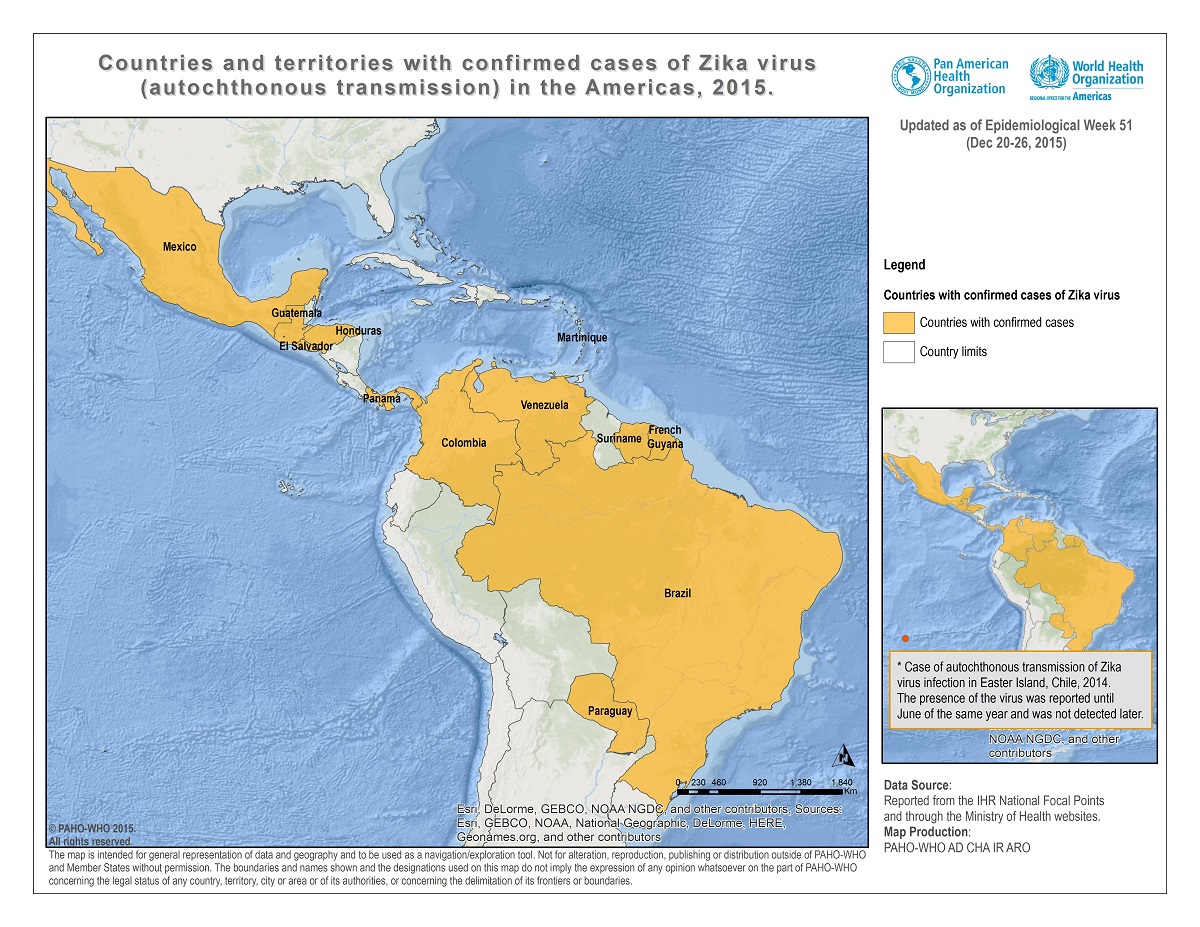
Countries and territories with autochthonous transmission.
Epidemiological Week 51 - 2015. PAHO & WHO.[23]

Microcephaly manifests, as the name suggests, as markedly smaller than normal head size and is linked to reduced brain growth in utero or brain development after birth.[6] While a link between microcephaly and viruses is not new, a link (statistical, supported with data) has yet to be found to ZIKV infection.[7] That is not to say a link will not be found, but it is awaiting the required studies. Three instances report ZIKV in amniotic fluid or in newborn tissues and one case of sexual transmission tentatively described.[19,21] Thousands of ZVD cases have reportedly been accruing on a weekly basis in Colombia alone which found its first local (autochthonous) transmission October 2015.[20] The first autochthonous reports of ZIKV infection in the Americas were confirmed in February 2014 on Easter Island, Chile.[22] In May 2015, Brazil reported discovery of its first autochthonous cases and November 2015 saw the first autochthonous circulation reports by El Salvador, Guatemala, Mexico, Paraguay, Suriname, and Venezuela.[22]

Laboratory confirmation of a suspected or probable case can be by detection of ZIKV RNA using RT-PCR in samples from an acutely infected case and by the finding of IgM antibodies 5 or more days after illness onset.[12,13] ZIKV antibody studies must be considered alongside studies of other flaviviruses which may cross-react or non-specifically flare up during infection by another related, or unrelated, virus.[14,15,16,17] The time during which virus remains in the blood may only be 3 to 5 days.[13]

But other infections can look just like ZVD including:[12]

  • dengue viruses
  • leptospirosis
  • malaria
  • rickettsia
  • group A streptococcus
  • rubella virus
  • measles virus
  • parvovirus
  • enterovirus
  • adenovirus
  • Chikungunya virus
  • Mayaro virus
  • Ross River virus
  • Barmah Forest virus
  • O’nyong-nyong
  • Sindbis viruses
So you can see that a lot of work, time and money is required for a lab asked to confirm the disease, rather than a specific viral infection.

No specific antiviral or vaccine exists for ZIKV infection - or most other viral infections.

References...
  1. http://wwwnc.cdc.gov/eid/article/20/6/et-2006_article
  2. http://viralzone.expasy.org/all_by_species/43.html
  3. http://www.ictvonline.org/taxonomyHistory.asp?taxnode_id=20141996&taxa_name=Flavivirus
  4. https://en.wikipedia.org/wiki/Flavivirus
  5. http://web.stanford.edu/group/virus/flavi/2008/flavi.html
  6. http://www.mayoclinic.org/diseases-conditions/microcephaly/basics/definition/con-20034823
  7. http://www.childrenshospital.org/conditions-and-treatments/conditions/microcephaly/symptoms-and-causes
  8. http://viralzone.expasy.org/all_by_protein/24.html
  9. https://commons.wikimedia.org/wiki/File:Aedes_aegypti_CDC-Gathany.jpg
  10. http://www.sciencedirect.com/science/article/pii/S0042682207006642
  11. http://journals.plos.org/plosntds/article?id=10.1371/journal.pntd.0001385
  12. http://www.cdc.gov/zika/hc-providers/clinicalevaluation.html
  13. http://ecdc.europa.eu/en/healthtopics/zika_virus_infection/factsheet-health-professionals/Pages/factsheet_health_professionals.aspx
  14. http://www.cdc.gov/westnile/healthcareproviders/healthcareproviders-diagnostic.html
  15. http://www.ncbi.nlm.nih.gov/pmc/articles/PMC2732478/
  16. https://books.google.com.au/books?id=73pYBAAAQBAJ&pg=PA1158&lpg=PA1158&dq=flavivirus+infection+triggers+heterologous+antibody&source=bl&ots=UYgmkBSso3&sig=CV1uAEb5NZTGfhD-hd0v6EZ7P4g&hl=en&sa=X&ved=0ahUKEwi8idCd0ZHKAhUMkZQKHXMnBNgQ6AEIOzAD#v=onepage&q=flavivirus%20infection%20triggers%20heterologous%20antibody&f=false
  17. https://books.google.com.au/books?id=BseNCgAAQBAJ&pg=PA1898&lpg=PA1898&dq=flavivirus+infection+triggers+heterologous+antibody&source=bl&ots=0JKxv695TR&sig=hvvhStq7BABzIKhzecMhFRW50cg&hl=en&sa=X&ved=0ahUKEwi8idCd0ZHKAhUMkZQKHXMnBNgQ6AEINjAC#v=onepage&q=flavivirus%20infection%20triggers%20heterologous%20antibody&f=false
  18. Zika virus. I. Isolations and serological specificity.
    DICK GW, KITCHEN SF, HADDOW AJ.
    Trans R Soc Trop Med Hyg. 1952 Sep;46(5):509-20.
    http://www.ncbi.nlm.nih.gov/pubmed/12995440
  19. http://www.forbes.com/sites/judystone/2016/01/04/zika-coming-to-america-through-mosquitoes-travel-and-sex/
  20. http://outbreaknewstoday.com/colombia-averaging-more-than-1000-zika-cases-weekly-for-the-past-month-54367/
  21. http://wwwnc.cdc.gov/eid/article/21/2/14-1363_article
  22. http://www.paho.org/Hq/index.php?option=com_docman&task=doc_download&Itemid=&gid=32405&lang=en
  23. http://www.paho.org/hq/images/stories/AD/HSD/IR/Viral_Diseases/Zika-Virus/2015-cha-autoch-human-cases-zika-virus-ew-51.jpg
Updates...
  1. Grammatical reference and additional location details
  2. Fixed some reference errors