Showing posts with label Ebola virus disease. Show all posts

Sunday, 9 July 2017

Ebola virus disease over in the DRC....

This post has been moved to the new Virology Down Under platform on WordPress.

You can get to this specific post by clicking on the link below...

https://virologydownunder.com/ebola-virus-disease-over-in-the-drc/


Please adjust your bookmarks.

Apologies for any inconvenience.

Saturday, 20 May 2017

Ebola virus disease in the DRC: first graphs...

The World Health Organization have apparently found an outlet for their Ebola virus disease (EVD) reports for 2017's Democratic Republic of the Congo outbreak.

It's not the Disease Outbreak News site. It's not the WHO media page. It's not any of the past EVD outbreak pages on the central WHO site.

Turns out the Situation Reports (SitReps) are to be found on a new page on the WHO African site.[1] Okay. Why not? Found it eventually. I've plotted the first 4 (they started from 15th of May) below. Not much to say about trends at this early stage obviously!

Click on image to enlarge.
Don't go expecting to find how we got to the totals shown on the 15th - those may well be lost details. Or they may come out later. We'll have to wait and see. Outbreaks viewed from the public point of view are very much about patience and trying not to leap to any dramatic conclusions - like those decisions taken by at least one country in Africa to start screening passengers for signs of EVD.[2] It's your budget guys - spend up if it makes you feel safe. At this stage, and perhaps ever, its a pretty wasteful exercise though; apart from your citizens seeing you doing something.

Back to numbers. I'm pretty impressed with the WHOAfro SitRep - the 4th Report carries a detailed table of cases, deaths and locations and also a timeline graphic (below) which is fantastic. 

Click on image to enlarge.This image is part of SitRep No.4.[3]
And to wrap up, just for a glimpse of what has come before and where we are now (and because I promised @kristindownie I would!), I've also added an updated "EVD through time" bar graph. Where we are with the current outbreak total is highlighted using a red arrow and the towering totals of West Africa are indicated by yellow arrows.

Click on image to enlarge.


References...

  1. http://www.afro.who.int/en/ebola/ebola-situation-reports.html
  2. http://www.premiumtimesng.com/news/231328-ebola-nigeria-intensifies-screening-at-airports.html
  3. http://apps.who.int/iris/bitstream/10665/255526/1/EbolaDRC-1852017-eng.pdf?ua=1

Saturday, 13 May 2017

Ebola returns to the Democratic Republic of the Congo (DRC): Zaire...

UPDATE No.1 14MAY2017 AEST
UPDATE No.2 15MAY2017 AEST
UPDATE No.3 17MAY2017 AEST
UPDATE No.4 18MAY2017 AEST
 UPDATE No.5 18MAY2017 AEST
UPDATE No.6 10MAY2018 AEST
The World Heath Organization alerted the world on May 12th [1] to an outbreak of Ebola virus disease (EVD) in Likati, a remote region in the Bas-Uele province of the Democratic Republic of the Congo (DRC).[4] The news had been communicated to them on the 11th May by the DRC Ministry of Heath.[6]

This is the 8th recorded outbreak in the DRC and it is hoped that their expertise, together with a range of rapidly mobilised outside expertise, will contain this one quickly and with a minimal loss of life.[5]

It reportedly took 10 days for the first samples to reach the lab in Kinshasa for testing.[8] Google estimates about 47 hours  to travel the ~3,000km from Kinshasa to Aketi (about 50km beyond Likati via Google's inland suggested route - doesn't account for off the 'main' road and forest parts) - it doesn't give estimates for Likati direct. The WHO explained...

See thread here if you use Twitter.
The journey to Likati is not an easy one.[16] Planes and helicopters are being used and there are questions around how secure the area is.[18] While remoteness is anecdotally beneficial for containing the spread of an outbreak, there are 2 clusters of illness and death outside of Bas-Uele, marked on the Ebola SitRep maps, which may test this theory.[17]

There are reportedly 300,000 (GAVI/Merck emergency stockpile [13])-700,000 doses of the  rVSV-ZEBOV vaccine which has been reported to be highly effective at preventing EVD.[3,9,10]

Early numbers were a bit confusing [2] - as often happens in the fog of announcement of an outbreak - but since 22nd April there seem to have been:
  • 20 suspected and confirmed cases in total [17]
    • 3 fatal cases (proportion of fatal cases: 15%)
    • 1 of 5 samples was initially laboratory confirmed (PCR) at Institut National de Recherche Biomédicale (INRB) in Kinshasa - it tested positive for Zaire ebolavirus
    • a 2nd case has since been Zaire ebolavirus lab confirmed [12]; 3 have tested negative [17]
    • at least 6 cases hospitalised [7]
    • ≧416 contacts being traced [17]
    • 1st case - 45 year old (or 39yo) male (45M) transported by taxi; died on arrival [11]
      • driver fell ill and died
      • carer of 45M fell ill and died (=25 contacts) 
    • Nambwa health district has notified the greatest number of the earliest cases: 13 in all, with 2 deaths (case fatality: 15%).[15]


References...

  1. https://twitter.com/WHO/status/863022054223773697 
  2. https://www.theatlantic.com/science/archive/2017/05/a-new-ebola-outbreak-in-the-democratic-republic-of-congo/526506/ 
  3. http://www.npr.org/sections/thetwo-way/2017/05/12/528124232/ebola-death-confirmed-in-democratic-republic-of-congo 
  4. https://www.wired.com/2017/05/ebola-returns-central-africas-virus-hunters-ready/ 
  5. https://foreignpolicy.com/2017/05/12/ebola-returns-in-congo-a-test-of-next-time/ 
  6. www.minisanterdc.cd 
  7. http://www.who.int/csr/don/13-may-2017-ebola-drc/en/ 
  8. http://www.mysanantonio.com/news/local/article/New-Ebola-case-reported-in-Democratic-Republic-of-11143890.php?cmpid=twitter-tablet 
  9. http://www.sciencemag.org/news/2017/05/will-vaccine-help-curb-new-ebola-outbreak-drc 
  10. http://www.nature.com/news/ebola-vaccine-could-get-first-real-world-test-in-emerging-outbreak-1.21989 
  11. http://www.afro.who.int/en/media-centre/pressreleases/item/9609-dr-moeti-in-kinshasa-to-discuss-reponse-to-ebola-outbreak.html 
  12. http://www.reuters.com/article/us-health-ebola-congo-idUSKCN18A0ZP
  13. https://www.newscientist.com/article/2131131-ebola-once-again-on-the-prowl-as-emergency-teams-stand-ready/
  14.  http://reliefweb.int/report/democratic-republic-congo/ebola-virus-disease-democratic-republic-congo-external-situation-0
  15. http://www.afro.who.int/en/media-centre/pressreleases/item/9631-drc-response-to-the-ebola-virus-disease-outbreak-in-bas-uele.html
  16. http://www.radiookapi.net/2017/05/15/actualite/sante/ebola-en-rdc-defis-et-chances-dun-lointain-enclavement 
  17. http://apps.who.int/iris/bitstream/10665/255486/1/EbolaDRC-1752017-eng.pdf?ua=1 
  18. http://www.healio.com/infectious-disease/emerging-diseases/news/online/%7Bf835f3ce-da12-4ae7-9c8c-0e0f3d6ef8f3%7D/extent-of-ebola-outbreak-in-drc-may-not-be-known-for-weeks

Maps used to help place Likati and Bas-Uele...
      Updates...
      1. Fixed spelling mistakes in Likati, added detail about sampling delays
      2. Added references 10-12; noted 2 cases now confirmed, 19 suspect cases in total 
      3. Update on where the 300,000 vaccines come from [13]
      4. Update on contacts and ReliefWeb and WHO references
      5. New SitRep from WHOAfro - altered case & testing numbers
      6. Replaced maps to add in the correct population!

      Thursday, 14 January 2016

      Ebola virus disease is not known to be occurring in humans anywhere in the world right now...but the virus is probably everywhere it was before..

      "Ebola" is not "extinct"

      Ebola virus is not kicked out of West Africa.

      West Africa is not "Ebola free".

      It is just wrong to say there is no more Ebola virus in Liberia, Guinea or Sierra Leone.

      But - as of right now - there are no known human cases of Ebola virus disease (EVD) in Guinea, Liberia, Sierra Leone, or anywhere else in the world for that matter.

      That does not mean there are not cases we don't know about. It certainly does not mean that Ebola virus is not still to be found in one or more species of animal reservoir in the forests throughout Africa.

      Of course we still don't know every way in which Ebola virus can re-occur in and from humans. We hardly know all the details of what it has done during the past 2 years thanks to slow and old fashioned ideas about publishing important clicnial data during times of wide need. 

      Do we have reliable antivirals to use after this epidemic? We do not. We have a pretty good looking vaccine - and lots of other potential things. We did show what the world can do when it works together in trying to get a vaccine to people. But we started much too late, in every aspect of the response. Everyone did. Except those on the ground already.

      Is Ebola virus persisting in an unknown number of EVD survivors? Undoubtedly. Sorry - but stigmatisation aside - that is a fact. Sticking our heads in the sand and not looking closely enough at events are two of the many reasons EVD was able to sow the destruction it did in West Africa. 

      Let's face the facts. Not hide from them or fail to fully explore them. 

      For the 900 health workers, of whom >500 died; for the >28,000 EVD case and >11,000 deaths; for the many families and friends, villages and communities who lost someone dear to them - we are all so glad it is nearly over. There will be more challenges in the coming month and years, but the constant Ebola-driven fear, sickness and death is behind you now. 

      One way or another. 

      For the rest of us, it is our responsibility to do honour to those who have and still are suffering by never again being so slow, so arrogant and so limited in our imagination as to let this happen - to any country - again.

      But of course, we will. 

      We do. 

      We are. 

      Tuesday, 29 December 2015

      Congratulations to Guinea for defeating its Ebola virus disease epidemic!

      CONGRATULATIONS!!!
      After a very long and painful battle with many, many losses, Guinea has stopped the Ebola virus epidemic that began there in December 2013; two years ago.[1]


      From Guinea, the Makona variant of a Zaire ebolavirus spread to and throughout Liberia and Sierra Leone. For Liberia, the wait for its third declaration of freedom from any new acute human cases, must continue until 14 January.[2] Two weeks and a bit. 

      Sierra Leone has remained free any human cases since early November.[3]

      My family and I were out having lunch when the clock ticked over and my 10-year old boy (10M) said "Dad, no-one at any of these other tables will know how good it is to hear this news". My family has talked a lot about Ebola virus and Ebola virus disease in the past year and a half. And we've all learned a lot by talking and sharing and generally communicating. We've also been frequently reminded of all that we have. But 10M was likely very right. 

      From http://virologydownunder.blogspot.com.au/2014/07/ebola-virus-disease-evd-2014-west.html
      For those of us that have been watching this tragedy unfold from the sidelines since the numbers started rolling out 23 March 2014, much more so for those citizens of Guinea and Liberia and Sierra Leone who have lived and died through this, for those who went to their aid, for those who facilitated that aid and for those in countries all around the world who received and treated cases - we are happy today in a way we have not been for nearly two years. Longer for some who were involved in caring for and trying to understand and diagnose the disease in the suspected index case, a small child from Meliandou village, Guéckédou in Guinea who became ill 26 December 2013. 

      While cases and clusters may yet flare up in Guinea and elsewhere in West Africa there remain many thousands of survivors who are still suffering the consequences of infection and of viral persistence.

      Good luck Guinea on your 90-day period of vigilance - and beyond. You have earned some dancing!

      References...

      Saturday, 7 November 2015

      Congratulations to Sierra Leone for defeating its Ebola virus disease epidemic!

      Edited by Katherine Arden, PhD.

      "On Behalf of the Sierra Leone National Ebola Response Centre (NERC) and the World Health Organisation (WHO)

      Note to Correspondents

      Subject: Ebola transmission in Sierra Leone over. 
      Nation enters 90-day enhanced surveillance period
      On 7 November 2015, if no new case of Ebola virus disease is recorded, Sierra Leone will have met the criteria set by the World Health Organization (WHO) for declaring the end of Ebola transmission. If Sierra Leone meets that milestone, on that day, the WHO will declare the end of Ebola transmission in Sierra Leone, at an event organised by the Government of Sierra Leone through the National Ebola Response Centre (NERC)."

      This is the message that greets you on the NERC website today. Ebola virus transmission has finally been kicked out of Sierra Leone after a 42 period with no cases confirmed. Getting to zero is now, Got to zero!

      CONGRATULATIONS!!! 

      It has been a hard fought battle with many, many losses. Battling the Ebola virus has also provided many teaching moments for the nation...as it has been for Liberia and still is for Guinea...and the world.

      Within the next 90 day enhanced surveillance period and in the months and months to come, we may see a case or cases pop up and clusters may result. But Sierra Leone knows what Ebola virus disease is and how to deal with it. It won't be caught out the same way again. 

      Many more teaching moments undoubtedly remain. But each will surely be faced with the same strength and passion that drove the nation to defeat an epidemic the likes of which the world had never before seen. 

      The people of Sierra Leone made many new friends during this tragedy and hopefully they will always be but a call or a text or an email away. Far too many of those incredibly brave local and international health workers, burial teams, laboratory specialists and ambulance drivers paid for their efforts with their lives. So to them, to those who survived, to all the contact tracers, the social anthropologists, the psychosocial experts, the survivor clinics, the organizers, the facilitators, the doers and the thinkers from within and outside Sierra Leone, we give our heartfelt thanks for your work and your many sacrifices. You together with the people of Sierra Leone all contained and defeated Ebola virus disease and you did it in the face of often overwhelming odds. 

      Enjoy the parties. Remember the lessons. Be vigilant.

      References...

      Monday, 12 October 2015

      Jon Snow is remarkably well informed compared to us...

      ...because we clearly know almost nothing when it comes to the specifics of where Ebola virus (EBOV) can, in some portion of survivors, hide. 

      What triggers EBOV to come out of hiding? If indeed that is what it has done within PC, the United Kingdom nurse who seems to have recently become ill while (or due to) hosting a reappearance of EBOV in her blood - 9 months after her blood was defined as containing no detectable EBOV. 

      This is not a new infection - but a return of a virus that had not been cleared from its hidey hole(s).

      There are obvious concerns to be discussed around this, including:

      1. What triggered its re-emergence
      2. Is this a strange and rare event or a more common one?
      3. Was the virus hiding in PC's central nervous system (she has meningitis-like symptoms reportedly) or in another place or places? 
      4. Is the thyroid a site of persistence? 
      5. Did the mysterious antiviral treatment she was given alongside a plasma treatment in 2014/15 act to push the virus into hiding? 
      6. Has the activated virus mutated in any significant way during its holiday out of the bloodstream? 
      7. Can EBOV become truly latent or at least dormant (still producing proteins, but not infectious virus particles) when off the beaten track, or is it constantly replicating?
      8. Is PC suffering from full-blown Ebola virus disease (EVD) now, or a disease due to tissue or organ damage from her earlier infection - although if she has detectable EBOV in her blood, one would assume it is EVD. 
      9. What the hell are a "lucky set of genes" in the context of a return to systemic EBOV infection? 

      Below are some known and some proposed/possible/unproven sites at which EBOV may linger, avoiding or not exposed to clearance by the full force of our immune response.
      In the future, perhaps tomorrow, in a non-rich nation, will others become infected from a convalescent patient who experience a return of EBOV long after they were declared virus-free based on a their blood test results. Has that happened already? Will they be our colleagues, friends or family members? The sooner we hear more about what is going on with PC, the better prepared those on the ground will be to intervene. Also, those tending to convalescent health workers in countries around the globe. 

      Communication has always been a key issue for EVD and other emerging diseases. Have we been listening?

      We know nothing but we can learn. Will we?

      Saturday, 10 October 2015

      Is the next Ebola virus revelation...reactivating infection?

      Update #1 11OCT2015 AEST
      Update #2 11OCT2015 AEST
      Update #3 22OCT2015 AEST

      Great. Are members of the Zaire ebolavirus (EBOV) species the most educational viruses of modern times or what? I mean, we've "known" about EBOV since 1976, but the West Africa Ebola virus disease (EVD) epidemic is the epidemic that keeps on giving - we seem to learn a brand new thing every few months.

      And the latest is a doozy although we don't know many of the details yet.

      So what do we know about this new finding of a seeming return of infection in a former EVD case? Or is this new disease because of damage from the old infection?

      1. A 39 year old nurse, PC, was originally infected with EBOV while working for 3 weeks in the Save the Children’s Kerry Town Treatment Centre in Sierra Leone. She did not show signs of illness until after arriving home in Scotland [1,11]
      2. PC was believed to have become infected while treating EVD patients in some way related to her use of a visor as part of her personal protective equipment, rather than goggles, [10]
      3. PC entered a Gartnavel Hospital isolation unit on 29-DEC-2014, and was subsequently flown to the Royal Free Hospital (RFH) in Hampstead, North London on 30-DEC-2015. She stayed there for around a month [2,4]
      4. During her time in the RFH, PC was treated with convalescent blood plasma and an experimental antiviral drug
      5. PC was declared free of EBOV and discharged from the RFH on 24-JAN-2015 but continued to report thyroid problems afterwards as she described just a week ago [3,4,12]
      6. On Monday evening, PC went to a GP service at Victoria Hospital with a temperature, headache, sore neck and sensitivity to light (photophobia). [15] She was sent home.
      7. On Wednesday 07-OCT-2015, PC was admitted to the Queen Elizabeth University Hospital (QEUH) in Glasgow, Scotland. Tests revealed that EBOV (presumably) RNA was present.[13] 
      8. On Friday 09-OCT-2015, PC was admitted to the RFH, 8 months and 15 days after being declared free of Ebola virus and discharged.[16]
      9. She is described as being in serious condition. However, it is unclear what her signs and symptoms were at presentation, or have become since.[4]
      10. On Wednesday 14-Oct-2015, PC's conditions was described as having deteriorated and was now classified as in critical.[16,19,20]
      11. On Monday 19-Oct-2015, PC's condition was described as improved.[16,21]
      12. On Thursday 22-Oct-2015, at a press conference made possible because PC had given permission for her case to be publicly discussed, PC was described as having significantly improved. She had meningitis and has received a "highly experimental" drug, GS-5734, under development by Gilead Sciences, and proven highly effective in the lab and in monkeys post-infection.[22,23,25,26]

      Descriptions note that PC is "not thought to be contagious". Presumably this means she is not symptomatic with EVD and if so the testing that must have identified EBOV somewhere in her system must have does so from a part of her system that is not readily in contact with the environment. In one report, laboratory staff in Glasgow who handled PC's samples, were not wearing the most basic of personal protective equipment (PPE) for lab staff-gloves.[24] All of that side, she is once again isolated at one of the world's best infectious diseases hospitals.[4] 

      There are also recent reports of PC having had thyroid problems after recovering-perhaps virus has been replicating in this tissue. PC's "condition is a complication of a previous infection with the Ebola virus".[4] Which leaves a lot of room for idle speculation but could just be that she is ill because of what the fallout from what EBOV previously did to a tissue/organ rather than because of EVD itself. Perhaps follicles in the scalp have been a site for virus replication, relating to her earlier hair loss. Another site may be the central nervous system...
      All speculation. Again, nothing is known about PC's signs and symptoms of disease when she presented herself to the QEUH, what tissue(s) are involved in her current illness, which samples tested positive first, whether viral culture has been conducted or just RT-PCR and where the virus may have been replicating all this time. While we understand that some tissues are sites for EBOV persistence, there is clearly much more to learn about the frequency and full range of tissues that harbour infectious EBOV once it becomes undetectable in the blood.

      Apart from how shocking and scary this must be for PC herself, another issue is how this will impact on the fragile processes of accepting of EVD survivors back into their West African communities. Extending the length of time that some male survivors are known to harbour EBOV already put pressure on their acceptance by some, but the potential for virus to return to the blood or other tissues - if indeed that is what has happened here - even after that time frame, will require a lot of communication to explain. It will be vitally important for this process that the facts underpinning what's happened here are deduced soon and communicated in ways that can be understood in West Africa. This is a chance for the World Health Organization to show off their shiny new intent to do better at communicating and reacting. 

      This is not the first time EBOV has been found to persist in a convalescent former EVD case.[5,6,7,8,9] But this may be the first documented time that the virus has re-emerged from an immune privileged site and returned to the blood, possibly causing EVD symptoms in the same former EVD case (recent media article mentions that this is the 2nd such case[15]).

      The comments about PC's photophobia are similar to those from Dr Ian Crozier - who was found to have persistent infectious virus in the aqueous humor collected by needle from the anterior chamber of his eye causing uveitis-14 weeks after his EVD diagnosis.[6,17] His blood did not become EBOV positive again.[17] The virus found in his blood earlier and his ocular fluid 14 weeks later were nearly identical-just five mutations differentiating the genomes. Could the eye be a site of PC's hidden virus also? Perhaps the central nervous system the reservoir given the meningitis-like symptoms PC's family mentioned early and which was confirmed 22OCT.[15,18] Again, lots of speculation. 

      Shingles has been thrown up as an example of a similar disease that results from a virus recurring but it's not the same thing at all. Although, we don't know that with absolute certainty. The viruses are very different - that we know for certain. Varicella zoster virus (VZV) is the herpesvirus that first causes chickenpox (doctors call it 'varicella'), usually in childhood. The virus then goes dormant in your nerves. In this state, the virus is not producing full virus particles and so VZV no longer excites our (cellular) immune system, which can eventually "forget" it. Decades later (again, usually) after lying dormant and because of triggers and a lack of suitable immune memory VZV may arise from dormancy (reactivate) to produce lots of whole virus and cause shingles (doctors call this 'herpes zoster' - still the VZV though).[14] As far as we know, EBOV does not go dormant or become latent, but remains active at some sites, like the testes and the eyeball,[5,7] where our immune system is programmed not to venture in full force, so as to protect those sites from unwanted inflammation (in a nutshell). There may well be other sites.

      Hopefully, more official key information will be made clear soon (as opposed to in the scientific literature weeks or months from now) as it will be vitally important for the continued management and support of EVD survivors in West Africa. It is also important knowledge for communicating real risks, and informing and toning down perceived but unrealistic ones. What falls into which category is however becoming harder and harder to discern.

      I'll update this blog post as more information comes to hand.

      References...
      1. http://www.bmj.com/content/350/bmj.h36.long
      2. http://www.bbc.com/news/uk-scotland-30629397
      3. http://www.independent.co.uk/news/uk/pauline-cafferkey-ebola-nurse-back-in-hospital-virus-can-live-on-in-tissue-for-months-after-recovery-a6687571.html
      4. http://www.bbc.com/news/uk-scotland-34483584
      5. http://virologydownunder.blogspot.com.au/2015/08/post-ebola-syndrome-or-just-chronic.html
      6. http://virologydownunder.blogspot.com.au/2015/05/ibola-and-speed-of-research-reporting.html
      7. http://virologydownunder.blogspot.com.au/2014/08/ebola-virus-in-semen-is-real-deal.html
      8. http://virologydownunder.blogspot.com.au/2015/03/liberia-enters-next-phase-of-ebola.html
      9. http://virologydownunder.blogspot.com.au/2015/03/catching-ebola-mistakes-messages-and.html
      10. http://www.theguardian.com/world/2015/oct/09/scottish-ebola-nurse-pauline-cafferkey-royal-free-hospital-london
      11. http://america.aljazeera.com/articles/2015/1/3/scottish-nurse-ebola.html
      12. http://metro.co.uk/2015/01/24/british-nurse-with-ebola-pauline-cafferkey-makes-complete-recovery-and-leaves-hospital-5035112/
      13. http://www.bbc.com/news/uk-scotland-34495250
      14. http://www.nytimes.com/ref/health/healthguide/esn-shingles-expert.html?pagewanted=all
      15. http://www.dailyrecord.co.uk/news/scottish-news/family-condemns-hospital-failures-after-6612236
      16. https://www.royalfree.nhs.uk/news-media/news/update-on-pauline-cafferkey/
      17. Persistence of Ebola Virus in Ocular Fluid during Convalescence
        http://www.nejm.org/doi/full/10.1056/NEJMoa1500306
      18. http://www.theguardian.com/world/2015/oct/21/ebola-nurse-pauline-cafferkey-condition-serious-but-stable-royal-free-hospital
      19. http://www.bbc.com/news/uk-scotland-34529575
      20. http://www.theguardian.com/world/2015/oct/14/ebola-nurse-pauline-cafferkey-critically-ill
      21. http://www.bbc.com/news/uk-34574899
      22. https://www.royalfree.nhs.uk/news-media/news/pauline-cafferkey-makes-significant-improvement/
      23. http://www.bbc.com/news/uk-scotland-glasgow-west-34592132
      24. http://m.eveningtimes.co.uk/news/13842874.Lab_staff_at_Glasgow_hospital_told_NOT_to_leave_the_country_over_Ebola_fears/
      25. http://uk.advfn.com/news/DJN/2015/article/68969936
      26. http://www.telegraph.co.uk/news/health/news/11945802/Ebola-caused-meningitis-in-nurse-Pauline-Cafferkey.html
      Updates...
      1. Added dates for PC being initially released from the RFH and that she was tested at the QEUH; described "dormant" and qualified that chickenpox and shingles can occur at any times but usually as a child and adult respectively; provided references about chickenpox
      2. Updated information from Ref 15 including dates, new calculation of time between RFH 1st discharge and admission and some symptom information from family
      3.  Added CSF+Blood Tweet; some tiny bits of new info from the RFH press conference; links to GS-5734 info

      Saturday, 22 August 2015

      Watch that last step, it's a doozy..

      For each of the past five weeks, Guinea has continued to throw up 1-5 Ebola virus disease (EVD) cases. But transmission chains are known and so this will hopefully stop very soon. Tracking down contacts that have been lost to follow-up and unknown spread in the community remain big variables in this equation. 

      Sierra Leone has reported 1-3 EVD cases over that period - but importantly, the last of those cases was reported by the World Health Organization (WHO) on the 10th of August - 12 days ago. We've seen one full case-free reporting week so far, and the next is looking good for Sierra Leone as well. 

      The latest confirmed EVD case data plotted below - which stretches from February to last Friday - we can really see how the death of an epidemic has occurred in steps. For Liberia, there was a very dramatic and precipitous decline, but for Sierra Leone and Guinea, it has been a slower process. 

      It looks like we will see an end to the EVD epidemic as we saw it begin, with Guinea harbouring cases. 

      And then we wait, watch and remain wary as the 21-day individual incubation periods elapse, then the 42-day national incubation periods lapse, indicating no known ongoing transmission, and finally the many months of vigilance pass. I'm not sure we're really that confident about the upper limit of this final step yet. 

      I can't imagine the period of vigilance will pass entirely without incident - Liberia has already taught us a hard lesson about occult transmission - but we've all been wrong about Ebola virus before and it would be great to be wrong about this. Here's hoping those final steps are a smooth descent to zero.


      Confirmed cases added by each WHO Situation Summary of Situation Report.
      Modified from my Ebola virus disease graphs and tallies page.
      Click on image to enlarge

      Saturday, 23 May 2015

      A good week for viruses...not so great for humans...

      Edited for clarity 25MAY2015
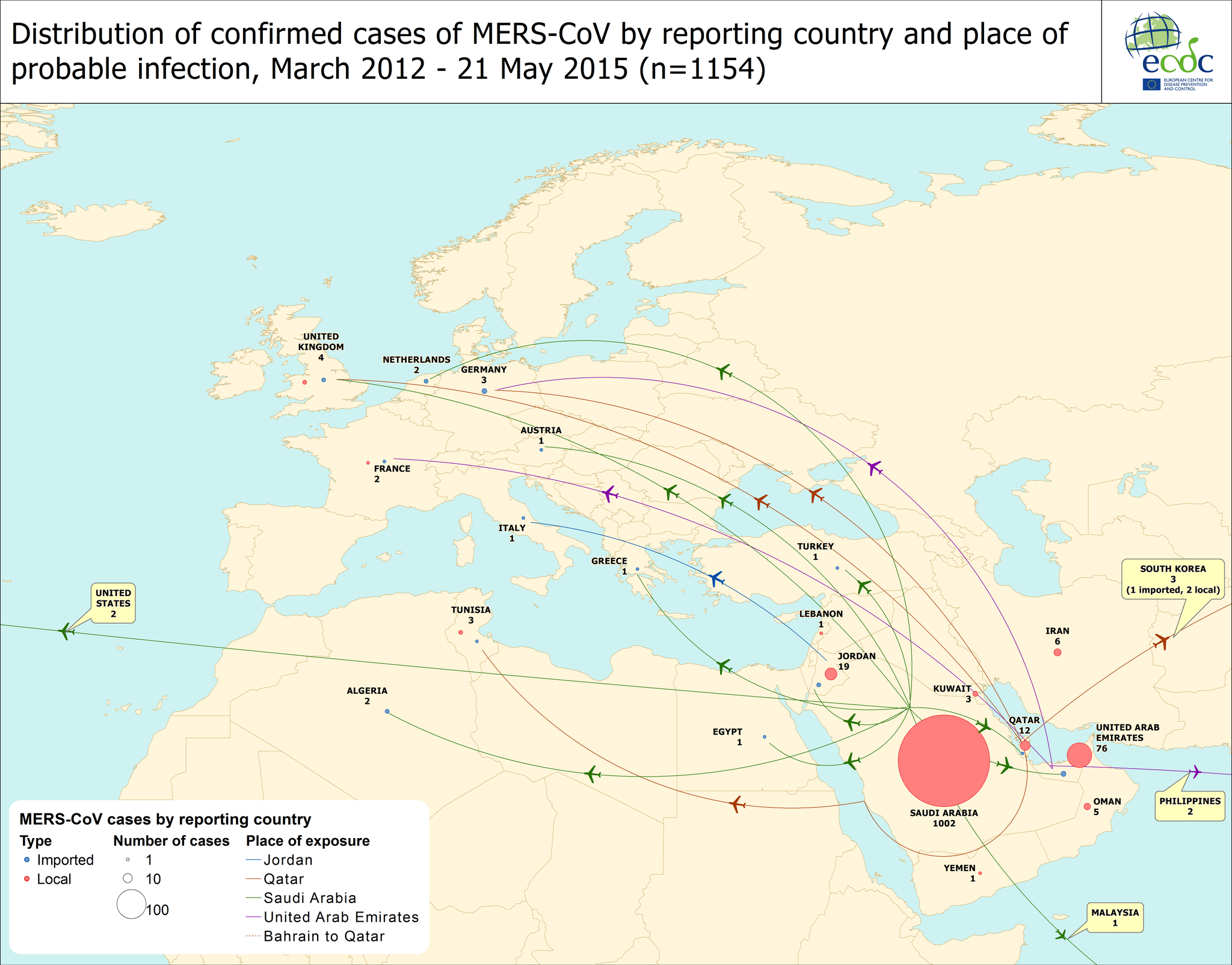
      Middle East respiratory syndrome coronavirus (MERS-CoV) managed to get out for some sightseeing - travelling to South Korea this week - and Ebola virus|Makona was given a helping hand to spread to new people in Guinea and Sierra Leone with a small splurge of new confirmed cases.

      MERS has now trickled into 24 countries world wide as shown in the European Centre for Disease Prevention and Control's (ECDC) epic 'travel-by-plane' map.

      Media preview
      The original of this is created by the ECDC and is presented here.
      Click on image to enlarge.
      Meanwhile, a crude extrapolation from current Ebola virus disease (EVD) case numbers saw the predicted date when we might reach zero cases, move further into June. 

      This could pull back again or it could move further away if the EVD clusters and sporadic cases continue to spread. We can't model that because it's entirely down to unpredictable human variables. We can list what those are, we can better prepare for them, we can educate about them and how to prevent them and we can acknowledge that they are real, but we cannot know when and in what mix they will come into play.

      Extrapolation of the public data for confirmed Ebola virus disease cases from
      WHO. The most recent week is boxed in red and bucked the trend of declining
       cases. To see how I made this please visit here.
      Click on image to enlarge. 
      The newest EVD cases remain mostly clustered around the Forecariah prefecture of western Guinea, on the north west border with Sierra Leone but also 5 new cases appeared in the north west of Guinea in Boke prefecture, which borders Guinea-Bissau. 

      Geographical distribution of new and total confirmed cases
      From the World Health Organization's Ebola virus disease Situation Report, 20MAY2015.
      Click on image to enlarge.
      Since the last EVD SitRep, two days of reporting have seen fewer cases than in the same two days of the week before. 

      So there's that. 

      Quickly reporting what is actually happening is invaluable for all sorts of reasons. Modelling and prediction allow us to get ahead of the virus. But having the data, and having them available publicly remains a challenge for every country and for every outbreak. 

      Public health data are about the public's health. If it has been considered worth collecting and collating, why not communicate it too?

      Wednesday, 6 May 2015

      Snapdate: Confirmed Ebola virus disease cases - the end in sight?

      I think we're a little bit beyond "jinxing" something by pointing it out, so here is graph of the confirmed Ebola virus disease cases based on the World Health Organization report date (Situation summary or Situation Report), including a basic model to predict when cases may hit zero, if nothing changes.

      The P-value for this linear trend model is 0.00067. The standard error = 19.29;R-square = 0.14.
      Click on graph to enlarge

      I use Tableau Desktop Public Edition v9.0.0 for my graphs these days - and have taken advantage of its inbuilt linear trend model for this chart. This "model" accounts for precisely nothing apart from the trend based on the numbers that are available and have been plotted in this particular way, on this day, near a full moon. 

      Reported numbers or outbreaks could flare up tomorrow or dry up overnight. 

      I can say that over the past 2 weeks, data from each new summary or report have moved the predicted "end" data closer - from mid-June to now early June.

      I am not an expert at modelling or statistics so please just take this at face value. The line suggests that if all things stay the same, we will reach zero considered cases per report around the 3rd of June 2015.

      Please let it be so. 

      Realistically, we may be heading for another "step down" - followed by a smaller trickle of ongoing cases for some period, ahead of a final push to zero. But there are experts who will know more about this than I.

      Once we get to zero, the 42 day count begins.

      Thursday, 9 April 2015

      Yes, there were signs that Ebola was in west Africa, perhaps as far back as 1973...

      This post has been moved to the new Virology Down Under platform on Wordpress.

      You can get to this specific post by clicking on the link below...
       
      http://virologydownunder.com/?p=4119&preview=true
       
      Please adjust your bookmarks.

      Apologies for any inconvenience.

      Friday, 3 April 2015

      Hans Rosling, a micro-outbreak of Ebola in Liberia and trust issues in Guinea...

      As is always the case, Prof Rosling can be seen in front of an audience here, providing a beautifully articulated example of how trust in the Ebola virus disease (EVD) treatment centre/unit plays such a pivotal role in (a) the containment of EVD, even witting a family and its contacts, and (b), the likelihood of survival of EVD patients.

      Frame taken from a BBC News video which was being hosted in
      an African Geographic Magazine story here. Red dots are survivors,
      black dots are deaths
      Click on image to enlarge.
      In this example, which you can listen to in its entirety here, as time went on, trust grew and this fewer transmission occurred and more f those infected, survived.

      This would seem to be a great example of what is lacking in Guinea - trust - a lack of trust that others are be able to stop the spread of virus and to save the lives of those infected. Thus people are not presenting for help at all and still being managed in the community - possibly infecting others - or else they are not presenting early enough, before the disease has done too much damage to the person. Trust and communication is increasingly seen as being as important to the successful reduction of cases in Liberia and Sierra Leone as the building of treatment centres - the two must co-occur.

      Trust comes from understanding, and that is heavily influenced by communication. Communication of accurate information, of clear and digestible information. Communication to the right people using the moist effective channels is also essential.

      It still feels like communication, or at least accurate and successful communication accessing the key important and influential people, may be the weakest part of the response in Guinea. It seems to have been better implemented in Liberia and Sierra Leone - or maybe just better received. Is it a groundwork thing? Difference in the way science is presented in different countries? I know far too little to guess further.

      There continue to be more security incidents and other types of refusal to cooperate in Guinea compared to the other two countries afflicted with the Makona variant of Ebola virus. These incidents are a marker of a community that does not believe or trust those claiming to be here to help. And that's a problem for stopping the constant rivulet of EVD cases in Guinea; a rivulet that never became the river of hundreds of EVD cases per week seen in Liberia or Sierra Leone, but was still a flow that seeded infection across the region and the world. A case anywhere is a threat everywhere, to paraphrase others.


      Location of laboratories in Guinea, Liberia, and Sierra Leone
       Location of laboratories in Guinea,
      Liberia, and Sierra Leone.
      From WHO SitRep 01APR2015.
      But there may be other issues to consider and question. 

      There are fewer treatment centres and laboratories in Guinea than in Liberia or Sierra Leone - strange given that Guinea is larger and that it still has a geographically widespread distribution of cases. 

      While it has lately been noted that new cases in Guinea could be adding to the tally more simply because of success in reaching more remote areas, this seems only to add support to the need for better communication and to provide more of a presence in these remote areas. Hopefully, now that this happening through the efforts of the US CDC and others, we will soon see the pay off as a reduction of EVD cases. But the rainy season is near and travel will be made into a muddy mess by that. Time has never been on the side of those trying to stop this epidemic.