This post has been moved to the new Virology Down Under platform on Wordpress.
You can get to this specific post by clicking on the link below...
https://virologydownunder.com/900-words-on-some-general-stuff-abou/
Please adjust your bookmarks.
Apologies for any inconvenience.
Showing posts with label science communication. Show all posts
Showing posts with label science communication. Show all posts
Saturday, 15 July 2017

Friday, 10 February 2017
Science needs to talk more but I know many scientists who don't...
This post has been moved to the new Virology Down Under platform on Wordpress.
You can get to this specific post by clicking on the link below...
https://virologydownunder.com/science-needs-to-talk-more/
Please adjust your bookmarks.
Apologies for any inconvenience.
You can get to this specific post by clicking on the link below...
https://virologydownunder.com/science-needs-to-talk-more/
Please adjust your bookmarks.
Apologies for any inconvenience.
Friday, 18 November 2016
The reality of the post-truth world's impact on science communication...
So:
We tweet 2each other.
We write 4each other.
We're considered elite.
We don't understand our community.
We can't reach them.
Cool. [sarcasm]
P.S.
Post-truth is now defined by the Oxford dictionary...
ADJECTIVE
Relating to or denoting circumstances in which objective facts are less influential in shaping public opinion than appeals to emotion and personal belief:
‘in this era of post-truth politics, it's easy to cherry-pick data and come to whatever conclusion you desire’
‘some commentators have observed that we are living in a post-truth age’
P.S.
Post-truth is now defined by the Oxford dictionary...
ADJECTIVE
Relating to or denoting circumstances in which objective facts are less influential in shaping public opinion than appeals to emotion and personal belief:
‘in this era of post-truth politics, it's easy to cherry-pick data and come to whatever conclusion you desire’
‘some commentators have observed that we are living in a post-truth age’
Friday, 26 August 2016
Get off my lawn you experts!
Two things were suggested by Richard P Grant in his recent piece for the Guardian, as reasons why scientists are losing the battle to communicate science.[1]
First, scientists keep telling people how to live their lives and second, scientists don't listen to people.
Okay - I agree. Scientists do that. When I started on social media, I mentally added "try not to be a supercilious git" to my list of things to do to be a better human being. That was up there with "make memories for my kids", "always work at my marriage", "don't speak ill of other people", "listen instead of interrupting", "don't be unintentionally racist", "be conscious of innate bias"...the list goes on and keeps growing.
But I still come across as a supercilious git on occasion. I'm not really sorry about that though. The main reason I do so is because my tribe is that of the scientist (#tribescience ?). A few different science tribes really. I've spent the past 30 years picking up the ways of my tribe - certain phrases, learning to speak in certain ways, using big scientific words, writing with a certain pattern, producing documents that everyone - including me - find boring, seeing patterns and thinking about how things around me can be tested, seeking out the next big idea that will fund my life and home loan and trying to remain agile enough to be prepared to update those views and words when all that I've learned changes in an instant. Imposter syndrome for an academic can drive the need to sound just as supercilious as our peers. It's a lot of baggage to set down if you dip in and out of interpreting science for the public. Facts, not excuses.
As a little experiment, I thought I'd look at how far listening got me when related to the "dangerous ones" [1]- the hardcore anti-vaccination believers. Not my first attempt to understand this group and not my last.
I'd already been in a small chat where someone @MaykeBriggs (not an anti-vaxxer let me stress) had suggested pesticides and "vaccine toxin" exposure should be looked at in relation to Zika virus and microcephaly in Brazil. I'd asked which toxins and we'd had a discussion about phenoxyethanol, used as a preservative in vaccines.[2,3] Interestingly, phenoxyethanol is used widely, because of its fragrant properties, in shampoos, toilet soaps, decorative cosmetics and is found naturally in avocado, endive and tea for example.[3] The things you learn when you read around a topic!
Next I received a snippet of an abstract by tweet from @LaLaRueFrench75. This went back and forth and just before I went to sleep got a request to comment on a couple of slides of aggregated science and theory by @2ndfor1st. When I woke up I had more tweets awaiting my sultana bran breakfast than on any day during the worst of the Ebola virus event (which got pretty busy for me).
I'd apparently inadvertently poked an anti-vaccine nest with a stick.
I Storified the whole thing if anyone wants to check it out.
The biggest thing for me was, I couldn't have told this group how to live their lives even if I'd wanted to! There was no discussion to be engaged in-just me being shown their material from several tweeters at once. Attempts to correct obviously wrong material were ignored, shouted down or artfully sidestepped.
I took a few other things away from this:
First, scientists keep telling people how to live their lives and second, scientists don't listen to people.
Okay - I agree. Scientists do that. When I started on social media, I mentally added "try not to be a supercilious git" to my list of things to do to be a better human being. That was up there with "make memories for my kids", "always work at my marriage", "don't speak ill of other people", "listen instead of interrupting", "don't be unintentionally racist", "be conscious of innate bias"...the list goes on and keeps growing.
But I still come across as a supercilious git on occasion. I'm not really sorry about that though. The main reason I do so is because my tribe is that of the scientist (#tribescience ?). A few different science tribes really. I've spent the past 30 years picking up the ways of my tribe - certain phrases, learning to speak in certain ways, using big scientific words, writing with a certain pattern, producing documents that everyone - including me - find boring, seeing patterns and thinking about how things around me can be tested, seeking out the next big idea that will fund my life and home loan and trying to remain agile enough to be prepared to update those views and words when all that I've learned changes in an instant. Imposter syndrome for an academic can drive the need to sound just as supercilious as our peers. It's a lot of baggage to set down if you dip in and out of interpreting science for the public. Facts, not excuses.
As a little experiment, I thought I'd look at how far listening got me when related to the "dangerous ones" [1]- the hardcore anti-vaccination believers. Not my first attempt to understand this group and not my last.
I'd already been in a small chat where someone @MaykeBriggs (not an anti-vaxxer let me stress) had suggested pesticides and "vaccine toxin" exposure should be looked at in relation to Zika virus and microcephaly in Brazil. I'd asked which toxins and we'd had a discussion about phenoxyethanol, used as a preservative in vaccines.[2,3] Interestingly, phenoxyethanol is used widely, because of its fragrant properties, in shampoos, toilet soaps, decorative cosmetics and is found naturally in avocado, endive and tea for example.[3] The things you learn when you read around a topic!
 |
| Example of anti-vax brochure. |
I'd apparently inadvertently poked an anti-vaccine nest with a stick.
I Storified the whole thing if anyone wants to check it out.
The biggest thing for me was, I couldn't have told this group how to live their lives even if I'd wanted to! There was no discussion to be engaged in-just me being shown their material from several tweeters at once. Attempts to correct obviously wrong material were ignored, shouted down or artfully sidestepped.
I took a few other things away from this:
- These are not the vaccine hesitant [5] - people sitting on the fence about whether this or that vaccine may be good or bad for their child. These are fully engaged professional aggregators of content, curates into a story to support whichever thread they are interested in highlighting.
This group create slick websites, videos, brochures and run a tight campaign to recruit like-minded followers and cast aspersions upon efforts to make our children even more healthy, reduce the burden of chronic disease and prolong life. - A central theme seems to be that there is a conspiracy to force their children to be injured by vaccination, perhaps mostly in relation to mandated vaccination, but vaccines in general.
But the community today could not show me any example of this injury. It has become a ethereal symbol for the movement, but there is no form nor substance to the claims of death or severe harm by vaccination. - If you choose to engage with this group, pick a particular point to address and do not let yourself be dragged away from it by the constant movement of goalposts you'll encounter. If you don't get the answer you're asking for, say that and move on.
- If you are a scientist planning to engage the public - engage with this group. There is much to learn about communication and about yourself.
You may be pilloried by your peers (psst - just don't tell them), but you may also gain important experience with extreme believers and very alternate viewpoints. - Those against using vaccines - at least based on my example - are mostly focused on the secondary ingredients especially preservatives and adjuvants - aluminium, phenoxyethanol, thiomersal.
This is pretty low hanging fruit though, because there could be more scientific studies to address some of the questions asked. Science has made a rod for its own back here. - This group do have valid concerns. But instead of being able to believe or engage experts, they choose to actively decry them as the puppets of commercial interests and instead seek out words, sentences, clips and snippets to support their views about their concerns.
Based on a lot of reading this past few days, this material is often "home made", out of context, quote studies that employ excessively high amounts of the chemical in question, or use the chemical repeatedly in a way that does not at all reflect vaccination, or use studies that do not have suitable control groups (h/t @JATetro). - The misuse of funds by medical doctors was also a big thing among this group. Apparently this extends to scientists - although that's laughable to me as I'm a science Doctor who has spent many years experiencing how hard it is to scrape together money to get to a conference let alone travel the globe in style.
I'm aware of the conflict of interest issues pertaining to medical doctors being paid by pharmaceutical interests. The presumption today was clearly that these payments sway these evil doctors towards prescribing that company's products, including more use of vaccines.
Oversight of vaccines both during early safety and subsequent clinical trials and when later while being monitored for adverse events once they are commercialised, requires experts to come together to review data (costly) - data which themselves are very expensive to collect and collate.
These payments, must be transparently documented or else consumer trust is rightly shaken. - Those who invent, develop, administer and oversee use of vaccines are seen as different
humans from the true believer anti-vaxxers. This may be for ulterior motives or because of a past bad experience.
"Them and us"
The impression I got was that the professionals are not thought of as having the same skin in the game - their own families, lives and children - as do "the public".
Do some of our science and medical doctors need to humanise more, at least in this space? - If you write about scientists who try and engage with the public, maybe think more deeply about the term "science communication". Currently it seems to cover everything that comes out of the mouth/keyboard of a scientist. Its too broad. How about adding some more terms? What about Science Interpretation? Science Engagement? If you paint all science communication as coming from a place of arrogance and control, you paint every scientist, even those who honestly try to do better, as arrogant and controlling.
That's some poor research right there.
It's also a tone that is likely to discourage other scientists out of theirhighly competitive, poorly funded, stressful, depressing, abusive, overcrowded, biased,"cosy little bubble and make an effort to reach people where they are, where they are confused and hurting; where the need"

Of course, if we do seek out people who seem confused, there is no guarantee we'll be able to get a word in edgewise. That does make being a tribal and supercilious git all the more challenging. But it's what we scientists excel out. Right?
References...
- Why scientists are losing the fight to communicate science to the public
https://www.theguardian.com/science/occams-corner/2016/aug/23/scientists-losing-science-communication-skeptic-cox - http://www.ncbi.nlm.nih.gov/pubmed/7764595
- http://www.ncbi.nlm.nih.gov/pubmed/17722087
- http://www.ncbi.nlm.nih.gov/pubmed/22036980
- http://www.ncbi.nlm.nih.gov/pubmed/?term=julie+leask+hesitant
Sunday, 14 August 2016
Social media scientists - we're probably still talking mostly to ourselves...
This post has been moved to the new Virology Down Under platform on Wordpress.
You can get to this specific post by clicking on the link below...
http://virologydownunder.com/social-media-and-scientists-the-communication-must-go-on/
Please adjust your bookmarks.
Apologies for any inconvenience.
You can get to this specific post by clicking on the link below...
http://virologydownunder.com/social-media-and-scientists-the-communication-must-go-on/
Please adjust your bookmarks.
Apologies for any inconvenience.
Friday, 29 July 2016
Editor's Note #26: Virology Down under gets an award!!
Well this is some pretty cool news to wake up to on a Friday morning!!
Virology Down Under (this blog and its extended presence on LinkedIn and Facebook) has just been awarded one of InfectionControl.tips "Top Innovations of the Year of 2016" awards for global engagement.

I'm one proud little blogger!
With the moniker of Join. Contribute. Make A Difference, InfectionControl.tips has been a welcome addition to the field of open, public-speak communication of health information and provides an avenue for health professionals to explain things to an eager and wide audience.
My partner in crime (and life) @kat_arden and I have written a few pieces for this site now, including our latest effort - The Language of Zika Virus Testing. No doubt we'll contribute more as time allows and needs dictate.
If you haven't already, it's also a great idea to have a try at writing in a different non-academic style of language too. IC.tips' editors can help you out with that if needed.
We also love that IC.tips is open-access, free and shares our enthusiasm for wanting to make a difference in some way.
You can see other award winners at: http://infectioncontrol.tips/award-top-innovations-year/

Wednesday, 25 May 2016
How are scientists responding to the threat of mosquito-borne viruses?
 |
| Photo courtesy of Dr. Sonja Hall-Mendelin, Forensic and Scientific Services, Department of Health, Queensland. |
Dr. @kat_arden, Dr Sonja Hall-Mendelin and myself wrote a story trying to give you a taste of what goes on, kinda behind the scenes, in Queensland, the only State in Australia that has the two tiny bads - Aedes aegypti and Aedes albopictus. Also the State with the greatest number of detected human Zika virus infections in travellers.
So, thanks to the foresight of the crew at Croakey, we have been able to briefly touch on the hard work done by Queensland's many innovative and agile scientists, medical doctors, entomologists, council workers, response teams and other collaborators whom I've undoubted and very unintentionally failed to list.
If you like the story - see the link below - please tweet it, facebook it and send it to your family and friends. This may lead to more of these kinds of pieces in the future - but only if you like them.
This was written for the community.
Thursday, 21 April 2016
Communicating science and medical research...
This post has been moved to the new Virology Down Under platform on Wordpress.
You can get to this specific post by clicking on the link below...
http://virologydownunder.com/science-and-outreach-the-good-the-bad-and-why-to-get-involved/
Please adjust your bookmarks.
Apologies for any inconvenience.
You can get to this specific post by clicking on the link below...
http://virologydownunder.com/science-and-outreach-the-good-the-bad-and-why-to-get-involved/
Please adjust your bookmarks.
Apologies for any inconvenience.
Friday, 25 December 2015
Avian influenza A(H7N9) virus case data in humans: more chicken scratchings
This is an example of a 2015 case announcement from the World Health Organization (WHO). I think it aims to provide information on some avian influenza A(H7N9) cases that occurred in China.
I suppose it does do that in the most basic sense. Yes, if you were a casual electronic browser to the WHO disease outbreak news site (...get out more!) then you would learn of 15 additional human cases of disease presumably due to H7N9 infection. Twenty percent of these cases died and this happened within a month.
But consider these questions for a moment:
When sufficient - or any - detail is lacking, then it comes down to the public to look for any answers they seek...by themselves. In this case, that has been FluTrackers & Co; this source has proven itself very worthy for this and for other viral threat monitoring, but cannot be expected to fill this need indefinitely.[2,3]
H7N9 is a good example of an absence of obvious change to the flow of information that the world's public, citizen scientists and its more professional scientists receive about new infectious threats. And this is all a bit strange because I was sure we'd heard a lot about the need to do much, much better on this sort of tracking and chatting in 2014/5 during one of the biggest modern moments of being "caught with our pants down" - the Ebola virus disease epidemic.
Time and viruses wait for no person. Be faster.
Ho. Ho. Ho.
References...
 |
| From WHO Disease Outbreak News (DON) at http://www.who.int/csr/don/15-june-2015-avian-influenza-china/en/ |
But consider these questions for a moment:
- Why would you visit the WHO to learn of this, if you were not seeking some actual detail and evaluation of risk?
- If you were a casual browser, I expect you would come away from this with some out-of-context concerns about a bolus of cases in such a short period, spanning a wide age range and occurring across considerable geographic distance. Should you be worried? Is this the precursor to some larger outbreak? Each difficult to answer from this very small cross-section of information.
- These public data are relied upon by some when they write papers or release infectious disease reports - so why not include key - yet deidentified - demographic detail in a line list format - remember MERS-CoV in South Korea anyone? That WHO list [4] was messy [5] but it was a step forward for those outside the WHO network who wanted free, publicly available basic data, quickly

When sufficient - or any - detail is lacking, then it comes down to the public to look for any answers they seek...by themselves. In this case, that has been FluTrackers & Co; this source has proven itself very worthy for this and for other viral threat monitoring, but cannot be expected to fill this need indefinitely.[2,3]
H7N9 is a good example of an absence of obvious change to the flow of information that the world's public, citizen scientists and its more professional scientists receive about new infectious threats. And this is all a bit strange because I was sure we'd heard a lot about the need to do much, much better on this sort of tracking and chatting in 2014/5 during one of the biggest modern moments of being "caught with our pants down" - the Ebola virus disease epidemic.
Time and viruses wait for no person. Be faster.
Ho. Ho. Ho.
References...
- http://ecdc.europa.eu/en/publications/Publications/RRA-Influenza-A-H7N9-update-four.pdf
- http://www.ncbi.nlm.nih.gov/pubmed/24885692
- http://www.ncbi.nlm.nih.gov/pmc/articles/PMC4140362/pdf/jphr-2012-2-e29.pdf
- http://www.who.int/emergencies/mers-cov/MERS-CoV-cases-rok.pdf?ua=1
- http://virologydownunder.blogspot.com.au/2015/06/matching-mers-case-identification.html
- https://flutrackers.com/forum/forum/china-h7n9-outbreak-tracking/143874-flutrackers-2013-15-human-case-list-of-provincial-ministry-of-health-government-confirmed-influenza-a-h7n9-cases-with-links?t=202713
Saturday, 4 July 2015
Editor's Rant: Communicating the data and about the data...

When it is, it may be available in unfriendly formats. It may not be made public at all. When it is available, it is often slow to appear or it may have random reporting gaps, or be partially incomplete. The style of the released data can change overnight as well, sometimes going from detail to summary.
So why bother about trying to get hold of these numbers at all? It's not like I work in the field. Well, that is a question I'm increasingly asking myself of late too. My personal reason has been because I think there need to be more voices in the vacuum between the numbers being reported and the often dry public health reports. I think scientists, even if they are not lifetime experts on a given virus or outbreak, still have much to offer when they come out from behind their manuscripts and apply their skills to interpreting what's happening. Well, many do anyway. And they should do it more. Now, perhaps more than ever, science needs steer away from its cold, dense and boring niche writing to a chattier, more helpful and community-based style of engagement. It astonishes me how often the public's interpretation of outbreak numbers must come from the media or from hobbyists, or even professionals who work in other areas and give of their own time to help explain something to us in their personal time. Helpful and engaging information and better access should come from the source of the data.
So it becomes really annoying (you would have to know me quite well to know how many times I just rewrote those words) when data are given out for public use that are a total mess...and there is not one tiny mote of explanation for it. I called it appalling on Twitter tonight. And at other times there are no explanations for why there are gaps, why data are delayed, why the format may have changed today compared to last week, why a line list is missing a case, using a new and totally independent numbering scheme or suddenly reshuffled, why there is no news about a new outbreak. No word. No contact. No-one taking the lead. No...communication.

Thursday, 14 May 2015
Outbreak resources: more expert detail presented simply, to more people, at a trusted site, quickly, and for free...
Many, many of us have learned a lot about Ebola virus and Ebola virus disease (EVD) over the past 61 weeks - some more than others.
Some have paid very dearly for their new knowledge and some few have leveraged the event to try and make a buck or draw more attention to themselves or their trade.
Many have been scared - few outside Guinea, Sierra Leone and Liberia have had a real need to be - but fear of this tiny killer is understandable. I stand by my comments on that from back in August when the United States woke up to what had been happening in west Africa for five months, and promptly started freaking out...without evidence of any widespread threat or danger.
For all of the unwanted, unnecessary and often inflammatory commentary, hypotheses, guesses and conspiracy theories, there was some good information to be found about EVD. Sometimes it was only able to be found by academics or others with access to journals that sit behind fee-for-view virtual walls (paywalls). Sometimes the science was too dense for the public to follow - even when they could access it. But most of the time it just took far more digging to unearth the basics than it should have. It would have been good if more of those who could access and interpret that information, had proactively done so.
EVD in west Africa helped generate a lot of publicly accessible descriptive information about some of the technical language of infectious disease outbreaks. But there could be more. New information for public consumption should be...
There will always be a portion of the public who seek their news and detail from the loudest and most garish 'news' source. There are also many who would like to be the smartest person at water cooler - but not if that comes at the expense of trying to locate and then wade through reams of technical guff.
More expert detail, simply presented, to more people, from a trusted site, quickly and for free.
The next 'Ebola' might have a much harder time getting traction in a territory if its population is ready for it, or can get up to speed quickly.
Some have paid very dearly for their new knowledge and some few have leveraged the event to try and make a buck or draw more attention to themselves or their trade.
Many have been scared - few outside Guinea, Sierra Leone and Liberia have had a real need to be - but fear of this tiny killer is understandable. I stand by my comments on that from back in August when the United States woke up to what had been happening in west Africa for five months, and promptly started freaking out...without evidence of any widespread threat or danger.
 |
| Not everyone has a library on everything |
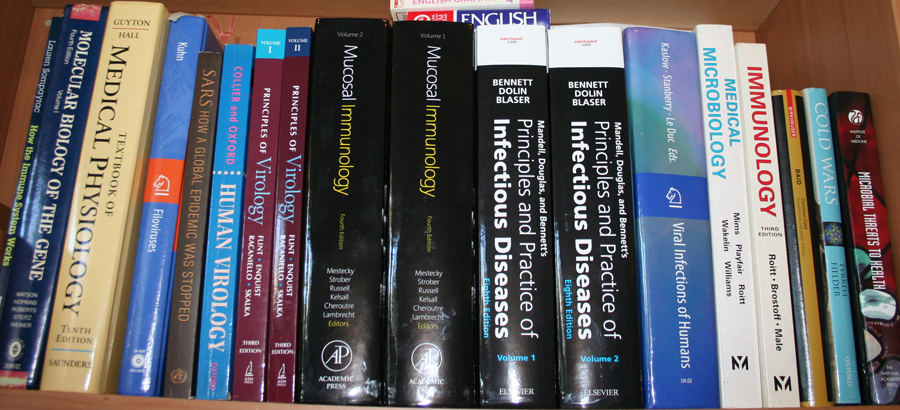
EVD in west Africa helped generate a lot of publicly accessible descriptive information about some of the technical language of infectious disease outbreaks. But there could be more. New information for public consumption should be...
- Clear, simple information that can be easily read and shared using today's short, punchy and graphic-laden social media communication tools
- Information that is quick and easily found or can be found using (way more) friendly search engines. A page of 2,000+ poorly descriptive results returned from a keyword search...is not helpful
- Broad descriptions about broad topics - not just narrow descriptions for one aspect of one outbreak caused by one virus. We need to explain the wider patterns that are shared among many outbreaks and by many viruses. Ebola virus is not the first bloodborne virus, not the first sexually transmitted virus, not the first virus to spread in vomit and faces or by droplets, or to survive on surfaces, or to mutate, or to have an RNA genome, or to be detected by RT-PCR, or to have its genome sequenced, or to be the trigger for contact tracing, or to have just appeared in west Africa in 2014...etc. Start tying these patterns together to give the public a better sense of what we live with every day, instead of responding to the now and the scary.
- A single online, well formatted (for multiple devices) site that hosts all this information provided, checked, updated and agreed upon by experts in the fields, written by communicators and hosted by the new and improved World Health Organization (WHO). The world needs a one-stop outbreak info shop that it can rely on. And that shop should be staffed by assistants who are available to answer questions or direct customers to the aisles best suited to their needs. We expect access to information and answers to questions from our phone company, so why not from our World's health experts?
- Using better citation to acknowledge the reference material in public health information - what is so wrong with letting everyone know what the guidelines are guided by? Anecdotal is not enough.
- Date stamped to make it clear when it was written and when it was updated. Am I looking at contemporary thinking - or something from 2 days ago before that major discovery/event changed everything we knew about virus X?
There will always be a portion of the public who seek their news and detail from the loudest and most garish 'news' source. There are also many who would like to be the smartest person at water cooler - but not if that comes at the expense of trying to locate and then wade through reams of technical guff.
More expert detail, simply presented, to more people, from a trusted site, quickly and for free.
The next 'Ebola' might have a much harder time getting traction in a territory if its population is ready for it, or can get up to speed quickly.
Friday, 3 April 2015
Hans Rosling, a micro-outbreak of Ebola in Liberia and trust issues in Guinea...
As is always the case, Prof Rosling can be seen in front of an audience here, providing a beautifully articulated example of how trust in the Ebola virus disease (EVD) treatment centre/unit plays such a pivotal role in (a) the containment of EVD, even witting a family and its contacts, and (b), the likelihood of survival of EVD patients.
In this example, which you can listen to in its entirety here, as time went on, trust grew and this fewer transmission occurred and more f those infected, survived.
This would seem to be a great example of what is lacking in Guinea - trust - a lack of trust that others are be able to stop the spread of virus and to save the lives of those infected. Thus people are not presenting for help at all and still being managed in the community - possibly infecting others - or else they are not presenting early enough, before the disease has done too much damage to the person. Trust and communication is increasingly seen as being as important to the successful reduction of cases in Liberia and Sierra Leone as the building of treatment centres - the two must co-occur.
Trust comes from understanding, and that is heavily influenced by communication. Communication of accurate information, of clear and digestible information. Communication to the right people using the moist effective channels is also essential.
It still feels like communication, or at least accurate and successful communication accessing the key important and influential people, may be the weakest part of the response in Guinea. It seems to have been better implemented in Liberia and Sierra Leone - or maybe just better received. Is it a groundwork thing? Difference in the way science is presented in different countries? I know far too little to guess further.
There continue to be more security incidents and other types of refusal to cooperate in Guinea compared to the other two countries afflicted with the Makona variant of Ebola virus. These incidents are a marker of a community that does not believe or trust those claiming to be here to help. And that's a problem for stopping the constant rivulet of EVD cases in Guinea; a rivulet that never became the river of hundreds of EVD cases per week seen in Liberia or Sierra Leone, but was still a flow that seeded infection across the region and the world. A case anywhere is a threat everywhere, to paraphrase others.
But there may be other issues to consider and question.
There are fewer treatment centres and laboratories in Guinea than in Liberia or Sierra Leone - strange given that Guinea is larger and that it still has a geographically widespread distribution of cases.
While it has lately been noted that new cases in Guinea could be adding to the tally more simply because of success in reaching more remote areas, this seems only to add support to the need for better communication and to provide more of a presence in these remote areas. Hopefully, now that this happening through the efforts of the US CDC and others, we will soon see the pay off as a reduction of EVD cases. But the rainy season is near and travel will be made into a muddy mess by that. Time has never been on the side of those trying to stop this epidemic.
 |
| Frame taken from a BBC News video which was being hosted in an African Geographic Magazine story here. Red dots are survivors, black dots are deaths Click on image to enlarge. |
This would seem to be a great example of what is lacking in Guinea - trust - a lack of trust that others are be able to stop the spread of virus and to save the lives of those infected. Thus people are not presenting for help at all and still being managed in the community - possibly infecting others - or else they are not presenting early enough, before the disease has done too much damage to the person. Trust and communication is increasingly seen as being as important to the successful reduction of cases in Liberia and Sierra Leone as the building of treatment centres - the two must co-occur.
Trust comes from understanding, and that is heavily influenced by communication. Communication of accurate information, of clear and digestible information. Communication to the right people using the moist effective channels is also essential.
It still feels like communication, or at least accurate and successful communication accessing the key important and influential people, may be the weakest part of the response in Guinea. It seems to have been better implemented in Liberia and Sierra Leone - or maybe just better received. Is it a groundwork thing? Difference in the way science is presented in different countries? I know far too little to guess further.
There continue to be more security incidents and other types of refusal to cooperate in Guinea compared to the other two countries afflicted with the Makona variant of Ebola virus. These incidents are a marker of a community that does not believe or trust those claiming to be here to help. And that's a problem for stopping the constant rivulet of EVD cases in Guinea; a rivulet that never became the river of hundreds of EVD cases per week seen in Liberia or Sierra Leone, but was still a flow that seeded infection across the region and the world. A case anywhere is a threat everywhere, to paraphrase others.
 |
| Location of laboratories in Guinea, Liberia, and Sierra Leone. From WHO SitRep 01APR2015. |
There are fewer treatment centres and laboratories in Guinea than in Liberia or Sierra Leone - strange given that Guinea is larger and that it still has a geographically widespread distribution of cases.
While it has lately been noted that new cases in Guinea could be adding to the tally more simply because of success in reaching more remote areas, this seems only to add support to the need for better communication and to provide more of a presence in these remote areas. Hopefully, now that this happening through the efforts of the US CDC and others, we will soon see the pay off as a reduction of EVD cases. But the rainy season is near and travel will be made into a muddy mess by that. Time has never been on the side of those trying to stop this epidemic.
Sunday, 22 February 2015
Two tales of the same review...
Could these articles about a recent review on Ebola virus transmission be any more different?
Which do you "believe"?
Limited airborne transmission of Ebola is ‘very likely,’ new analysis says Post
From the Washington Post
http://www.washingtonpost.com/news/to-your-health/wp/2015/02/19/limited-airborne-transmission-of-ebola-is-likely-new-study-says/
No, A New Scientific Report Does Not Say That Ebola Is Now Airborne
From Vice News
https://news.vice.com/article/no-a-new-scientific-report-does-not-say-that-ebola-is-now-airborne
The article being referred to is from a team of "Ebola experts" and is entitled:
Transmission of Ebola Viruses: What We Know and What We Do Not Know.
http://mbio.asm.org/content/6/2/e00137-15
At this juncture might I just add that I do not consider myself a real Ebola virus disease (EVD) expert. I'm just an interested scientist who blogs about Ebola virus and the most recent outbreaks and epidemic. To be an expert, at least in my opinion, one would have to have one or more of the following under one's belt:
Which do you "believe"?
Limited airborne transmission of Ebola is ‘very likely,’ new analysis says Post
From the Washington Post
http://www.washingtonpost.com/news/to-your-health/wp/2015/02/19/limited-airborne-transmission-of-ebola-is-likely-new-study-says/
No, A New Scientific Report Does Not Say That Ebola Is Now Airborne
From Vice News
https://news.vice.com/article/no-a-new-scientific-report-does-not-say-that-ebola-is-now-airborne
The article being referred to is from a team of "Ebola experts" and is entitled:
Transmission of Ebola Viruses: What We Know and What We Do Not Know.
http://mbio.asm.org/content/6/2/e00137-15
At this juncture might I just add that I do not consider myself a real Ebola virus disease (EVD) expert. I'm just an interested scientist who blogs about Ebola virus and the most recent outbreaks and epidemic. To be an expert, at least in my opinion, one would have to have one or more of the following under one's belt:
- to have conducted experiments on the Ebola virus and written those up in the scientific literature
- to have generated data from other derivative works with parts of the virus, such as in vaccine works, and written those up
- to have treated or cared for patients with Ebola virus disease (EVD)
- to have worked in a public health capacity managing an outbreak of EVD
The rest of us are interested parties but will likely always miss some aspect of understanding the virus and its disease having not been in close contact with it, its hosts or the response to it.
Subscribe to:
Posts (Atom)