Friday, 12 December 2014

WHO Media Release: Sierra Leone reacts swiftly in the face of desperate need

I am reprinting in full, with permission, what I think is a really well written "story behind the numbers". These stories provide invaluable context around the various individual human and community tragedies that are constantly occurring during this epidemic. They also highlight the many difficulties faced by those trying to help people, track and contain spread and and collate all the numbers. Those numbers may be dispassionate in their quantification of aspects of the epidemic, but they are so important to guide timely aid to the right areas and at the right scale

Freetown 10 December 2014 - Racing to fact check an ominous spike in Ebola cases from the remote diamond district of Kono in eastern Sierra Leone, bordering Guinea, a World Health Organization rapid response team found a worse-than-expected scene. WHO and the U.S. Center for Disease Control (CDC) joined forces with the Sierra Leone National Ebola Response Center (NERC) and Ministry of Health and Sanitation (MoHS) to sound the alarm and are now rallying all-comers in a massive build up to contain this burgeoning Ebola outbreak which ran the risk of continuing to grow and remaining hidden as world attention focuses on urban centers.

“Our team met heroic doctors and nurses at their wits end, exhausted burial teams and lab techs, all doing the best they could but they simply ran out of resources and were overrun with gravely ill people,” explains Dr Olu Olushayo, WHO National Coordinator, Ebola Epidemic Response. “In districts like Kono, with moderate transmission confined to limited villages and chiefdoms, the best chance of eliminating transmission is through aggressive and comprehensive case investigation and contact tracing,” he said. Scattered villages in 8 of the 15 chiefdoms are affected.

Reacting on intel from the Ministry of Health of Sierra Leone, WHO sent a seasoned field epidemiologist to Kono 10 days ago to tease out whether reported Ebola cases told the whole story. Cases go unreported for a variety of reasons and are exacerbated when overwhelmed and under-resourced frontline workers are unable to reach remote areas to get the truth from reluctant villagers. The surveillance officers had no vehicles. WHO and CDC quickly sent more investigators and rugged trucks.

They uncovered a grim scene. In 11 days, 2 teams buried 87 bodies, including a nurse, an ambulance driver, and a janitor drafted into removing bodies as they piled up at the only area hospital, ill-equipped to deal with the dangerous pathogen. In the 5 days before the team arrived, 25 people died in the hastily cordoned off section of the main hospital serving as a makeshift Ebola holding center.

As of 9 December 2014, this district of over 350 000 people officially has 119 reported cases. Upon hearing the WHO findings, Dr. Amara Jambai, MoHS Director of Disease Prevention and Control harkened a local saying to describe what remains yet to be discovered, "we are only seeing the ears of the hippo."

Help is arriving daily. The NERC and MoHS for the Government of Sierra Leone and UNMEER with WHO support are connecting ready-to-help partners with an all-out multi-agency response to critical needs on the ground. WHO field staff are sharing their expertise with surveillance investigators, community mobilizers, infection controllers, and coordinators. The doctors from Partners in Health and Wellbody Alliance who supported the overwhelmed holding center, are willing to stay on board to support care at the source in outlying health posts. The International Federation of the Red Cross will build a new Ebola Treatment Center on a tight timetable, while they disinfect the hospital with MoHS and create a temporary safe holding unit. The IFRC Kenema Ebola Treatment Center will take Kono patients until these solutions are in place. CDC has staff on the ground. UNMEER has lent it’s helicopters to the effort in support of the UN family (WHO, UNICEF, UNFPA, WFP, and others) engaged in building up capacity for staff and volunteers through training, materials and logistical support. International Rescue Committee is supporting infection prevention activities in the district. Funders such as DIFD and USAID are making much of the fast response possible. The race is on in this frontier fight against the virus, as Ebola responders dash to get ahead of the epidemic rather than chasing its tail.


Monday, 17 November 2014

Ebola testing: 48-72 hours for a negative to turn positive

Currently, some fraction of the people who present very early after they may have been infected by Ebola virus for testing, return a negative result. This is probably a rare event because the majority of cases arrive for care with Ebola virus disease (EVD) already well underway.

The latest Centers for Disease Control and Prevention (CDC) guidance in these instances is to wait (48 to) 72 hours and see if the patient remains ill, or becomes more unwell. If they do either of these, a second test is performed.[1] If the suspect case recovers from illness, no repeated testing is indicated. 

The test we rely on to confirm a clinically suspected EVD case is called a reverse transcriptase polymerase chain reaction (RT-PCR). RT-PCR is a technique designed to  seek out a tiny but very specific region of the Ebola virus's RNA genome, copy it into DNA then amplify those DNA copies a billion-fold by making more copies. Somewhere during that exponential amplification process, the technology of the day (currently fluorescence detection but formerly agarose gel detection, radiation and chemiluminescence) allows us to identify that the specific DNA we seek is appearing above an arbitrary threshold...we have a positive test result for Ebola virus. 

RT-PCR is a very sensitive technique. It was not that long ago - the 80s, not that long for some of us anyway - that clinicians and scientists were complaining that PCR methods were too sensitive. This was in large part because PCR was too successful at finding infectious agents where, and when, they had not been previously found. Change to dogma was in the wind. Fast forward to today and now we're lamenting that PCR isn't always sensitive enough. Very early on after acquiring what we later know to be a true infection, even exquisitely sensitive PCR methods can fail to detect those earliest of viruses while they are struggling to gain a foothold in our cells and replicate themselves to levels that outstrip our immune system's capacity to contain. Whether this is because the virus is hidden away in organs during its early replication or whether too few circulating viruses yet exist to surpass the necessary threshold of the RT-PCR assay's sensitivity at these early stages is unclear.

EVD patients who are not yet showing signs and symptoms of disease may present early for testing and care because they they are healthcare workers with a suspected or known exposure, or they may be the contact of a known EVD case or infected animal being tested early on to exclude infection. But as we have seen and read anecdotally, that first test can sometimes be negative; not due to inhibition of the RT-PCR (which can also happen, just not so much with today's purification methods) nor because they are truly uninfected, but simply because we're testing too early. These are examples of false negative results.

For the past few weeks I have been trying to find he evidence that underpins why the world chooses to use a 48-72 hour window in its guidelines. I've been asking a lot of people-and I thank those who replied. Tonight the very diligent and extremely tolerant folks at the World Health Organization got back to me with a quote from Dr Pierre Formenty, team leader Emerging and Dangerous Pathogens. A hard man to get hold of sometimes-as you might imagine. He said (lightly edited)...
There is at least one documented case during an outbreak in Africa; a contact with fever = a suspect case; he was negative at day 1 with RT-PCR (CDC Lab) and was found positive at day 3 (when retested).
So the 48-72 hours come from this incident. We want to be on the safe side and limit the number of false negative that are inevitable with any test.
And so there you have it. If anyone has anything further to add to this story, I'd be most happy put it here.

References...

Sunday, 2 November 2014

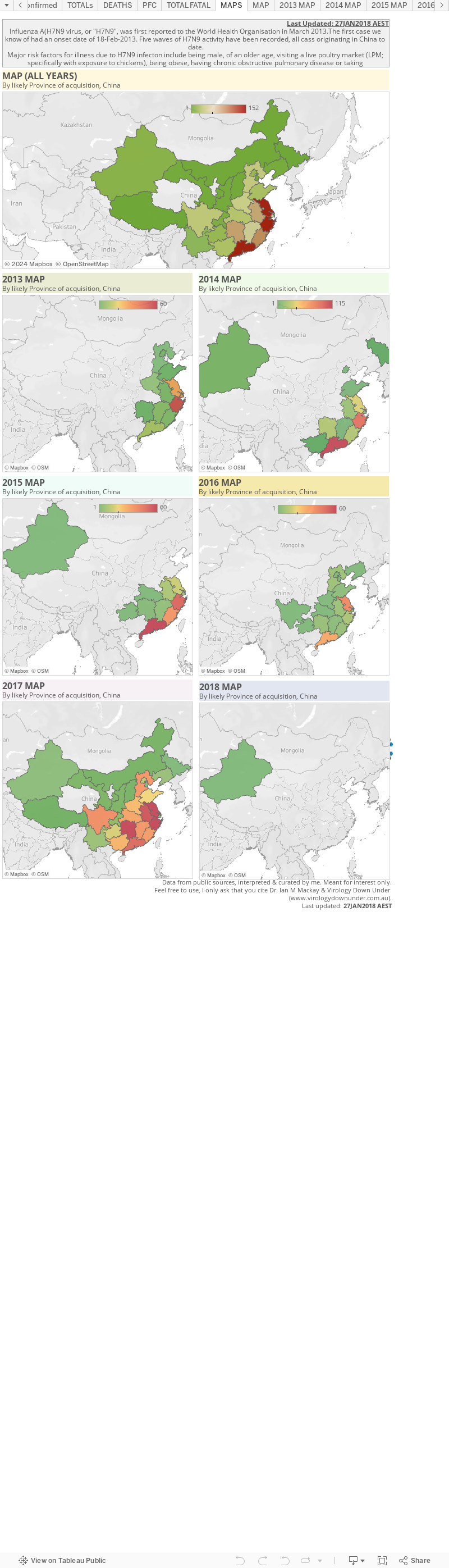
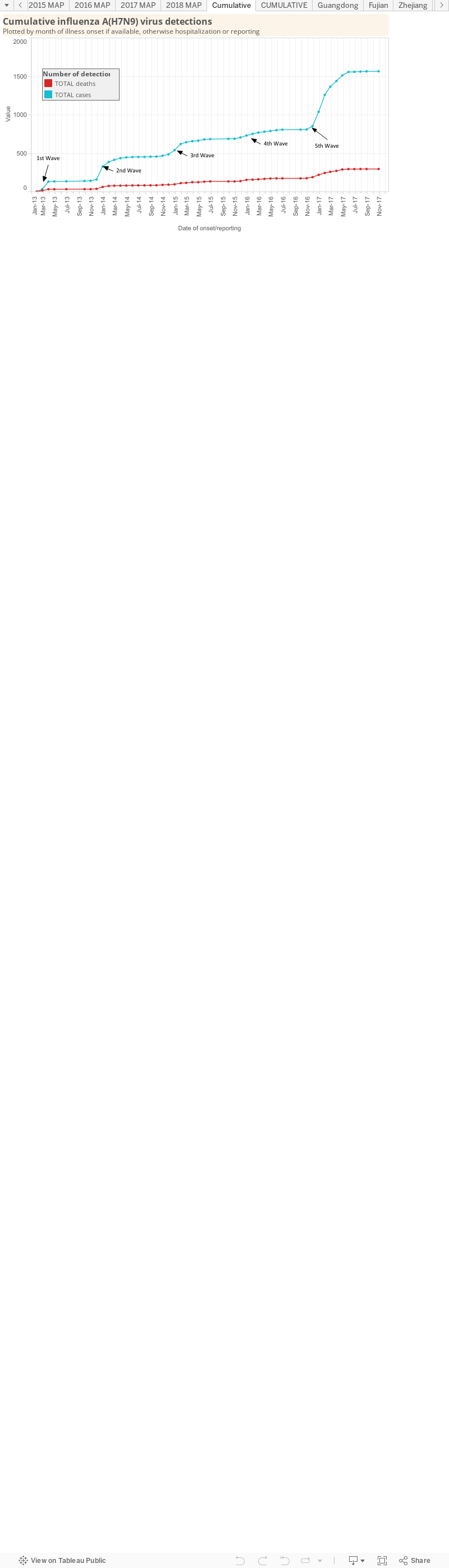
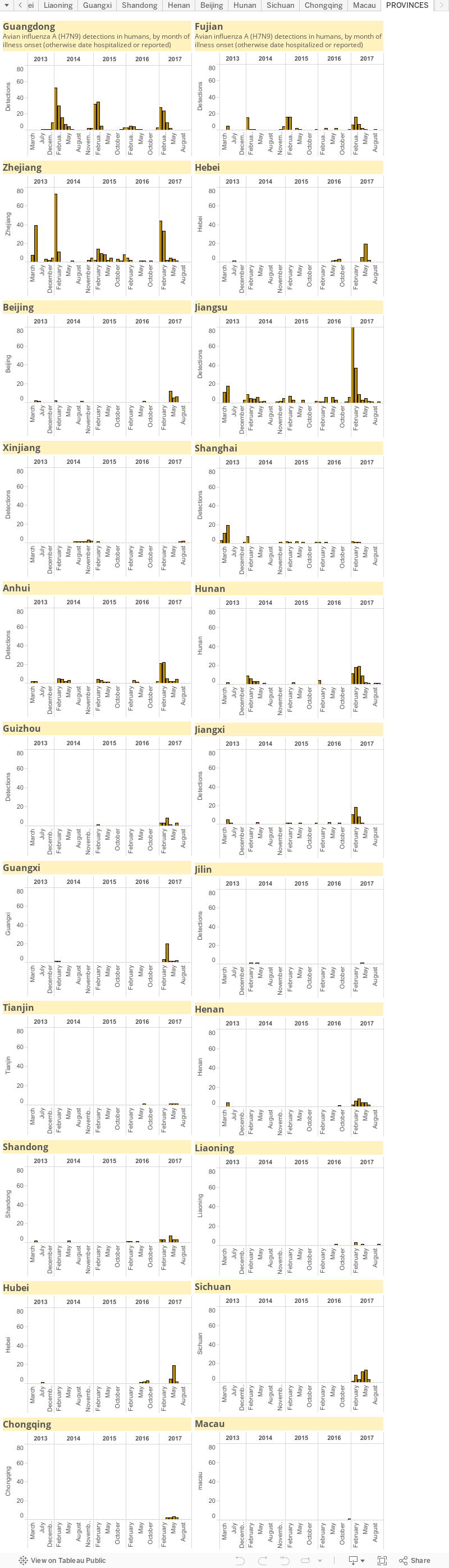
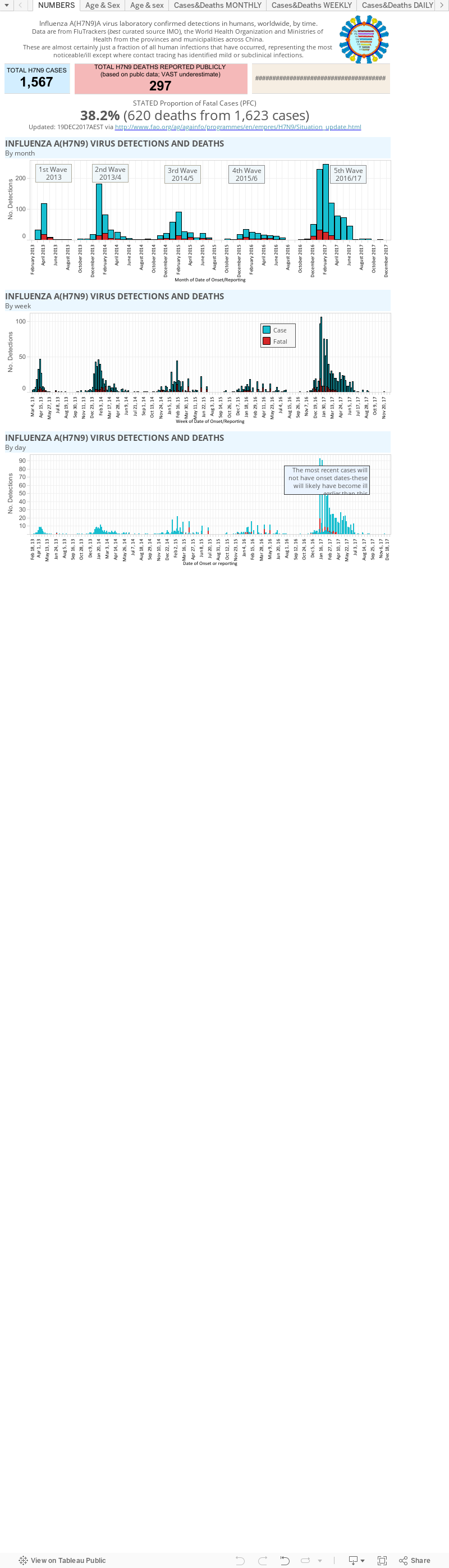
Influenza A(H7N9) virus: detection numbers and graphs...

This is a static page that houses my graphs of influenza A(H7N9) virus ("H7N9") numbers produced by the various Ministries of Health for the provinces and municipalities of China, Hong Kong's Centre for Health Protection (CHP) the World Health Organization and FluTrackers.

Please be aware that these numbers are in flux during the winter epidemic. They are a guide only.

There is also an accompanying map page which for now is located here.


Reminders: 
  • The graphs above, as with all on VDU, are made for general interest only. They are also freely available for anyone's use, just cite the page and me please. The data can be downloaded by clicking on the "Download" link at the bottom-right of each dashboard. It may be that I have misinterpreted the language in the reports (sometimes a little tricky to wade through) or miscalculated some totals based on the way data have been presented.
  • In any outbreak, epidemic or pandemic caused by a know or emerging pathogen, the numbers presented publicly, and used in these graphs, are expected to represent only a fraction of all the cases that have and are occurring. This is just the nature of the imperfect biological'ness of these events.
  • I am only able to plot what is publicly available-you could do this too. No secret associations or back-room deals provide me with these data.

Friday, 31 October 2014

The bad the worse and the over-interpreted...

EVD case numbers between WHO reports. 
The World Health Organization (WHO) Ebola virus disease (EVD)case numbers that came out on 29-Oct were pretty big (see graph on the left). As if there weren't already enough new cases and deaths every 2-5 days, now there is this bolus of 3,562 cases added to the total. And a net change in deaths of -2? What the heck?  

Let's see if we can add some context.

According to a number of past WHO reports, a lot of effort has been going in to trying to collect data more effectively including improving the linkage of lab results to cases, cases to deaths, lab data to deaths and probably a million other things. 

Dr Bruce Aylward
http://www.who.int/dg/adg/aylward/en/
In the previous Roadmap SitRep and Roadmap update, the Liberian numbers did not move - they even had the same date. That was new and it was concerning because it suggested that reporting had been stopped or collapsed entirely. However this new large download of cases is in some way good news because it suggests reporting is working and the systems and processes are coping - although undoubtedly still stressed - again. 

The thing to be aware of is that these are not cases that have all been detected or all occurred since the last report 5 days previously. According to Dr Bruce Aylward, WHO Assistant Director-General, Polio and Emergencies, during a preceding media conference (and my thanks Martin Enserink for asking the important question; underlining is mine)..

In terms of the jump in the number of cases, one of things that we've talked about in the past on this is that with the huge surge in cases in certain countries, particularly in September and October, people got behind on their data.
They ended up with huge piles of paper in terms of cases, etc, and we knew and I actually said to you the last time, we are going to see jumps in cases at certain times that are going to be associated more with new data coming in but it's actually on old cases.
And a couple of days there were about 2,000 additional cases in, if I remember correctly, it was actually the Liberia case report but most of these were old cases because remember they got swamped a couple of months ago with a lot of new cases and just got behind on their data, so a lot of that is about reconciling new data.
If we look at sort of a seven day rolling average number of cases which have been around 1,000, just under that, about 900, there hasn't been a big change in that in the recent weeks.
So the 3,562 cases come largely from the past as well as the present. It's not that the sky has fallen in the past 5 days. Which is good news. But of course, that puts us back to "just" 1,000 or so Ebola virus disease cases a week. In other words, in just 1 week there are more cases than in any individual outbreak since 1976. 


The cumulative EVD case curve at 29-Oct
However, this week has seen a few articles and comments noting that the number of new cases in parts of Liberia seem to have fallen slightly. 

This seems to be a real trend in that there are fewer burials and more empty treatment beds and fewer cases found when sought in the community. Why there are fewer is not precisely known and it is far to early to rely on this yet. But we do know that there are better numbers of safe burials, better education, more experience with the disease, more help and facilities and more PPE comapred to when this started. 

The three countries with intense transmission still require a lot of help from us though - that urgency must not let up. Remember that cases had dropped a lot back in May - and now look where we are.  

If you can't get there in person to offer specialist help, and most of us cannot, keep bringing the issue to the attention of your country's leaders, learn about the virus and the disease from trusted sources and help teach others and head off ignorant comments, and donate some (some more) money to those groups who can make a real difference on your behalf (I've listed some great options here). 

Fighting the fire at its source is still the best way to help save lives in Guinea, Sierra Leone and Liberia and to stop new outbreaks from occurring in other countries.

References..

  1. WHO Ebola Roadmap SitRep#10
    http://apps.who.int/iris/bitstream/10665/137376/1/roadmapsitrep_29Oct2014_eng.pdf?ua=1
  2. Virtual Press Conference transcript
    http://www.who.int/mediacentre/multimedia/vpc-29-october-2014.pdf?ua=1

Tuesday, 28 October 2014

Why Ebola virus is not human immunodeficiency virus (HIV)

I'm not an HIV expert and only an Ebola virus hobbyist but let's see if we can list some things that are similar and different about these two viruses.

Some ways that Ebola virus and HIV are similar...
  1. Both are harder to catch than a cold. They do not spread through an airborne route.
  2. Both have lipid envelopes - Ebola virus is about 904-
    1,100nm long x 80nm wide whereas HIV is about 120nm around
  3. Both can be transmitted in blood, breast milk, and through sexual contact, being present in seminal fluid (HIV also in female genital secretions). For HIV the extent of the frequency of exposure and the viral load play during that exposure, play a role in the likelihood of infection; this is not well defined for Ebola virus.[1]
Some ways that Ebola virus and HIV differ...
  1. HIV is an RNA virus that goes through a DNA phase which allows it to hide in our cells while Ebola virus is strictly an RNA virus
  2. Ebola virus infects dendritic cells, monocytes, macrophages, endothelial cells, endocardium, kidney and liver cells but not peripheral lymphocytes while HIV primarily infects CD4+ lymphocytes and also dendritic cells
  3. They differ in the mechanics underpinning the way that they replicate themselves
  4. Ebola virus disease occurs very quickly whereas acquired immunodeficiency syndrome (AIDS) has a long latent period (although there is an earlier more acute disease)
  5. At writing, no antiviral or vaccines exist on the market for Ebola virus or Ebola virus disease; a range of drugs exist to slow or suppress HIV
  6. Ebola virus acutely kills cells, causes coagulation, organ damage and disrupts the immune response without lingering; HIV eventually becomes latent in the cells it infects, integrating with the genome
  7. Ebola virus has 7 genes, HIV has 9 and overlapping reading frames.
References...
  1. Principles of virology. Flint SJ, Enquist LW, Racaniello VR, Skalka AM.3rd Edition. Vol 2. Chap 6.

Saturday, 25 October 2014

Mali makes it 6 countries in the West African Ebola virus disease epidemic

v2 251014

The 6th country in the West African outbreak to host a case of Ebola virus disease (EVD) in 2014, is Mali.

The case was a 2-year old girl who was symptomatic while still in Guinea.

She travelled with her grandmother >1,000km by public transport to Bamako (Capital city of Mali), setting out 19-Oct. WHO are treating the situation as an emergency; there were multiple opportunities for exposure. The case's mother may have died of EVD in Guinea and her grandmother may have travelled from Mali to Guinea to attend the funeral.


The case had contact with health services in Kayes, western Mali, on 20-Oct. She was referred and admitted to a paediatric ward of Fousseyni Daou Hospital 21-Oct with a fever of 39’C, cough, bleeding from nose and blood in her stool). Tests were negative for malaria but positive for typhoid fever. Pain relief was given but there was no improvement. 

Further tests confirmed EBOV 23-Oct at the SEREFO (Center for TB and AIDS Research) laboratory in Mali.

Samples are being sent to a WHO-approved laboratory for confirmation.

The girl has since died.[2]

The 2014 West African epidemic and Central African outbreak of EVD.
Click on image to enlarge. Feel free to use and share this map
(please attribute to this blog).

NB: Nigeria (19-Oct) and Senegal (17-Oct) were declared EVD free.
References..


    1. http://www.who.int/mediacentre/news/ebola/24-october-2014/en/
    2. http://www.bbc.co.uk/news/world-africa-29755443

    Sunday, 12 October 2014

    Ebola double vision....

    A quick post to crudely highlight that total (suspected+probable+laboratory confirmed) Ebola virus disease case numbers have been doubling approximately every month  since June (as far back as I went). 
    Click on image to enlarge.
    The reality is that the most recent reports from the World Health Organization (WHO) may be even less accurate than the underestimated numbers we have become used to during the epidemiological fog-of-war that surrounds any outbreak, epidemic or pandemic. 

    Apart from the most recent update, WHO Situation Reports (SitReps) of late have made a point of highlighting that the numbers have been lower than what those in the field expect is real.
    "It should be emphasized that the reported fall in the number of new cases in Liberia over the past three weeks is unlikely to be genuine. Rather, it reflects a deterioration in the ability of overwhelmed responders to record accurate epidemiological data. It is clear from field reports and first responders that EVD cases are being under-reported from several key locations, and laboratory data that have not yet been integrated into official estimates indicate an increase in the number of new cases in Liberia."

    So, if you are a senior influencer or a decision-maker in your country and if that country, in which you are a citizen, has offered only limited, financial, or non-existent support to this unprecedented outbreak of infectious disease, I suggest the following: Stop disproportionately worrying about the few sporadic but simply controlled EVD cases that your already-straining healthcare budget has to look forward to. Stop worrying about how those budgets will cope with the unnecessary burden of your feel-good but near-pointless rollout of temperature monitoring resources at entry ports. Stop thinking that by blocking flights out of West Africa you will somehow protect your country and the rest of the world from exported cases.


    Think about this instead: If you are not doing your damnedest to insist that your country has put people and equipment on the ground in Liberia, Sierra Leone or Guinea, then you do a disservice to humanity, and on your shoulders be the burden of the many deaths to come. 

    We individual citizens can't do this. You and our governments can.

    Complain about and hide behind who didn't react fast enough if you must, but do be very, very clear in your own mind that now, right this minute, if you are not acting, calling someone, pleading a humanitarian case, then it is you and those like you who are to blame for some of our global villages burning out of control. 

    I don't care a damn if the currency for today's political action is "security" - you find a way to bring it back to being about humanity. 

    We live in an interconnected world and some of those country's citizens are your constituents.

    The global calls have gone out, the Resolution has been passed, the pleas have been made, the situation is clear to all. And you are failing. 

    Get up and do something. Now.


    References..
    1. Ebola Virus Disease in West Africa — The First 9 Months of the Epidemic and Forward Projections.
      New England Journal of Medicine. 23-Sept. WHO Ebola Response Team
      http://www.nejm.org/doi/full/10.1056/NEJMoa1411100

    Tuesday, 7 October 2014

    Ebola index: Virology Down Under posts...

    This post has been moved to the new Virology Down Under platform on WordPress.

    You can access this post by clicking the link below.
     
    https://virologydownunder.com/ebola-virus-disease-evd-index/

    Please adjust your bookmarks.

    Apologies for any inconvenience.


    Saturday, 4 October 2014

    What words would you use to separate influenza spread from Ebola virus disease spread?

    I need your help.

    I have spent umpteen hours on trying to make this message simple. None of that has been aided by the way that the CDC, the WHO and now the UN use the terms and words confusingly to convey messages to the public. The message is often delivered as if they were sitting around their meeting rooms talking to other health and science professionals. In my opinion, we all look to these guys for simple clear and consistent messages. Right now they need to do much better to convey complex concepts, simply, quickly and more often. Education helps prevent panic, mistakes and conspiracy theories (well-as much as anything can anyway).

    So here is another attempt by me to get this wording into line with what the rest of world can make sense of. 

    I could also really use your input to make this work - so leave a comment below, or Tweet me @MackayIM or email me or send me a carrier pigeon - with how to make this message simpler for you and your kids and your grandparents and that weird uncle you stay clear of at Christmas, to understand. 

    Let's crowdsource a solution to this confusion, help out others and then see if the major public health bodies can come on board.


    Propelled droplets versus a cloud of suspended.
    This post and issue have been fuelled most recently by the Ebola virus disease (EVD) epidemic but is also fuelled by my experiences in talking to people about the MERS-CoV and influenza A(H7N9) virus outbreaks. They are respiratory viruses while ebolaviruses are not. Different viruses yes, but common concerns for people and to the issues around trying to understand overly technical terms when they are used differently in everyday life. 

    Public health speaking is very public.

    Public health issues are spoken about on a global stage, more now than ever. It is up to us to better define the right words and use them consistently. That has definitely not happened for "aerosol" and "airborne". 

    We professionals can't just sit back and expect our stakeholders to come along with us for the ride - they will get confused when imagery conflicts with lingo and official statements, and when different public organizations disagree with each other or use tiny but significant differences in their language to communicate risks. 


    People are not stupid and deserve more respect than they are currently getting from those who should know much, much better about how to work alongside the public (public health and all).  


    So what is the problem here? 


    Droplets would probably be an ideal word to differentiate from airborne - and it has been used to differentiate the level of precautions of personal protective equipment (PPE) to prevent infections - droplet precautions and airborne precautions - but the evil physicist types have ruined the use of that word for us by introducing droplet nuclei (the part of the aerosol that lingers in the air and can convey those viruses that survive in it, to a new person to infect them). Physicists like technicalities.


    So the problem is trying to define a name for that other process that can simply and clearly describe infectious disease transmission of viruses & bacteria that are propelled from/by the sick person, across the gap between them and an uninfected person, measurably infecting the recipient. The name should make clear that it is a different process to the one that sees a person get sick by inhaling infectious viruses or bacteria held aloft by the air, in a cloud, made by a previously ill person, that has been hanging around for perhaps an hour or more. That one is an airborne route of transmission. 


    Some people have berated me for talking technicalities and semantics in recent days while I try to better define this. Tough! Water off an influenza-host's back. Words have meaning and impact and useful words are needed. Especially when everyone is freaking out over a disease they have only read about in dramatized books or seen in Hollywood blockbusters. The two processes listed above are distinct and different for some viruses & bacteria. But it is biology and nothing is 100%, except death. 

    Some infections, like those leading to influenza, could result from both processes. Some, like Ebola virus disease have never been observed in humans via one route (airborne), whereas there is a defined risk of them occurring by the other (direct contact between a range of virus-laden body fluids propelled onto a mucous membrane). Yes, coughing a tiny barely visible droplet onto someone else's mouth is direct contact between the wet fluids and the mucous membrane.


    They two processes are battled differently. We protect ourselves from them differently. And names can tell us about the different levels of risk. But what is that other route to be called? 


    I have an idea. First some perspective.


    Ways to think of the differences.

    A word cloud of ways to think of the
    two different processes of spreading viruses
    or bacteria that result in infection and disease
    in humans.

    v2 Thanks to Nina West for good analogy (Fog/Rain)


    The idea.

    How about we call the process of relatively short (up to about 3m) distance, coughed/sneezed/vomited wet droplet transfer of disease-causing doses of viruses or bacteria, "Propelled"?


    Over to you, world.

    Some greats from the comments below...
    • "void the spray and live another day"
    • Only touched by air, no need to care. Where it splatters, that's where it matters